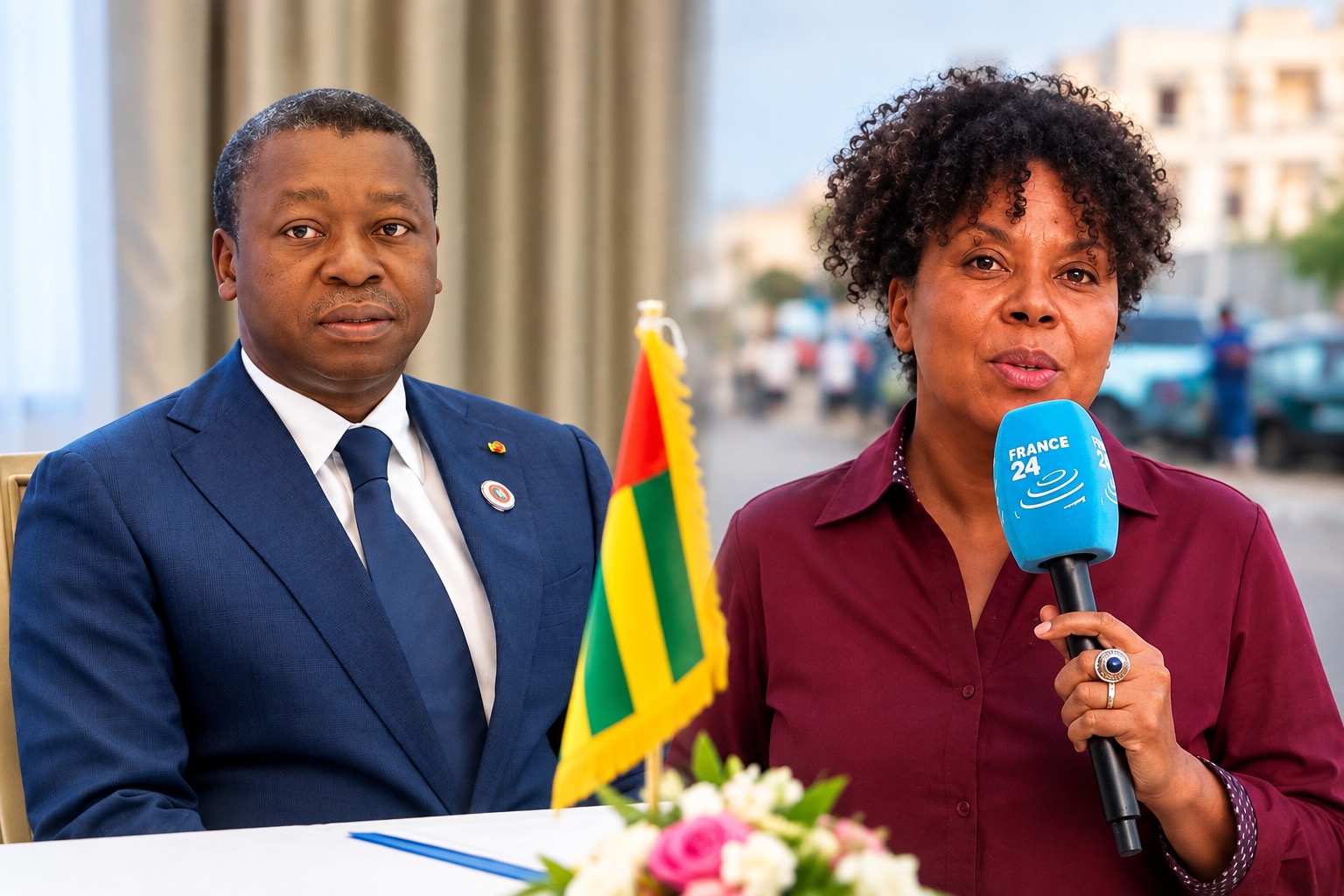
Togo’s press freedom under scrutiny after journalist’s sanction
The sanction imposed on journalist Emmanuelle Sodji has reignited concerns about the state of press freedom in Togo, raising critical questions about the intersection of regulatory enforcement and the public’s right to know. As the debate intensifies, the implications stretch beyond newsrooms, casting a shadow over businesses, citizens, and the broader democratic landscape in the country.
The controversy stems from an incident in August 2026, when Sodji, a long-time correspondent for France 24 in Benin, reported on the legal proceedings against two French nationals detained in Togo. While the information was already publicly available—circulating in multiple media outlets and on social platforms—the regulatory body later acknowledged that the details had been in the public domain since August 18. The arrested individuals, filmmakers Gaël Mocaër and Sebastian Perez Pezzani, had been held since late July on charges related to their visa declarations before being granted provisional release on September 1.
The crux of the dispute lies in the timing and clarity of regulatory guidelines. Can a journalist be penalized for reporting information that is publicly accessible, especially when no prior restriction had been formally communicated to their newsroom? The debate has exposed deeper tensions in Togo’s media environment, where journalists now operate under heightened scrutiny and ambiguous enforcement rules.
Regulatory ambiguity fuels press freedom concerns
Togo’s media landscape has come under increasing pressure in recent years, with regulatory actions targeting international broadcasters like RFI and France 24. In June 2025, the High Authority for Broadcasting and Communication (HAAC) suspended the programs of both outlets for three months, citing repeated violations of impartiality, factual accuracy, and verification standards. While the authorities defended the move as necessary to uphold professional integrity, critics argue it reflects a broader strategy to curb critical reporting, particularly on politically sensitive topics.
The Sodji case underscores a troubling pattern: when regulatory bodies wield opaque or retroactive measures, the autonomy of journalists—and by extension, the public’s access to information—becomes collateral damage. The absence of transparent, pre-established rules creates an environment where enforcement is unpredictable, leaving professionals vulnerable to punitive action for actions taken in good faith.
A shifting landscape for journalists and businesses
The ramifications of this uncertainty extend beyond editorial decisions. For businesses operating in Togo, the tightening grip on media freedom poses risks to transparency and investor confidence. Investors and multinational corporations rely on accurate, timely reporting to assess operational environments. When media outlets face punitive sanctions for reporting verified information, the credibility of official communications comes under scrutiny, potentially deterring economic engagement.
Citizens, too, bear the consequences of a constrained media space. Access to diverse, independent sources of information is a cornerstone of democratic accountability. When regulatory actions prioritize control over transparency, the public’s ability to hold authorities accountable is eroded. The Sodji case serves as a reminder of how quickly regulatory tools can be weaponized, not to uphold standards, but to silence dissenting voices.
Faure Gnassingbé’s legacy: press freedom as a litmus test
Under President Faure Gnassingbé’s leadership, Togo has witnessed prolonged political tensions, including protests in Lomé in 2025 that were met with a heavy-handed security response. These events coincided with institutional reforms surrounding the presidency of the Council of Ministers, further straining the country’s democratic fabric. In this context, every regulatory move against the media is scrutinized for signs of a broader crackdown on dissent.
The core of the issue transcends Sodji’s case. It challenges the fundamental principle of whether journalists can operate freely when their reporting intersects with sensitive political or judicial matters. The answer should not hinge on the political alignment of a media outlet or the nationality of the journalist. Rather, it should be grounded in clear, pre-agreed professional standards, robust legal protections, and an unwavering commitment to transparency.
What’s at stake for Togo’s democracy
The stakes are high. A media environment governed by ambiguous or politically motivated regulations risks undermining public trust in institutions and stifling constructive dialogue. For the Togolese government, the path forward must prioritize clarity, accountability, and a genuine commitment to press freedom. The international community, civil society, and the media itself will be watching closely to see whether regulatory actions serve the public interest—or merely the interests of those in power.
The questions facing Togo are not just about rules and sanctions; they are about the future of its democracy. Will the country uphold a standard where journalists can report without fear, or will it continue down a path where information is controlled, and dissent is suppressed? The answers will define Togo’s democratic trajectory in the years to come.
Comments are closed, but trackbacks and pingbacks are open.