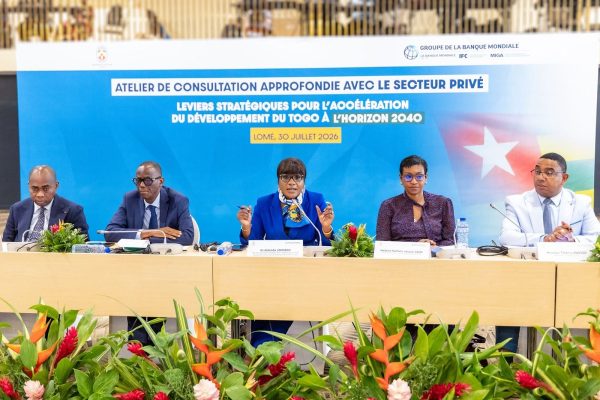
Lomé, 30 July 2026 — Togo is reshaping its economic future by placing the private sector at the heart of its long-term ambitions. In a pivotal gathering held in the capital, government officials, business leaders, and international partners convened to map out how private enterprises can become the engine of the country’s transformation over the coming decades.
The high-level workshop, centred on Vision Togo 2040 and the 2026–2031 government roadmap, brought together representatives from the World Bank Group, the National Employers’ Federation, the Chamber of Commerce and Industry, leading local businesses, and global economic experts. The session was inaugurated by Sandra Ablamba Johnson, Secretary-General of the Presidency’s Council, on behalf of President Faure Essozimna Gnassingbé.
Transforming ambition into action
The discussions were not merely theoretical. At their core lies a bold objective: by 2040, Togo aims to double the average standard of living and reduce poverty to below 15%. Achieving such targets, officials acknowledge, will require more than state-led initiatives. It demands a robust partnership with the private sector—one capable of mobilising investment, generating employment, and fostering sustainable growth.
As one participant noted, the state alone cannot shoulder the full weight of such a sweeping economic overhaul. The path forward hinges on attracting capital, nurturing domestic industries, and creating an enabling environment where businesses can thrive and expand.
From vision to operational roadmap
The workshop served as a platform to bridge the gap between high-level aspirations and ground-level execution. Participants delved into the practical steps needed to transition the private sector from a supporting player to a strategic ally of public policy. Key areas of focus included investment conditions, enterprise development, capital mobilisation, and the launch of new productive ventures.
The involvement of the World Bank and international specialists added significant depth to the deliberations. Their presence allowed for a vital exchange of ideas, enabling Togolese policymakers to benchmark national priorities against global best practices and adapt proven strategies to the local context.
Building a private-sector-led economy
The outcome of the Lomé meeting sends a clear signal: Togo’s next phase of development will be built on the strength of its private enterprises. The gathering marked a critical milestone in forging a new growth model, one that aims to deliver tangible improvements in living standards by 2040.
For government leaders, the challenge now is to convert these discussions into decisive policies—and those policies into measurable results. Only through such concerted action can the outlined targets evolve from ambitious projections into tangible economic and social progress for all Togolese.
Comments are closed, but trackbacks and pingbacks are open.