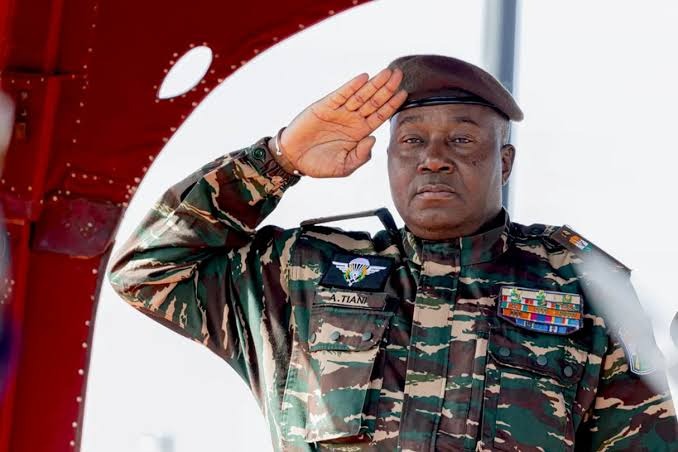
The decree signed on 15 September 2026 by General Abdourahamane Tiani was dressed up as a neutral “technical reorganisation”, yet its consequences stretch far beyond the walls of the cabinet room. This first large-scale government reshuffle is, in practice, a political rescue mission — and the bill will be settled in farms, lecture halls and family kitchens across Niger.
Boxed in on several fronts, the National Council for the Safeguard of the Homeland (CNSP) is doing what weakened regimes usually do: closing ranks, paying off its loudest supporters and tightening its grip while popular frustration keeps climbing.
A rescue plan disguised as a routine administrative adjustment
Nothing about this team change happened by chance. It follows directly from last August’s mutiny at Air Base 101 in Niamey, an episode that shook the ruling circle to its core. After purging and hastily reorganising the military command and the presidential guard, the Tiani government has now turned to the political side of its self-defence: protecting itself rather than governing.
The result is a cabinet built around survival, where the qualification for holding a ministry is proximity to the palace rather than a plan for the country. When fear dictates the composition of a government, the sectors that depend on competent civilian management are the first to pay the price.
Agriculture and livestock under a soldier’s eye
Putting Colonel Bilaly Elhadj Gambobo in charge of Agriculture and Livestock has nothing to do with transforming what ends up on people’s plates. It places a military man at the head of one of the most sensitive economic sectors, while pushing aside officers who had become inconvenient.
For producers, herders and traders, the practical effect is a strategic resource chain run through a security lens instead of a development one — less transparency, less civilian oversight, and little hope of a genuine response to the pressures crushing rural livelihoods.
Loyalty paid in portfolios: what the UNPP appointment means for young people
The arrival of Abdourahamane Oumarou, leader of the UNPP and a tireless mobiliser of the sovereigntist camp, is the most glaring sign of where the logic now sits. He was not picked for managerial skill, but for his ability to shout louder than anyone else. A loyalist from the first hours after the July 2023 coup, he inherits the Ministry of Youth and Refoundation as his reward.
A ministry handed over as payment
While young Nigeriens sink deeper into unemployment and despair, the CNSP distributes jobs to its propagandists. The calculation is cold: buy the silence of activists and use street-level figures to shape opinion and drown out criticism on social networks. For a generation already short on prospects, the message could hardly be harsher — loyalty pays, competence does not.
Academic figures deployed as protective shields
To blur the impression of a purely political trade-off, the junta slipped in a handful of academic names, including Professor Mahamadou Saidou at Higher Education and Oumarou Maman at Humanitarian Action. Their presence is cosmetic, and the consequences for the institutions they take over are heavy.
Impossible mandates on empty coffers
How is Professor Saidou expected to calm the universities without any financial leeway? How is Oumarou Maman supposed to assist war-displaced populations when state coffers are empty and international assistance has been cut? These technocrats act as human shields: their real function is to carry the blame when a system propped up by poverty finally collapses.
What the reshuffle means for households, businesses and public services
Stripped of the political rhetoric, the shake-up leaves citizens with a set of very concrete effects:
- Students and universities: a new minister arrives with no budget to answer demands that have been piling up for years.
- Displaced families: humanitarian action changes hands at the very moment state resources are exhausted and foreign funding has been suspended.
- Young jobseekers: the ministry meant to shape their future is handed to a political operator as a reward.
- Farmers and herders: a key economic sector moves further under military supervision, with less room for civilian input.
- Shoppers and small traders: nothing is offered on high living costs or a struggling economy, so daily pressure carries on unchecked.
This is neither a strategy nor a vision for Niger’s future. It is a desperate patchwork by a regime at bay, one that would rather feed its loyal supporters than confront high prices, economic crisis and the expectations of the people. Changing the faces around the table will not be enough to hide a failing system — and it is ordinary citizens who will keep footing the bill.
Comments are closed, but trackbacks and pingbacks are open.