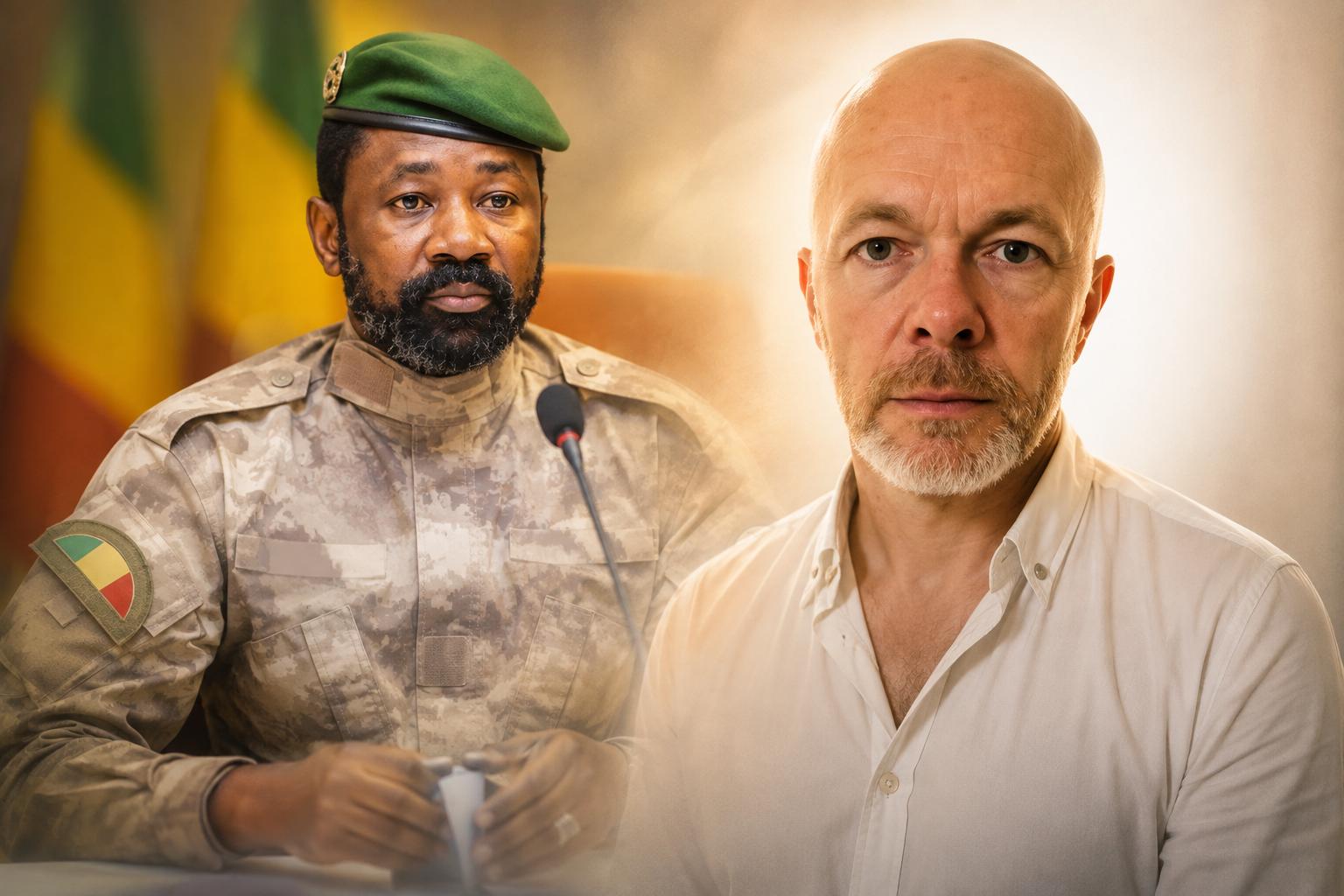
In a carefully staged ceremony, Mali’s military leader, General Assimi Goïta, granted a presidential pardon to Yann Vézilier, a French intelligence officer detained in Bamako for over a year. The announcement followed the officer’s conviction in June, where he was sentenced to twenty years behind bars for alleged attempted destabilization—a verdict that was anything but routine. While Mali’s transitional authorities frame this as an act of sovereign clemency, the reality behind the decision tells a far different story.
Behind the diplomatic curtain: more than just a pardon
The presidential pardon was not an isolated act of magnanimity. It was the final act of a meticulously crafted performance, designed to serve a higher political purpose. Far from being a spontaneous gesture of forgiveness, this decision was the logical conclusion of a propaganda trial orchestrated from the start to reinforce the regime’s domestic and international positioning.
A justice tailored for public perception
The trial’s swift and opaque proceedings left little doubt about its political underpinnings. With no verifiable evidence presented to the public, the charges—including a vague accusation of threatening state security—were hastily fabricated to fit a narrative of external aggression. The harsh twenty-year sentence handed down in June was never intended to be served. Instead, it served as a bargaining chip, a tool to be traded in future negotiations.
Silent deals and hidden compromises
While Bamako’s official communications boasted of total control over the nation’s security landscape, the truth was far more complex. Recent clashes with armed groups like the Cadre Stratégique Permanent (CSP-DPA / FLA) and the Group for the Support of Islam and Muslims (JNIM) revealed a glaring gap in Mali’s military capabilities. Russian instructors and mercenaries from Africa Corps remained conspicuously absent from the front lines, despite earlier claims of their operational involvement.
To secure the release of Malian soldiers captured in previous engagements, the transitional government pursued a far less confrontational approach. Rather than military intervention, Bamako engaged in discreet, direct negotiations with the leaders of these armed factions. These talks were not merely diplomatic exchanges—they involved substantial financial transactions, a pragmatic but controversial solution to Mali’s growing security vulnerabilities.
The real motives: power, perception, and political leverage
The case of Yann Vézilier was never about justice. From the moment of his arrest in August 2025, his fate was predetermined. As a foreign intelligence officer operating under official accreditation, his presence in Mali was widely known to local security apparatuses. The sudden decision to strip him of his status and brand him a conspirator was a calculated move to rally domestic support by shifting blame to an external enemy.
The trial’s outcome was never in question. The verdict of twenty years in prison was a symbolic strike against France, the former colonial power, while simultaneously establishing a high-value diplomatic currency. The presidential pardon, when it came, was merely the closing act of this political theater—a performance designed to showcase Mali’s authority and independence.
Justice as a tool of state communication
Legal experts and diplomats agree: the trial was a textbook example of state hostage diplomacy. The sentencing created a narrative of aggression, while the subsequent pardon allowed the regime to present itself as the victor, magnanimous in its clemency. The entire process was a calculated manipulation of justice, where the outcome was predetermined by political necessity rather than legal merit.
For the military leadership in Bamako, the affair was never about fairness or transparency. It was about control—control over the national narrative, control over public perception, and control over the levers of power. The release of Yann Vézilier, framed as a presidential act of grace, was in truth the final stroke in a carefully orchestrated campaign to reinforce the regime’s legitimacy and authority.
The lesson of this case is clear: in Mali’s current political climate, justice is not blind. It is a weapon, wielded with precision to serve the interests of those in power.
Comments are closed, but trackbacks and pingbacks are open.