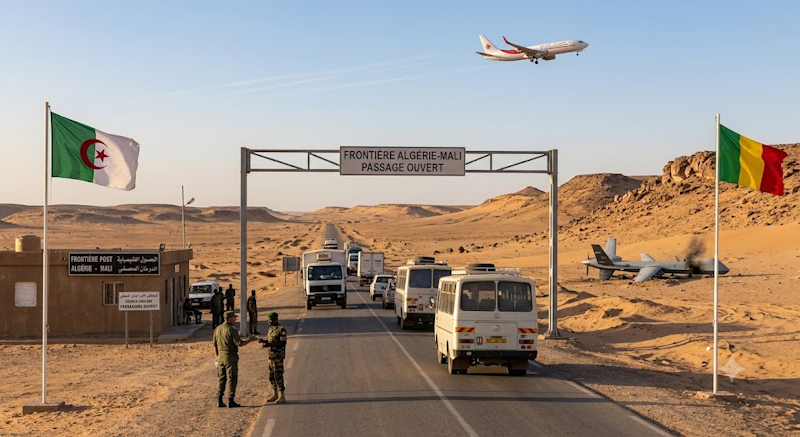

After more than a year of diplomatic tension, triggered by the destruction of a Malian drone, Algeria and Mali have announced the reopening of their respective airspaces and the imminent return of their ambassadors.
This marks the conclusion of a 15-month crisis that had threatened to destabilize security cooperation across the Sahel region. Through separate statements released on Friday, both the Algerian and Malian governments formally confirmed the lifting of reciprocal retaliatory measures. Airspaces are now accessible once more for civil and military flights, and diplomatic envoys are preparing to resume their duties.
Bilateral relations had been completely frozen since April 2025, following a significant military incident that occurred along the shared border between the two countries.
The Tinzaouaten incident: igniting the dispute
The core of the disagreement dates back to the night of March 31, 2025. Algerian defense forces shot down a Turkish-made military drone operated by the Malian army, near the town of Tinzaouaten. This strategically vital border area, located within the Kidal region, has historically served as a stronghold for Tuareg separatists who oppose the Bamako government.
From Algeria’s perspective, radar data unequivocally showed the aircraft had breached Algerian airspace. However, this account was vehemently disputed by the Malian military junta, which cited a lack of evidence and labeled the action an «agression».
The crisis swiftly escalated, taking on regional implications:
- Regional solidarity: Mali, backed by its allies in the Confederation of Sahel States (Niger and Burkina Faso), recalled its ambassador in protest, describing the incident as «aggression against confederal airspace».
- Algeria’s response: Algeria, deeming Bamako’s accusations «serious and unfounded,» immediately closed its airspace to flights originating from and destined for Mali, while also recalling its own diplomatic representatives.
A significant security breakdown
In recent months, the escalation broadened into the multilateral arena. Last September, Mali brought the matter before the International Court of Justice (CIJ), accusing its neighbor of intentionally downing the drone to obstruct its military operations against rebel groups. Concurrently, Bamako withdrew from the Joint Operational Staff Committee (CEMOC), a cornerstone of counter-terrorism coordination in the Sahel originally established by Algeria.
Did you know? For over a decade, Algeria played a pivotal role as an indispensable mediator in the conflict between the Malian state and Tuareg rebels, notably through the Algiers Accords signed in 2015.
A profoundly transformed regional landscape
This diplomatic thaw occurs amidst a radically altered geopolitical landscape in the Sahel, marked by successive coups in Mali in 2020 and 2021. The ruling juntas in Bamako, Niamey, and Ouagadougou have increasingly distanced themselves from traditional partners like France and Algeria, forging closer military alliances with Russia.
On the ground, the security situation remains critical. Since 2012, Mali has been grappling with a jihadist insurgency linked to Al-Qaeda and the Islamic State. In recent months, pressure has intensified on the Malian government, which faces coordinated attacks from both terrorist groups and Tuareg separatists. Re-establishing dialogue with the influential Algerian state could prove vital for regional stability.
Comments are closed, but trackbacks and pingbacks are open.