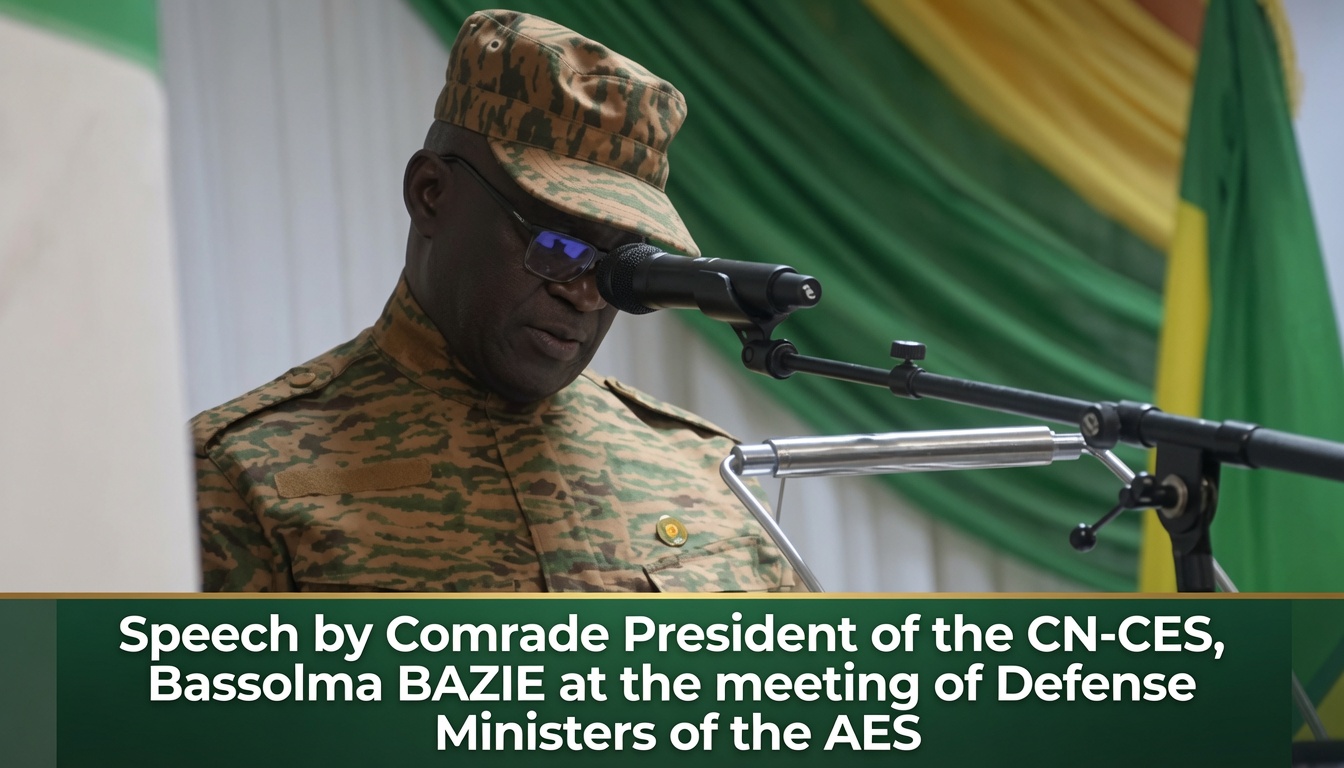
Following a recent assembly of defense ministers from the Alliance of Sahel States (AES), Bassolma Bazié, the president of the CN-CES, extended profound commendation for the unwavering commitment and sacrifice demonstrated by the Defense and Security Forces across Mali, Burkina Faso, and Niger. This robust tribute was coupled with an address emphasizing the crucial defense of national territorial integrity, the safeguarding of civilian populations, and the pursuit of what was described as a historically significant sovereignty.
Yet, this official narrative invariably prompts a critical query among the populace: do these pronouncements of governmental satisfaction truly align with the grim realities experienced daily by ordinary citizens?
Since the inception of the AES, authorities in the three member nations have consistently championed themes of reclaimed sovereignty and strategic autonomy. However, the ground truth paints a starkly different picture, with numerous communities enduring persistent armed assaults, mass displacements, and an pervasive insecurity that remains a formidable challenge. In this environment, the frequent accolades bestowed upon security forces, while undeniably deserved given the profound sacrifices made by soldiers, fall short of satisfying the public’s expectations, which are primarily anchored in tangible outcomes.
The chasm between official rhetoric and lived experience becomes acutely apparent when considering the devastating human toll of this protracted crisis. While military personnel make the ultimate sacrifice on the front lines, the daily existence for civilian populations is a harrowing struggle for survival. Thousands of families find themselves compelled to abandon their homes and livelihoods, undertaking desperate mass migrations to neighboring countries in pursuit of the peace and safety their own governments can no longer assure. The sight of citizens displaced as refugees beyond their national borders serves as the most undeniable evidence that the sovereignty celebrated in ministerial chambers remains a distant, abstract notion for those who bear the brunt of the conflict.
Confronted with this massive exodus and the tragic loss of life, the stance adopted by leaders, characterized by mere official tributes and repeated posthumous eulogies, provokes a stark interrogation: can such conduct genuinely secure the populace or stem the relentless tide of fatalities? Evidence on the ground strongly suggests otherwise. Funeral orations and ceremonial medals provide no defense for front lines, offer no sanctuary for isolated villages, and cannot restore lost lives. By merely commemorating the sacrifice of soldiers, rather than addressing the fundamental strategic deficiencies that contribute to their demise, political action appears to dissipate into symbolic gestures, leaving the underlying drivers of insecurity unaddressed.
Fundamentally, the paramount objective of any defense policy must be the tangible enhancement of citizen security. When civilians continue to endure the constant threat of aggression, when certain regions remain largely inaccessible, and when humanitarian crises persist unabated, declarations extolling the triumphs of security strategies inevitably strike many as profoundly detached from the harsh realities on the ground.
The very notion of «real sovereignty» also warrants rigorous scrutiny. Many analysts contend that sovereignty extends beyond mere declarations of political or diplomatic independence. It is, crucially, gauged by a state’s demonstrable capacity to ensure public safety, facilitate the unimpeded movement of its people, safeguard vital public services, and cultivate prospects for stability among its citizenry. Across these critical benchmarks, the Sahelian region continues to grapple with formidable obstacles.
While the military personnel deployed to the front lines frequently pay an immense price, and their dedication is universally acknowledged, the act of honoring soldiers does not absolve political leaders of their fundamental obligation to rigorously evaluate implemented strategies. The profound sacrifices made by the armed forces necessitate a transparent and candid assessment of the efficacy of both military and political decisions, aimed at ascertaining whether stated objectives are, in fact, being realized.
Ultimately, the most meaningful way to honor the defense forces transcends mere official pronouncements. It lies, above all, in forging conditions that foster a lasting improvement in security and the daily lives of the population. As long as citizens continue to bear the brunt of persistent insecurity, declarations proclaiming a fully achieved sovereignty are likely to be met with profound skepticism from a significant segment of the public.
Comments are closed, but trackbacks and pingbacks are open.