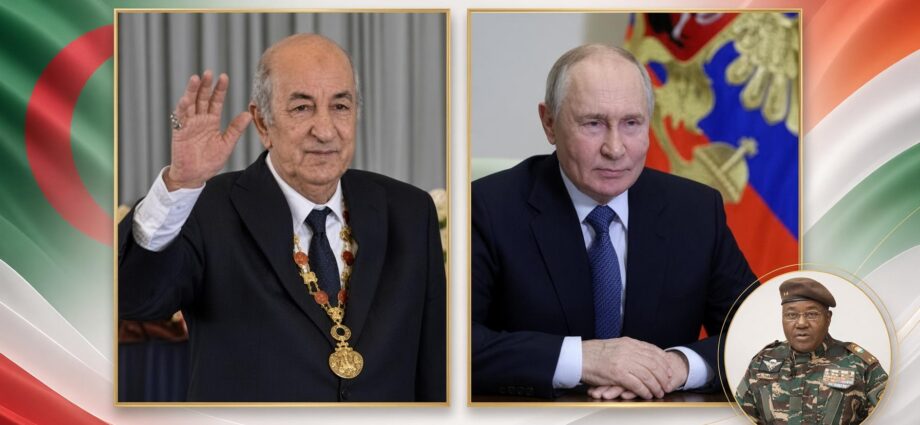
In a historic move that reshapes Sahel security dynamics, Algeria’s parliament has approved the unprecedented deployment of regular army troops to Niger—a decision that dismantles Moscow’s long-held dominance in the region.
The move comes as Russian security influence in the Sahel was presumed solidified following the expulsion of Western forces from the Alliance of Sahel States (AES). By sanctioning the National People’s Army (ANP) deployment, Algeria has not only broken a decades-long taboo but launched a new theater of influence, pitting itself against its historic Russian ally on Nigerien soil.
Moscow’s military monopoly cracks under Algerian pressure
Since Niamey’s government shift, Russia rapidly consolidated its defense partnerships with Niger, supplying advanced air defense systems, tactical drones, attack helicopters, and paid advisory units under Africa Corps. These deals, worth hundreds of millions, were accompanied by mining and oil concessions to finance Moscow’s mercenary presence.
Algeria’s official troop deployment directly undermines this model:
- End of exclusive Russian supply chains: Algerian military support, backed by a structured, well-equipped national army, reduces Niger’s need to purchase more Russian hardware at inflated prices.
- Undermining extractive deals: The ANP’s presence weakens Russia’s indirect monetization strategy, which relied on securing mining and oil permits to fund its mercenary operations.
- Technical rivalry: Algeria, already using Soviet-origin equipment (Su-30 jets, armored vehicles), can now provide maintenance and operational support, cutting Russia off from lucrative after-sales contracts.
Algeria secures energy assets against mercenary threats
For Algeria, the troop deployment is a strategic safeguard against paramilitary groups near its southern border—posing a direct risk to critical energy investments in Niger.
Key priorities include:
- Kafra oil field: Operated by Algerian national company Sonatrach (via SIPEX), this site holds reserves in the tens of millions of barrels and is central to Algiers-Niamey industrial cooperation.
- Trans-Saharan Gas Pipeline (TSGP): This megaproject aims to transport over 30 billion cubic meters of Nigerian gas to Europe via Niger and Algeria—requiring absolute security in the Sahara, incompatible with armed non-state actors.
By deploying troops, Algeria ensures the financial viability of these energy corridors while signaling to Moscow that Russian forces will not control the infrastructure.
Algeria-Moscow axis tested as Sahel power balance shifts
Once Russia’s top African defense client, Algeria is now using its military leverage to counter Kremlin ambitions in the Sahel. The National People’s Army forces Niger’s junta to diversify alliances and moderate its alignment with Moscow.
Russia, which considered the AES its unchallenged sphere, now faces a reality where its security expansion collides with Algeria’s vital financial and geopolitical interests. The Sahara has become a high-stakes arena where yesterday’s arms purchases do not guarantee today’s economic or military dominance.
By approving the Niger deployment, Algeria reasserts itself as an indispensable regional power. For Niger’s junta, the troops offer a new tool to renegotiate its costly dependence on the Kremlin. For Russia, the illusion of exclusive control over the AES evaporates, leaving a tense cohabitation in the heart of the Sahel.
What’s next?
The deployment marks the beginning of a new phase of geopolitical chess in the Sahel. With Algeria now an active security player in Niger, the balance of power is being redrawn—and Moscow’s influence is no longer unchallenged.
Comments are closed, but trackbacks and pingbacks are open.