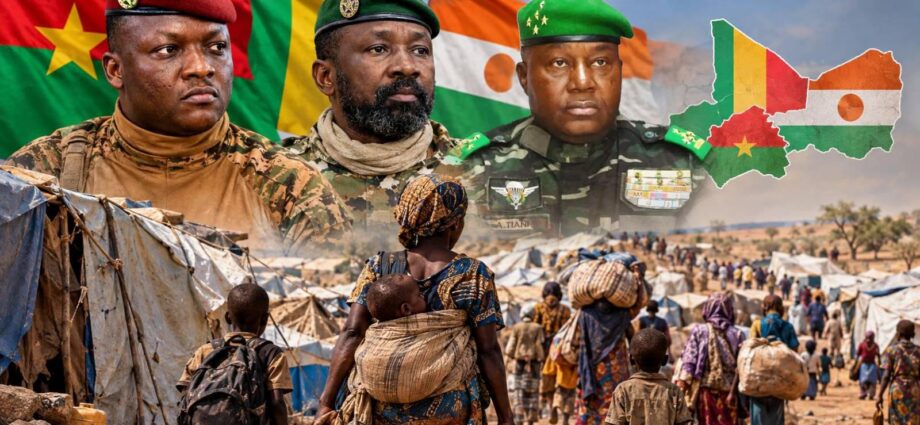
The scale of forced displacement across the central Sahel has reached a level that demands closer scrutiny. The Office of the United Nations High Commissioner for Refugees (UNHCR) now places the combined number of displaced persons and refugees in Burkina Faso, Mali and Niger at close to four million — nearly double the figure recorded in 2020, the year that saw the first military takeover in Mali.
These statistics carry particular weight for the three member states of the Alliance of Sahel States (AES). Beneath the official narratives, policy announcements and public communication campaigns, millions of people continue to face insecurity, precarious living conditions and the loss of their livelihoods. For these populations, the true measure of the crisis lies not in leaders’ declarations but in their ability to secure shelter, reach essential services and live without fear.
An analytical look at the widening humanitarian gap
Since the changes of power in these countries, military authorities have repeatedly pledged to restore sovereignty, reclaim territory and re-establish security. Yet the trajectory of displacement raises a fundamental question: how can the humanitarian situation deteriorate so sharply when security is among the primary justifications cited by military regimes for holding power?
The question becomes more pressing when one considers that displaced populations are often forced to abandon their land, their economic activities and their communities to escape violence. Behind every figure are uprooted families, children deprived of a stable environment, and individuals struggling to rebuild their lives.
Examining the priorities of AES governments
This situation also invites scrutiny of the priorities set by the AES governments. While official communication regularly highlights military operations, political initiatives and achievements presented as symbols of sovereignty, the results on the ground must also be assessed against the living conditions of the population.
When political messaging takes precedence over factual examination, it risks diverting attention from everyday hardships. No communication campaign alone can erase the consequences of forced displacement or substitute for concrete responses to the needs of those affected.
What the displacement figures reveal about security policy
The real challenge, therefore, is not merely to proclaim sovereignty but to demonstrate that it genuinely improves security and living conditions for citizens. As long as millions remain displaced or living as refugees, the record of security and humanitarian policies in Burkina Faso, Mali and Niger will remain open to question.
Journalistic note: the figure of nearly 4 million people and the comparison with 2020 are attributed to UNHCR, as indicated in the information provided. Before publication, the date of the report, the reference period and the population categories counted should be verified in order to distinguish internally displaced persons from refugees and to avoid any confusion in interpreting the figures.
Comments are closed, but trackbacks and pingbacks are open.