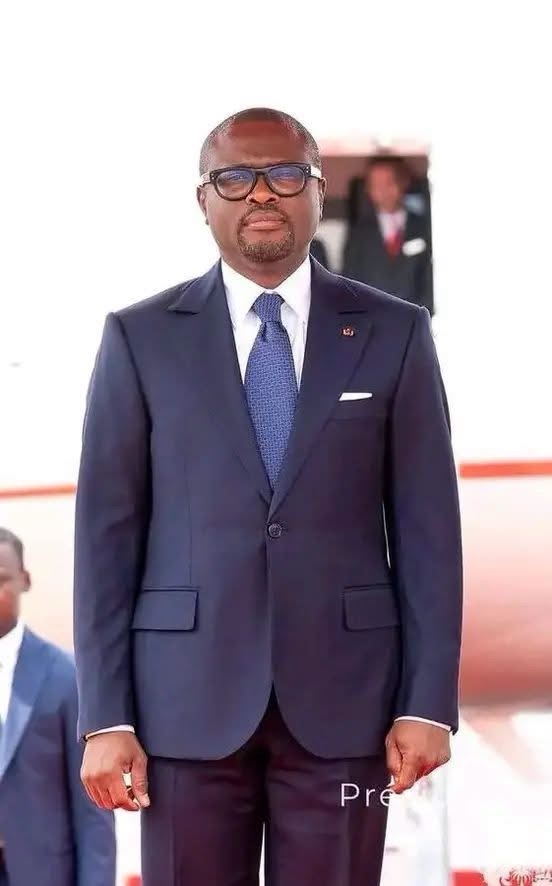
By granting freedom to a man condemned to two centuries of incarceration, President Romuald Wadagni has not merely signed an act of grace. He has set a significant direction for his nascent mandate: one where justice remains resolute against offenses but is also capable of integrating a human dimension when circumstances warrant it. Beyond a simple presidential decree, this decision sparks a profound debate on the ultimate purpose of punishment, societal reintegration, and the state’s role in individual reconstruction.
The extraordinary calculus of a life regained
On paper, Donouvossi Olivier’s prison horizon extended to June 19, 2198. An almost surreal deadline, the result of a sentence of 2,400 months in prison, equating to 200 years of detention, handed down for complicity in armed robbery.
Imprisoned since June 19, 1998, at the Akpro-Missérété civil prison, he belonged to that exceedingly rare category of inmates whose sentence far exceeded a human lifespan. It was a condemnation so extensive that it seemed to preclude any prospect of returning to society.
Yet, on July 31, 2026, this trajectory was dramatically altered. After 28 years and one month, or 337 months of detention, Donouvossi Olivier regained his liberty, more than 170 years before the theoretical end of his sentence.
This release stands as one of the most remarkable cases in Bénin’s recent judicial history. It exemplifies the institutions’ capacity to adapt the application of punishment when the general interest, humanity, and the imperatives of reintegration converge.
A presidential decision transcending an individual case
The case of Donouvossi Olivier is not an isolated incident. It forms part of a broader measure of grace and amnesty that has benefited 369 detainees across various correctional facilities nationwide.
The sheer scope of this decision reflects a political will to address the carceral question holistically. It comes at a time when numerous African judicial systems grapple with prison overcrowding, prolonged detentions, and the challenges of reintegrating former inmates.
Presidential clemency, enshrined in institutional frameworks, remains an exceptional prerogative. It does not challenge the guilt established by the courts, erase convictions from the judicial record, or rewrite the facts. It solely terminates, either wholly or partially, the execution of the sentence.
This distinction is crucial. The state does not undermine the authority of justice; rather, it exercises a constitutional competence designed to introduce a dimension of equity and humanity into certain exceptional situations.
Justice prioritizing the human element
Every penal policy pursues multiple objectives: punishing offenses, protecting society, deterring criminal behavior, and also, when possible, fostering the reintegration of convicted individuals.
After nearly three decades of incarceration, the question becomes inescapable: at what point has the punishment fulfilled its function?
An extremely lengthy sentence may meet a demand for firmness at the moment it is pronounced. However, once decades have passed, the discourse naturally evolves towards the possibility of rehabilitation.
By granting this grace, Béninese authorities underscore that modern justice is not reduced to the mechanical execution of sentences. It must also consider the journey undertaken by the condemned, their personal evolution, and the prospects for reintegration into society.
This approach aligns with a vision of justice where punishment is not intended to definitively confine an individual to their past, especially when they have already spent a significant portion of their life behind bars.
A signal to penitentiary institutions
This decision also conveys a message to the penitentiary administration.
It values the efforts in reintegration, discipline, and support provided within correctional facilities. Indeed, the prospect of a measure of clemency can reinforce initiatives for good conduct, learning, and rehabilitation undertaken by detainees.
An effective penitentiary policy is not solely predicated on the deprivation of liberty. It also presupposes the gradual preparation for a return to society to limit the risks of recidivism and promote responsible reintegration.
Thus, presidential grace also becomes a public policy tool, capable of encouraging positive behaviors throughout the execution of the sentence.
A strong political choice early in the mandate
On a political level, this decision arrives at a symbolic moment.
Just months after assuming the highest office, Romuald Wadagni is imprinting his own interpretation of the exercise of power. Where some leaders might favor an exclusively repressive approach to assert their authority, he chooses to demonstrate that institutional firmness and humanity can coexist.
This decision contributes to shaping the image of a president attentive to issues of governance, fundamental rights, and the effectiveness of public policies.
It also illustrates how constitutional instruments can be utilized not only to address individual considerations but also to convey a comprehensive vision of the state.
Enhanced international standing
Beyond Bénin’s borders, this measure can also be perceived as a positive signal in favor of respecting the principles of humanized justice.
International partners are increasingly focusing on penal policies, detention conditions, and mechanisms that foster social reintegration.
By implementing a measure of clemency of such magnitude, Bénin cultivates the image of a state that seeks to reconcile judicial authority, respect for institutions, and consideration for human dignity.
This orientation further strengthens the country’s credibility in international discussions dedicated to human rights and the modernization of judicial systems.
A decision opening a new chapter
The liberation of Donouvossi Olivier will undoubtedly remain the most striking symbol of this wave of presidential grace. Behind this singular story lies a broader reflection on the very vocation of justice.
Punishment remains indispensable when an offense is committed. But a society also distinguishes itself by its capacity to recognize the moment when a sanction has achieved its objective and when a second chance becomes possible.
By transforming a seemingly irreversible condemnation into the possibility of restarting a free life, President Romuald Wadagni marks the beginning of his mandate with an approach where justice is not limited to sanctioning: it also seeks, when circumstances permit, to repair, to reintegrate, and to offer a perspective to those who have long paid the price for their transgressions.
Comments are closed, but trackbacks and pingbacks are open.