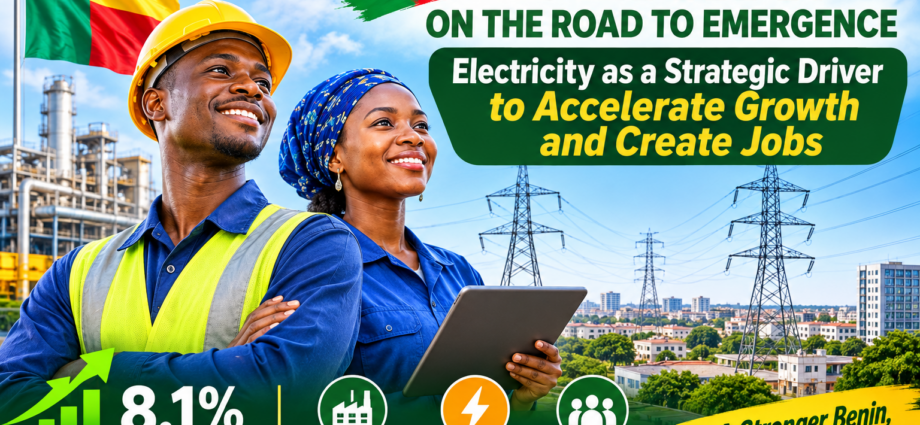
With an 8.1 % economic expansion recorded in 2025 and an average growth rate of 7.1 % between 2021 and 2025, Benin stands out as one of West Africa’s fastest-growing economies. This performance reflects robust public and private investments in infrastructure, industrialization, and economic modernization.
Yet, despite these encouraging figures, a critical challenge persists. Economic growth has not yet translated into a significant increase in formal, stable, and well-paying jobs. This disparity lies at the heart of the country’s economic paradox, where productivity gains do not correlate with broader employment stability.
Employment growth remains trapped in informality
According to the latest official labor data, 96.3 % of Benin’s workforce operated within the informal sector in 2022. Even more striking, eight out of ten new jobs created were entirely independent, underscoring the lack of formal employment opportunities. In 2024, only 19.8 % of workers held salaried positions a figure that plummeted to just 9 % among young adults, revealing a deep structural imbalance in the labor market.
The issue is not a shortage of economic activity but the economy’s limited capacity to convert growth into productive employment. A street vendor managing a daily trade does not receive the same legal protections or income stability as a factory worker with a formal contract and social benefits. Similarly, small-scale artisans often lack the capital and infrastructure to expand operations, hire staff, or adopt modern technologies that could boost output and competitiveness.
Industrial zones show promise but scaling up requires power
Industrialization has emerged as a strategic solution to bridge this employment gap. The Glo-Djigbé Industrial Zone (GDIZ), for instance, employed 22,798 workers in 2025 an increase of nearly 29 % from the previous year. This growth demonstrates how large-scale industrial projects can drive job creation, particularly in sectors such as agribusiness, textile manufacturing, and light industry.
However, for these gains to multiply across the economy, a fundamental prerequisite must be met: reliable, affordable electricity.
Unreliable power supply stifles business competitiveness
A recent assessment shows that nearly half of Beninese businesses cite electricity access as a major operational barrier. Alarmingly, 86.1 % of firms report experiencing regular power outages. The cost of these disruptions is substantial. Factories face lost production time and spoiled raw materials. Small workshops incur additional expenses by relying on diesel generators. Exporters may miss shipment deadlines, jeopardizing contracts and long-term client relationships.
Transmission infrastructure also lags behind demand. By 2024, 24.7 % of electricity was lost in transmission and distribution partly due to aging equipment, with over half of the country’s high-voltage lines and transformers operating beyond their 25-year lifespan. Compounding the issue, gas supply constraints have forced utilities to increase reliance on more expensive heavy fuel oil, pushing energy costs higher for both businesses and households.
Mission 300: A blueprint for electrification and economic transformation
In response to these challenges, the government has partnered with international development institutions to launch Mission 300, a continent-wide initiative aiming to connect 300 million Africans to reliable electricity by 2030. In Benin, this push is aligned with the National Energy Pact, which prioritizes three key objectives: expanding generation capacity, modernizing transmission and distribution networks, and attracting private financing.
Several flagship projects are already underway. Four solar power plants set for construction in Natitingou, Djougou, Bohicon, and Parakou will add 50 MW of clean energy to the national grid. Meanwhile, the planned 128 MW thermal plant in Onigbolo is designed to bolster baseload power. Together, these developments are expected to diversify energy sources and reduce dependency on costly fuels.
Energy reforms could unlock 160,000 new jobs by 2030
Analysts estimate that the successful implementation of Mission 300 could generate or stabilize up to 159,000 jobs in Benin by the end of the decade. However, this outcome is contingent on multiple conditions: strict project execution, improved energy governance, reduced technical and commercial losses, tighter cost controls, and faster connection rates for new consumers.
The potential benefits extend beyond employment figures. Reliable electricity would empower small businesses to increase production, protect equipment, and invest in expansion. Farmers could operate cold storage facilities to extend shelf life for perishable goods. Young entrepreneurs could open digital service hubs or modern workshops without the financial burden of backup generators. Each of these improvements would strengthen the foundations of a more inclusive and productive economy.
From growth to opportunity: the final hurdle
Benin’s recent economic performance demonstrates its capacity to attract investment and maintain steady expansion. The GDIZ success story is proof that industrial policy can deliver tangible employment gains. Now, the country must turn to the broader economy supporting SMEs, agricultural processors, and youth-led startups through foundational reforms in its energy sector.
The true test of Benin’s economic resilience lies not in its GDP growth rate alone, but in whether that growth translates into decent, sustainable jobs. Equally vital will be the reliability of the power supply, the productivity of its businesses, and the ability of its young population to access meaningful economic opportunities. Only then can the country shift from abstract economic statistics to real, widespread prosperity.
By AMINATA KABORE — Journalist
Comments are closed, but trackbacks and pingbacks are open.