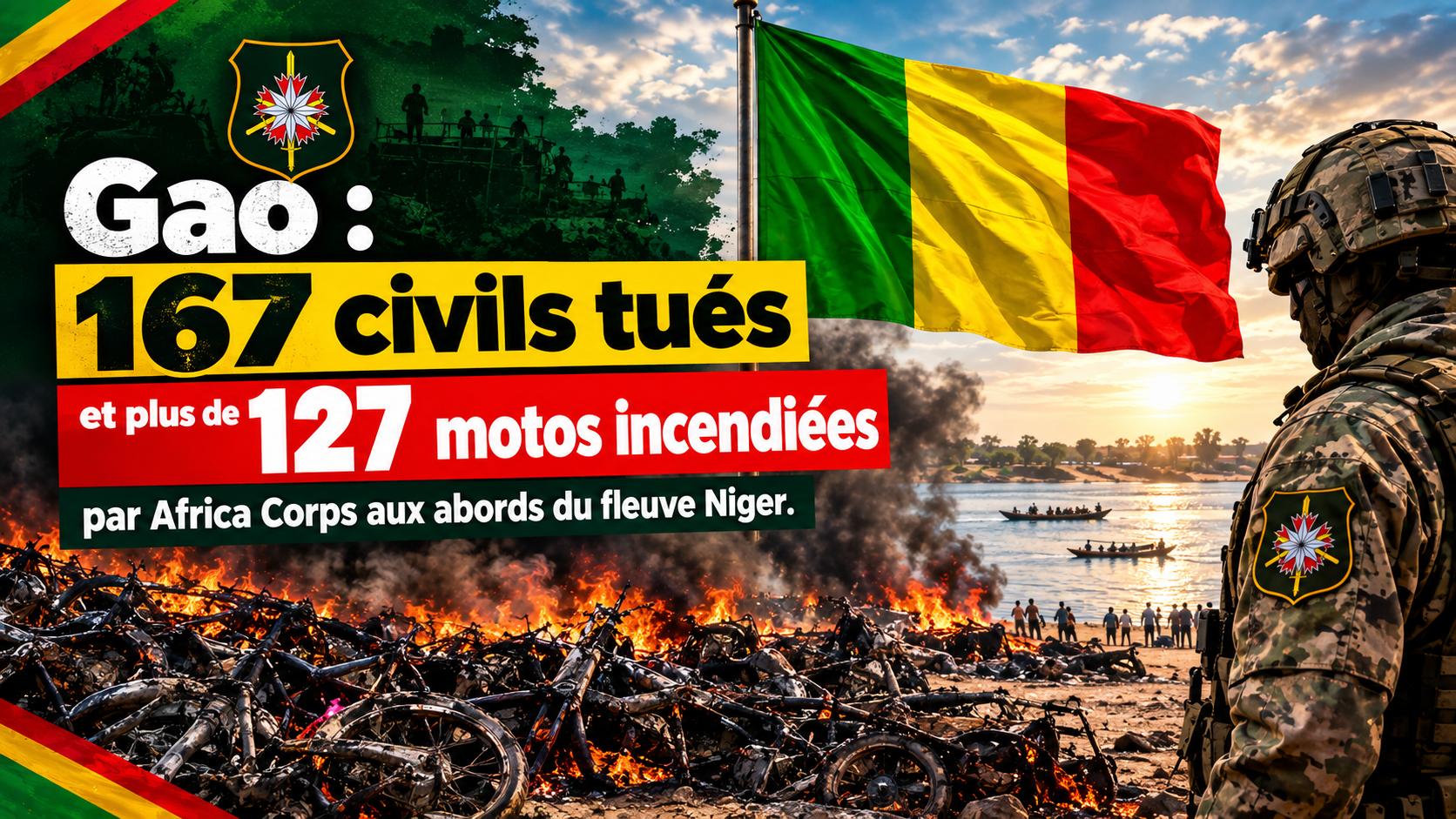
One morning on the edge of Gao, in northern Mali, ended with 167 civilians dead and more than 127 motorbikes reduced to charred metal. The killings, carried out along the Niger river, are being attributed to the Russian mercenaries of Africa Corps — the force that took over from Wagner on the continent — and they have left a riverside population in mourning, in shock and in dread of the next patrol.
How the attack unfolded at the water’s edge
Tuesday, 15 September 2026, had barely begun when bursts of automatic fire and columns of black smoke rose above the river on the outskirts of the city. In a strip of land that families depend on for their survival, a unit of Africa Corps fighters launched an operation of extraordinary brutality against unarmed people.
Market gardeners, fishermen and small traders were cut down as they started their working day. This was neither a clash nor a pursuit: it was a deliberate strike on the people whose labour keeps the river economy alive.
A toll counted in bodies and burnt machinery
By the time the shooting stopped, 167 civilians had been executed and at least 127 motorbikes had been rounded up and set on fire, methodically, batch after batch. The scene left behind was one of total desolation, and the community is still struggling to grasp what happened to it.
Destroying motorbikes, strangling an entire local economy
The human losses are only part of the damage. In Gao, a motorbike is not a luxury or a hobby — it is the tool with which young people earn a living, the only practical way to carry goods from the riverbanks to the markets, and the financial backbone of extended family networks that share whatever comes in.
When more than a hundred of those machines go up in flames, the supply of fresh produce to the city stalls almost immediately. A serious food crisis becomes a real possibility, and hundreds of households slide toward destitution overnight.
“They shot without warning before herding our vehicles together and setting them alight. My brother is among the victims. Without my motorbike and without him, we have nothing left to live on and nothing to feed our children tonight,” said one survivor, who asked not to be named, his voice breaking with grief.
Targeting the means of transport and killing the men who ride them does not secure a single square kilometre of territory. It suffocates a civilian population that has already endured more than a decade of violence.
Why the Moscow alliance is being blamed
The slaughter on the riverbank has revived a question that officials in the region prefer to avoid: what exactly has the turn to Russian force delivered?
A sovereign solution that turned predatory
In Niamey and in Bamako, the alignment sought by General Abdourahamane Tiani and his partners in the Alliance of Sahel States (AES) was marketed as a proud, home-grown answer to years of insurgent violence. The pitch was simple — order, reclaimed on local terms, without Western tutelage.
Events at Gao tell a different story. The arrival of Africa Corps has not dismantled the armed groups it was hired to fight. Instead it has installed a predatory, unaccountable force that turns its weapons on the very civilians it claims to shield, behaving less like an ally than like an occupying army.
Silence that looks like complicity
No official condemnation has followed the killing of 167 people. That quiet, coming after so much talk of emancipation and security, undermines the credibility of the transitional authorities and deepens the rupture between the state and the communities it governs.
A riverbank emptied by fear
In Gao, grief is giving way to a bitter sense of abandonment. Residents say the promised return of order has instead brought armed men who answer to no national chain of command and who trample international humanitarian law without consequence.
The banks of the Niger, once busy from sunrise, are emptying. Survivors are afraid to return to the plots and the landing points where they work, terrified of meeting another death squad on the road.
A demand that has nothing to do with geopolitics
The transitional authorities cannot answer this with their usual silence. What the people of Gao are asking for is not a slogan about sovereignty or new partnerships, but the most basic right there is: to live, and to live in dignity. Africa Corps, for now, keeps trampling that right in blood.
Comments are closed, but trackbacks and pingbacks are open.