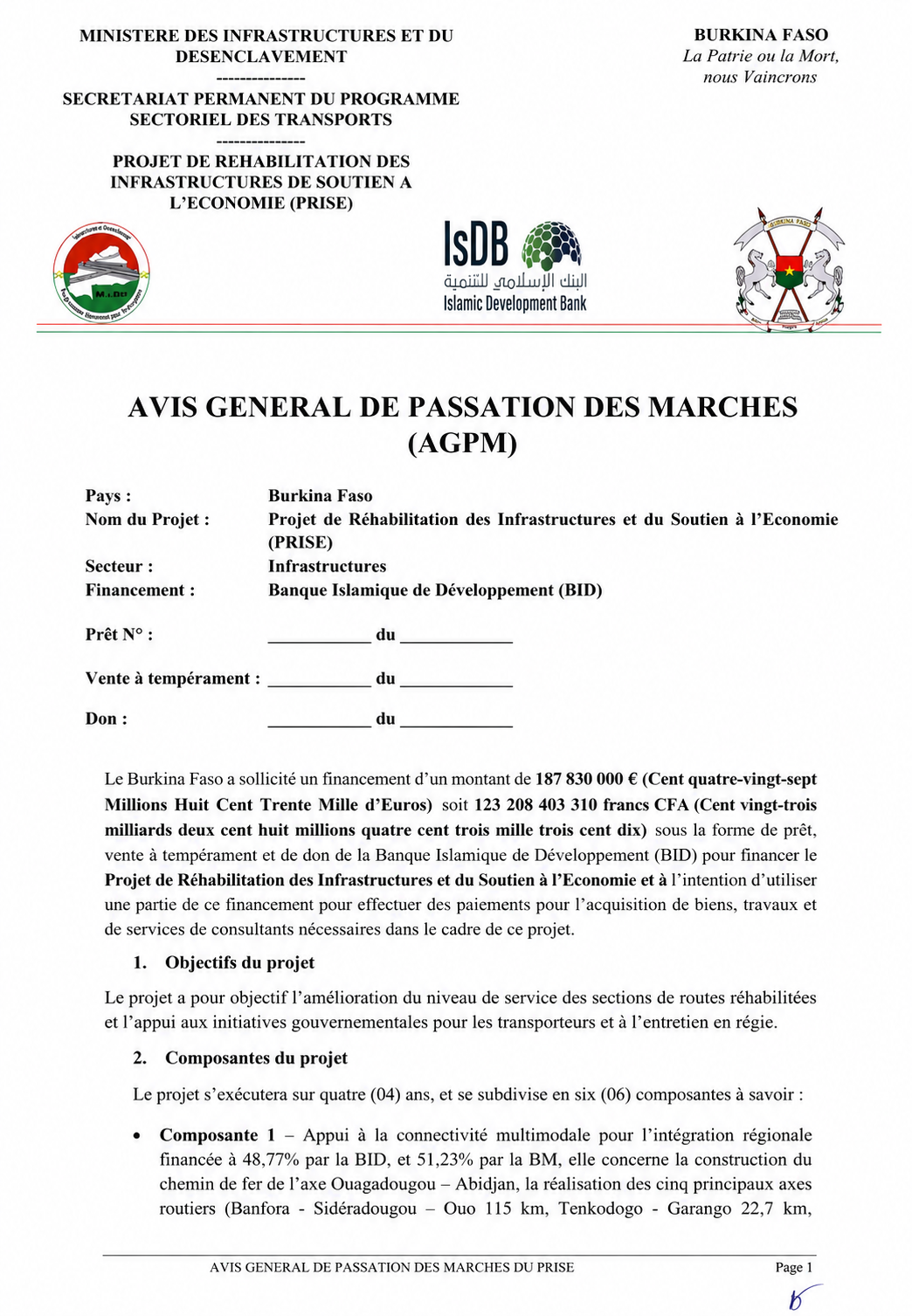
Captain Ibrahim Traoré and Burkina Faso’s military leadership have repeatedly championed a bold economic slogan: “Y’a pas crédit dedans,” or “there’s no credit in it.” This phrase, echoed across social media platforms and parroted by the regime’s supporters, suggests that the nation is funding major infrastructure projects—road rehabilitation, equipment acquisition, public sector modernization—entirely from domestic resources, free from foreign debt.
From slogan to financial reality
The message is clear, compelling, and politically potent: Burkina Faso is advancing on its own strength, liberated from the shackles of international donors. Yet beneath the bold rhetoric lies a far more nuanced—and financially complex—landscape.
While self-reliance in economic development is a commendable goal, the claim that every public investment is fully financed by internal funds contradicts publicly available financial records, funding agreements, and official declarations. Recent agreements with multilateral lenders, including the Islamic Development Bank, reveal that many large-scale projects are, in fact, backed by concessionary loans that must be repaid over time.
Where transparency meets contradiction
The slogan’s insistence that “there’s no credit in it” raises a crucial question: why deny external financing when it is being actively utilized? Borrowing is not an anomaly—it is a standard fiscal tool governments employ to bridge funding gaps when domestic revenues fall short of investment needs.
What stands out is the glaring discrepancy between:
- a public narrative of near-total financial autonomy; and
- a persistent reliance on international financial partners.
This disconnect fuels skepticism about the sincerity of official communications.
Economic strain and fiscal constraints
Burkina Faso’s current economic climate further challenges the feasibility of self-financing major public works. The nation faces a confluence of pressures:
- an escalating security crisis draining state coffers;
- soaring defense expenditures;
- strained public finances;
- urgent infrastructure demands;
- massive internal displacement of citizens;
- declining tax revenues amid economic slowdown in key regions.
In such a context, funding multi-billion-franc infrastructure projects exclusively through national resources—without external borrowing—strains credulity, according to independent economic analysts.
Debt is not the enemy—opacity is
Public borrowing in itself is not inherently problematic. When strategically directed toward productive infrastructure—transport networks, energy systems, public services—it can catalyze growth, raise productivity, and improve living standards. The central issue lies not in the existence of debt, but in the absence of transparency surrounding it.
Citizens deserve full disclosure on:
- the exact sources of funding;
- loan amounts and interest rates;
- repayment timelines and conditions;
- collateral or guarantees provided;
- the true cost of completed projects.
A responsible financial governance framework hinges on clarity, not slogans.
A communication strategy rooted in politics
The “Y’a pas crédit dedans” slogan appears designed to serve a political function. It reinforces the image of a government breaking decisively with past reliance on foreign aid, positioning each new construction or service as evidence of restored national sovereignty. It also taps into a growing nationalist sentiment, where sovereignty and self-determination dominate public discourse.
Yet when political messaging eclipses fiscal education, it risks fostering unrealistic expectations about the state’s capacity to fund development independently. The danger is not just misinformation—it’s the long-term burden placed on future generations.
The burden we leave behind
Every loan contracted today will be repaid tomorrow using tomorrow’s tax revenue. Every infrastructure built today may serve future citizens—but so too will the financial obligations attached to it. This makes transparency in public borrowing not just a fiscal issue, but a democratic imperative.
Citizens must be able to assess whether borrowed funds are financing productive investments capable of generating sufficient economic returns to cover repayment.
True sovereignty lies in responsible stewardship
Economic sovereignty is not measured by the absence of debt. It is demonstrated through:
- sustainable public finance management;
- efficient public investment;
- clear, accessible financial reporting;
- accountability to citizens;
- prudent and purposeful use of borrowing;
- a gradual reduction in dependency through a more competitive and resilient economy.
A strong nation is not one that denies its financial commitments—it is one that acknowledges them openly and directs them toward sustainable development.
Beyond the slogan: the path forward
The “Y’a pas crédit dedans” refrain has left a deep imprint on public perception. But governance cannot be built on catchphrases alone.
International financing agreements continue to underpin key national projects. The real debate, therefore, is not whether Burkina Faso should borrow—but how it borrows. The focus must shift from rhetorical declarations to accountable, transparent fiscal management. Ultimately, it is today’s and tomorrow’s taxpayers who will bear the consequences of today’s financial decisions. Their right to know—and to hold leaders to account—must never be overshadowed by political convenience.
Comments are closed, but trackbacks and pingbacks are open.