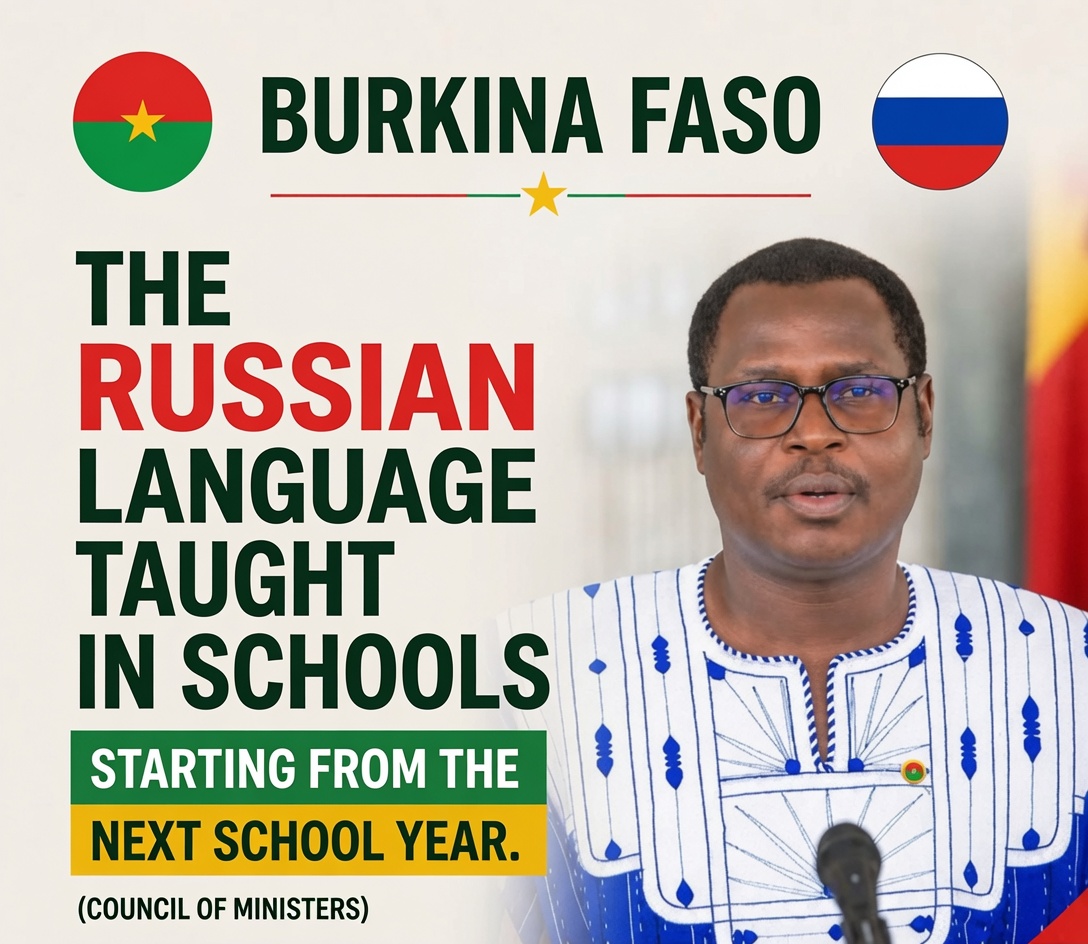
A significant shift in Burkina Faso’s strategic alliances has been cemented by a recent government decree. The transitional administration, following a Council of Ministers meeting, mandated the introduction of Russian language instruction into the national curriculum, effective from the upcoming academic year. While officially framed as an avenue for cultural and economic enrichment, the move has ignited a profound national discourse and raised considerable apprehension regarding the underlying motivations.
What truly underpins this new educational policy? Proponents within the government articulate a pragmatic and forward-looking rationale. They contend that in an increasingly multipolar global landscape, equipping the nation’s youth with diverse linguistic capabilities will foster future commercial, technological, and academic collaborations with the Eurasian bloc. Russia, which has emerged as the regime’s primary security partner, is now making its presence felt within the school system. For the authorities, this initiative merely serves to solidify, through education, a partnership deemed indispensable for state survival amidst the persistent terrorist threat.
Yet, beneath this veneer of educational cooperation, a pressing question arises concerning potential disguised foreign influence. Does this decree represent the unspoken dimension of a geopolitical transition, where the government might be withholding certain truths? As Burkina Faso legitimately strives to shed the burdensome legacy of French colonialism and Western paternalism, the swiftness of Moscow’s expanding footprint raises concerns about falling into a trap of inverted dependency. Critics argue that merely substituting one external influence for another does not equate to genuine sovereignty, but rather a mere change of overseer.
Several compelling arguments suggest that this measure could signify the nascent stages of a subtle, modern form of colonization:
The “Soft Power” as a Tool for Political Penetration
Contemporary history demonstrates that the imposition of a language through political decree seldom remains a purely academic endeavor. It frequently serves as the spearhead of cultural influence, or “soft power.” By familiarizing Burkina Faso’s youth with the Russian language and culture, Moscow effectively cultivates a future local elite predisposed to its interests, capable of engaging with its media, internalizing its narratives, and ultimately validating its long-term presence.
The Eastern Bloc Precedent
During the Cold War, the mandatory introduction of Russian in schools across Soviet satellite states was a deliberate strategy to homogenize thought and solidify political control. Applying such a method today in the heart of the Sahel bears a striking resemblance to the implementation of a well-established playbook for influence, where educational institutions effectively become extensions of military or political command.
The Stark Asymmetry of the Relationship
Authentic linguistic cooperation typically thrives on reciprocity. However, this particular adoption unfolds against a backdrop of extreme vulnerability for Burkina Faso, a nation heavily reliant on Russian military and logistical support to secure its territory. Introducing Russian into schools under these circumstances appears less like a thoughtfully considered strategic choice by the educational community and more akin to a significant political concession extended to its Moscovite benefactor.
The Peril of Cultural Asphyxiation
Burkina Faso is rich in indigenous languages, many of which struggle to secure adequate recognition and funding within the educational system to promote national identity. The decision to prioritize a foreign language, distant from West African realities, therefore raises significant questions. Rather than truly decolonizing minds, this measure risks merely shifting the locus of dependency.
By allowing Russia to embed itself so deeply across military, mining, and now even the intimate sphere of classrooms, Burkina Faso faces the potential for a disguised form of colonization—one more subtle, yet equally detrimental to its freedom. Confronted with this precarious geopolitical gamble, the nation’s future hinges on the vigilance of its populace. May wisdom guide Burkina Faso, ensuring that today’s assertion of independence does not inadvertently pave the way for tomorrow’s subjugation.