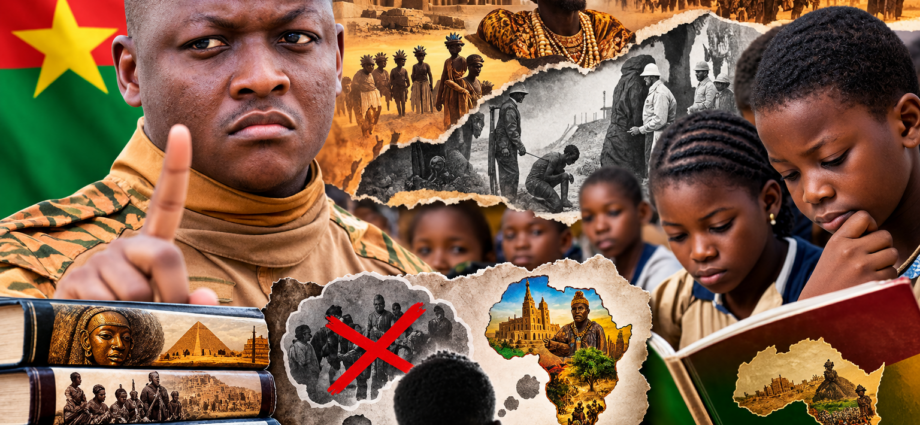
History education reform aims to reshape Burkina Faso’s school curriculum
The Burkina Faso government has initiated a sweeping reform of its history and geography curricula, with the stated goal of “decolonizing” school textbooks. While this initiative raises legitimate questions about the inclusion of African history in education, it also demands a critical reflection: revising curricula must not trap future generations in a one-sided interpretation of their own past.
Beyond colonial narratives: the full picture of African history
History is not defined solely by colonization, its injustices, or conflicts with the West. It encompasses civilizations, empires, kingdoms, trade systems, discoveries, social transformations, and intercultural exchanges. Teaching this history to young learners requires rigor a balance between acknowledging historical wounds and avoiding the reduction of collective memory to a single narrative of suffering.
Curriculum reform’s true purpose: education, not retribution
Burkina Faso risks misdirecting its efforts if the reform frames history education as a tool to retroactively correct historical wrongs by reshaping the narrative taught in schools. While textbooks can expose the injustices of colonization, highlight African resistance, and restore the legacy of marginalized figures, they cannot rewrite history or heal the wounds of the past.
The core challenge is to provide students with a more comprehensive understanding of history not to subject them to a new ideological framework that limits their perspective. A curriculum seeking to liberate minds could, ironically, result in a generation whose knowledge of the past is constrained by a different kind of bias.
The Ivorian model: lessons in balanced historical education
Examining Ivory Coast’s approach offers valuable insight. A well-balanced history curriculum must integrate national history, African kingdoms and empires, key continental figures, and international events that shaped the modern world. Understanding one’s own country does not mean ignoring others rather, it means situating local history within a broader context to better grasp power dynamics, exchanges, and the forces that have molded contemporary societies.
The way forward: clarity, not confrontation
Decolonizing education should not involve replacing one singular narrative with another. Students must study the crimes of colonization without losing sight of the complexities of European societies, just as they should explore African civilizations without overlooking their contradictions, conflicts, and evolution. Knowledge of past injustices is essential but so is understanding their origins, mechanisms, and historical responsibilities.
The ultimate question: what legacy does Burkina Faso want to leave?
The deeper question Burkina Faso must confront is not merely how to reform textbooks, but what kind of memory it wishes to pass on to its youth. Will it be a memory that keeps them mired in perpetual confrontation with the past, or an education that equips them with the intellectual tools to understand, debate, and shape the future?
History is not repaired by concealing its pages from future generations. It is addressed by giving them the means to read, interpret, and learn from every chapter so that they may become enlightened citizens, rooted in their heritage yet connected to the world at large.
By Alasane OUEDRAOGO — Journalist
Comments are closed, but trackbacks and pingbacks are open.