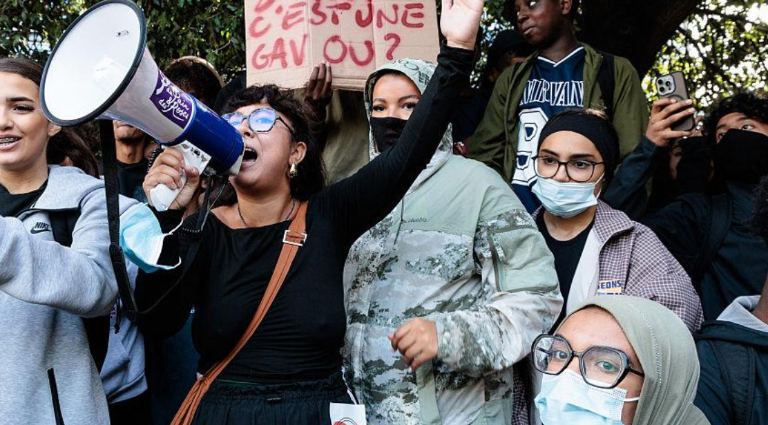
Students Take to the Streets Over School Conditions as Presidential Race Looms
The latest wave of protests gripping France reveals deeper frustrations about education, social inequality and governance as the country gears up for the 2027 presidential election. What began as school-based demonstrations has rapidly evolved into a broader movement, drawing participation from students, parents and educators across France’s major cities on October 17.
This mobilization arrives at a pivotal moment, with youth demands amplifying calls for systemic reform in a nation where public education is central to national identity. Behind the visible unrest lies a generation questioning whether the educational system can still serve as a ladder for social mobility—or whether it has become part of the problem.
Classrooms in Crisis: Overcrowding, Absenteeism and Resource Gaps
Student frustration erupted following September’s return to school, where complaints emerged over crumbling infrastructure, teacher shortages and unmanageable class sizes. Long schedules, unreliable heating and dilapidated toilets have become symbols of neglect. Online university admissions through “Parcoursup” are criticized as opaque gatekeepers to higher education, adding to academic pressure.
Blockades and walkouts have intensified in the past month. On October 13, the fifth round of protests saw participation numbers diverge sharply between organizers and official estimates—480,000 versus 161,500—underscoring both the depth of engagement and the rift between government and grassroots movements.
These grievances are not uniform. Rural and working-class schools report higher frequencies of teacher absences and underfunded programs, while urban institutions battle unmanageable enrollment rates and inadequate student support.
Unequal Schools: A System Under Strain
The movement’s demands extend beyond funding. Students argue that inequality has become institutionalized within the education system. Some regions face chronic teacher shortages, forcing teachers to cover classes outside their specialty. Others grapple with overcrowded classrooms where one-on-one attention is a luxury. Government data released in October highlighted school schedule difficulties as the top complaint—ranking above building conditions and teacher replacements.
In response, authorities have pledged to increase teacher replacements and boost education spending in the 2027 budget. Yet activists and student leaders dismiss these efforts as insufficient, pointing to a fundamental disconnect between budget increases and tangible improvements. Distribution of resources, they argue, remains uneven and fails to address systemic inadequacies.
Convergence of Struggles: From Classrooms to Cost of Living
The October 17 protests signaled a broader coalition, with trade unions, retirees and welfare advocates joining student-led demonstrations. While motivations differ—pensions, wages, public services—shared frustration over living costs and institutional neglect has created an unexpected alliance. This convergence has injected new energy into the movement but also raised concerns over public order.
Violent clashes were reported in Paris and Marseille, with property damage and police intervention drawing media attention. While peaceful marches continued elsewhere, these incidents risk overshadowing the core issues. Authorities face calls to balance security with the right to protest, ensuring that dissent remains constructive and protected.
2027 Election Looms: Education Takes Center Stage in National Debate
With presidential campaigning set to intensify, youth concerns are becoming a defining political issue. Education spending, school equity and job security for young graduates are now focal points in national discourse. Political analysts suggest that the government’s response—or failure to respond—could shape voter sentiment across all demographics, not just the youth vote.
The current administration has framed education as a priority, with budget proposals for 2027 emphasizing teacher recruitment and facility upgrades. However, critics argue that piecemeal funding without structural reform will not address the root causes of inequality. Whether candidates can translate youth demands into coherent policy remains an open question.
The president, whose second term ends in 2027, faces a dual challenge: addressing immediate grievances while shaping a legacy that resonates with a generation demanding change. His government’s next moves could determine whether this protest becomes a turning point or fades as political theater.
From Protest to Policy: Can Change Be Achieved?
The movement has succeeded in exposing long-neglected realities: underfunded schools, unequal access to resources and a growing sense of generational abandonment. Yet visibility does not guarantee transformation. Diverse agendas, infighting among organizers and government resistance complicate consensus-building.
To move forward, experts advocate for inclusive policy development—engaging students, educators and families in co-creating solutions. Without structured dialogue, even widespread demonstrations risk being reduced to fleeting moments of outrage rather than catalysts for real change.
As France approaches the 2027 election, the fate of its youth may well rest on whether the nation’s leaders listen—or whether the streets grow louder still.
Comments are closed, but trackbacks and pingbacks are open.