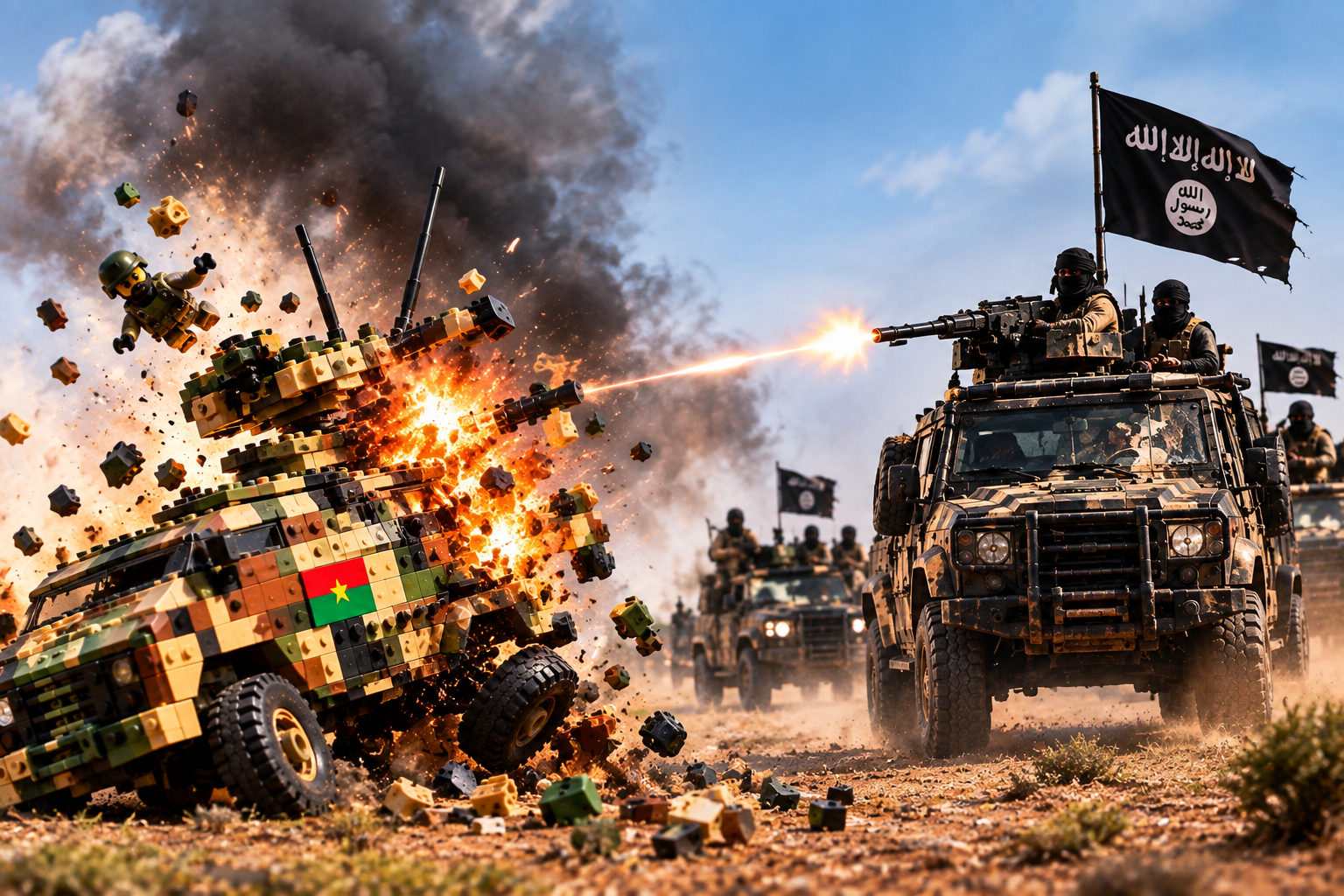
The morning of Wednesday, September 16, 2026, brought a stark reminder that official narratives and battlefield reality rarely align. The Group for the Support of Islam and Muslims (JNIM) claimed it had seized two positions held by Volunteers for the Defense of the Homeland (VDP) in Mahlou and Winten, in Bam province. The claim, which has not been independently verified, raises pressing questions about the effectiveness of Burkina Faso’s locally assembled armored vehicles and the consequences for the people living in these contested areas.
From showcase to battlefield: the real cost of the armored gamble
For months, the government of Ibrahim Traoré has championed the growth of Burkina Faso’s military industry, touting the country’s ability to produce or assemble equipment for its defense forces. The official line emphasizes sovereignty, domestic manufacturing, and reduced reliance on foreign suppliers. Industrialization is regularly presented as a cornerstone of national policy.
But on the ground, an armored vehicle does not win a war simply because it is hailed as an industrial achievement. It must withstand attacks, protect its occupants, remain operational under fire, and, above all, help hold a position. That is the real test.
After the official presentations and carefully staged images, the moment has arrived for these vehicles to move from the exhibition hall to the battlefield. And here, ironically, some observers might wonder whether these are armored vehicles assembled like Lego pieces: put together, displayed, applauded… then left to the field to prove whether they truly hold up.
The mockery is real, but behind the joke lies a serious question: what is the actual performance of this equipment when confronted with the operational conditions of northern Burkina Faso?
When equipment alone cannot secure territory
The growing number of attacked positions recalls a reality far less flattering than industrial slogans: having equipment, even locally made, is not enough to guarantee lasting control of territory. On August 19, JNIM had already claimed the capture of several VDP positions, notably in Séguénéga and Bourzanga. Recent analyses also highlight the difficulty Burkinabè forces face in sustainably holding certain areas, even those they have retaken or secured.
The true indicator will not be the number of vehicles paraded before cameras, nor speeches about industrial sovereignty. It will be their behavior when actually under fire.
What the fall of Mahlou and Winten could mean for local communities
If JNIM’s claim is confirmed, the consequences for civilians in Bam province are immediate and tangible. Losing these positions could leave villages more exposed to attacks, disrupt local markets, and force further displacement. For businesses, the insecurity threatens supply routes and economic activity, deepening the hardship in a region already grappling with a multifaceted crisis.
At Mahlou and Winten, the message from the ground would be particularly embarrassing: between building an armored vehicle, showing it off, and proving its operational effectiveness, there remains a world of difference. And that difference is not measured in speeches. It is measured in kilometers of territory actually held, positions defended, and soldiers brought back alive.
The stakes extend beyond military prestige. They touch the daily lives of citizens, the viability of local economies, and the credibility of a government that has staked much on its industrial ambitions. As the situation unfolds, the real test will be whether these locally assembled vehicles can help reverse the tide or whether they will remain symbols of a promise unfulfilled.
Comments are closed, but trackbacks and pingbacks are open.