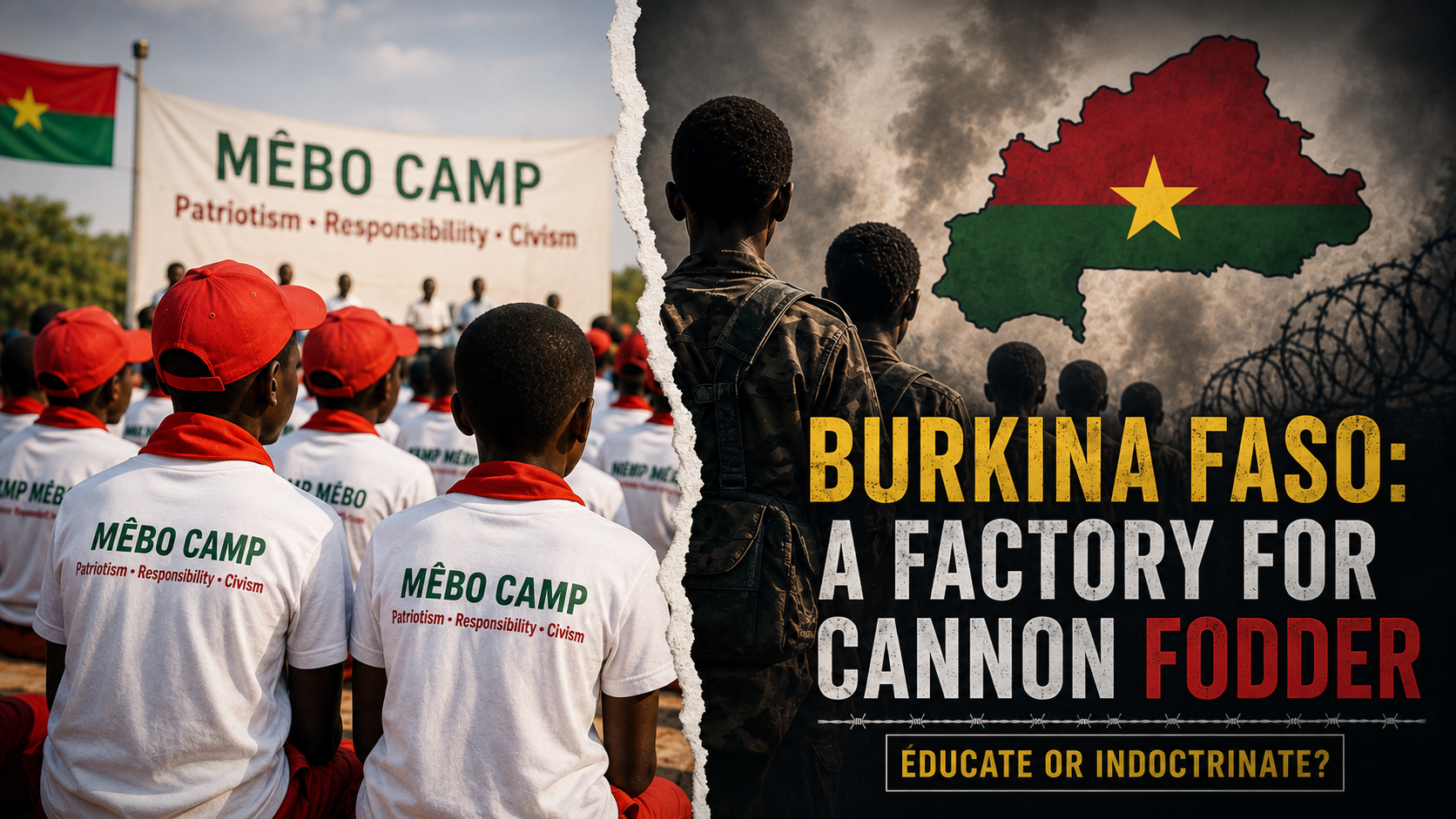
The initiative appears, at first glance, to be a conventional civic project. In Burkina Faso, the Mêbo holiday camp has brought together thousands of young people for cultural, sporting, and community-based activities. The stated objective of the authorities? To foster patriotism, responsibility, and civic awareness from an early age. Yet beneath this seemingly virtuous institutional facade, a far more troubling debate is gaining traction in the public sphere: could these large-scale gatherings also mark the beginnings of a gradual militarization of Burkinabe youth?
The Ambiguity of Civic Initiatives
Civic education itself is not inherently problematic. Instilling in young people a sense of responsibility, respect for institutions, solidarity, and the common good is undeniably legitimate. However, when patriotism becomes a tool for political mobilization, when critical thinking is overshadowed by blind obedience, and when national defense is framed as an unceasing duty, the line between genuine civic engagement and ideological indoctrination becomes dangerously blurred.
A Recognizable Pattern
Such strategies are far from unprecedented on the African continent. Historical precedents show that recruitment or early indoctrination mechanisms often follow similar patterns. From Sierra Leone to Liberia, and even in parts of the Democratic Republic of the Congo, the boundaries between patriotic awareness, ideological mobilization, and the recruitment of young people in conflict zones have, at times, proven extremely fragile. When authorities manipulate national sentiment among an impressionable audience, the risk arises of transforming civic education into a means of coercion rather than empowerment.
The Power of Discourse
The language used in these initiatives merits close scrutiny. When terms such as homeland, sacrifice, enemy, national defense, and commitment are repeatedly paired in speeches aimed at youth, they risk normalizing the idea that military service is the natural endpoint of responsible citizenship. Yet a child or adolescent must first learn to think, debate, create, and innovate before being called upon to sacrifice themselves for a political or military cause.
A Context of Escalating Tensions
Within the volatile security landscape of the Sahel, the policies implemented by Burkina Faso’s transitional administration under Ibrahim Traoré raise significant questions. The country faces an ongoing conflict that has upended society, displaced populations, and thrust national defense into the heart of public discourse. In such a climate, patriotic mobilization can easily take on a more radical dimension. The critical issue, then, becomes one of balance: to what extent can the state justify instilling a defensive mindset in youth?
Balancing Commitment and Critical Thinking
By shaping a youth deeply aligned with official narratives, does the government whether deliberately or inadvertently risk narrowing the space for dissent and critical thought? A truly civic-minded youth should not merely echo the government’s positions. Instead, it should be capable of defending its country while questioning its leaders, respecting the nation without conflating it with the regime, and serving the community without becoming a political tool.
The Normalization of Sacrifice
Another concern lies in the gradual acceptance of sacrifice as a civic virtue. When combat death is repeatedly framed as the ultimate expression of patriotism, it can desensitize young minds to the dangers of armed conflict. Yet a child’s dedication to their country should be measured not by their willingness to embrace violence, but by their commitment to education, healthcare, agriculture, innovation, social cohesion, and sustainable development.
Unease Surrounding Symbolic Elements
Particular attention must also be paid to the presence of uniforms, military symbols, and war-related rhetoric in these programs. While each element individually may not constitute proof of militarization, their cumulative effect especially within a context of prolonged national mobilization demands careful examination. It is in these gray areas that the distinctions between civic education, patriotic propaganda, and psychological conditioning for military engagement can begin to dissolve.
The Age Factor
Equally pivotal is the question of age. An adult, equipped with political and military awareness, can make an informed choice regarding engagement. A child, however, lacks both the maturity and the judgment to do so. Institutions bear the responsibility of safeguarding young minds against manipulation and ensuring that their education fosters emancipation rather than conformity to a confrontational ideology.
The Potential Pitfalls of a Militarized Discourse
In the face of pressing security challenges, the temptation to militarize young minds is understandable. Yet responding to military threats by ideologically preparing an entire generation for confrontation risks perpetuating a dangerous cycle. The more society conditions its youth to perceive conflict and sacrifice as normal responses to political and social disputes, the more entrenched such responses become.
Redefining True Patriotism
Genuine patriotism must offer an alternative to this logic. To love Burkina Faso is not merely to be prepared to die for it. It is also to desire stability, so that future generations can live, study, work, and build their futures without constant exposure to war. It is to accept that citizens can support their country while holding their government accountable.
Demanding Transparency and Accountability
Before endorsing uncritically the narratives surrounding civic mobilization, it is essential to seek clarity: What are the pedagogical goals of these camps? How much emphasis is placed on critical thinking? Are participants free to express dissent? Do the activities include military or paramilitary components? And, above all, where is the line drawn between nurturing responsible citizens and preparing a generation to accept war as an inevitable fate?
Burkina Faso requires a youth that is engaged, educated, and cognizant of its duties. Yet it must also ensure that this generation retains its autonomy of thought. Preparing citizens to build the nation’s future is a noble ambition. Preparing them to serve as cannon fodder in future wars would be an entirely different and deeply troubling endeavor.
The question remains: Are these programs equipping children to construct Burkina Faso’s tomorrow, or are they grooming them to become expendable tools in tomorrow’s conflicts?
Comments are closed, but trackbacks and pingbacks are open.