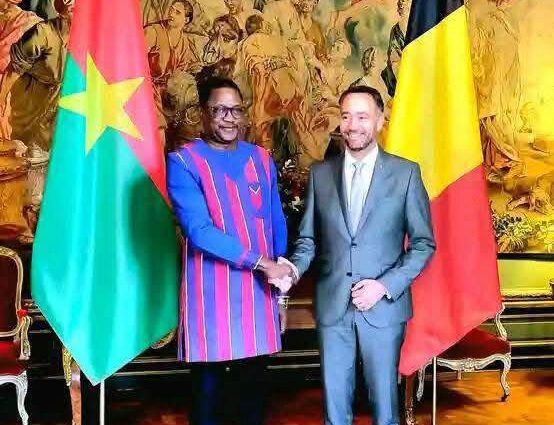
Ouagadougou’s diplomatic playbook has taken a sharp turn. After years of publicly severing ties with Western partners and championing Moscow as Burkina Faso’s financial savior, the transitional government is now back in Brussels, cap in hand, seeking urgent financial lifelines.
Diplomatic pivot highlights financial realities
On November 4 and 5, 2026, Burkina Faso’s foreign minister, Karamoko Jean Marie Traoré, held high-level talks in Brussels, meeting both EU High Representative Kaja Kallas and Belgian Deputy Prime Minister and Foreign Minister Maxime Prévot. The timing speaks volumes: these discussions followed closely behind Burkina Faso’s participation in the Russia-Africa Economic and Humanitarian Forum in Moscow, where officials had hailed a new era of cooperation with Russia.
The Burkina Faso delegation returned from Moscow with renewed rhetoric about shifting away from Europe. Officials pointed to a newly signed memorandum between the Confederation of Investment and Development Banks of the Alliance of Sahel States (AES) and Russia’s VEB.RF bank as proof of progress. Yet beneath the diplomatic fanfare, a critical question lingers: where are the concrete financial commitments that Burkina Faso desperately needs?
Moscow’s promises fall short of financial needs
The memorandum signed in Moscow outlines broad cooperation frameworks, but cooperation agreements do not equate to immediate financial injections. For a country grappling with spiraling security costs, crumbling infrastructure, and pressing social needs, Burkina Faso requires substantial, tangible funding not just signed sheets of paper.
The stark reality is that Russia, despite its strategic statements, has yet to demonstrate an ability to replace the financial contributions traditionally provided by Western partners. The gap between diplomatic messaging and financial outcomes raises doubts about whether Moscow can meet Burkina Faso’s immediate economic challenges.
Brussels extends a financial lifeline
Amid these uncertainties, Brussels has stepped back into the spotlight. On November 5, Belgium announced a €40 million financial commitment to Burkina Faso, earmarked for post-2027 development projects through Enabel, Belgium’s international cooperation agency. This pledge underscores a fundamental truth: despite public posturing, Burkina Faso’s transition government still actively pursues and secures European funding.
The minister’s meetings in Brussels focused not just on diplomatic niceties but on consolidating financial partnerships to address Burkina Faso’s most pressing needs. Discussions also involved European Commission officials and operational cooperation bodies, including Enabel and Bio Invest, signaling a return to pragmatic engagement with Brussels.
Can ideological posturing serve economic survival?
The heart of the issue lies in the disconnect between Burkina Faso’s anti-Western rhetoric and its ongoing reliance on Western financial support. Public statements have frequently framed Europe as an undesirable partner, yet the government continues to negotiate funding that is vital for the country’s stability and growth.
This contradiction raises pressing questions. How can authorities justify criticizing Western influence while simultaneously seeking its financial aid? If Russia’s promised partnership has not delivered tangible results, why maintain a public narrative of rupture?
Sovereignty, in this context, is not strengthened by anti-Western slogans but by the ability to secure resources, fund development, and meet the needs of the population. Burkina Faso’s transition leadership must prioritize results over rhetoric, ensuring that financial partnerships whether with Brussels or Moscow translate into real benefits for its people.
Where are the tangible results from Russia?
As Ouagadougou re-engages with Brussels, Burkinabè citizens are justified in asking what, exactly, their government has gained from the much-touted partnership with Moscow. Political speeches alone cannot build roads, fund healthcare, or ensure security. Economic survival demands concrete financial commitments not just declarations of solidarity.
The next phase of Burkina Faso’s diplomatic strategy must answer one fundamental question: after presenting Russia as the solution to its financial woes, what measurable progress can the transitional government present to its people?
By Alasane OUEDRAOGO — Journalist
Comments are closed, but trackbacks and pingbacks are open.