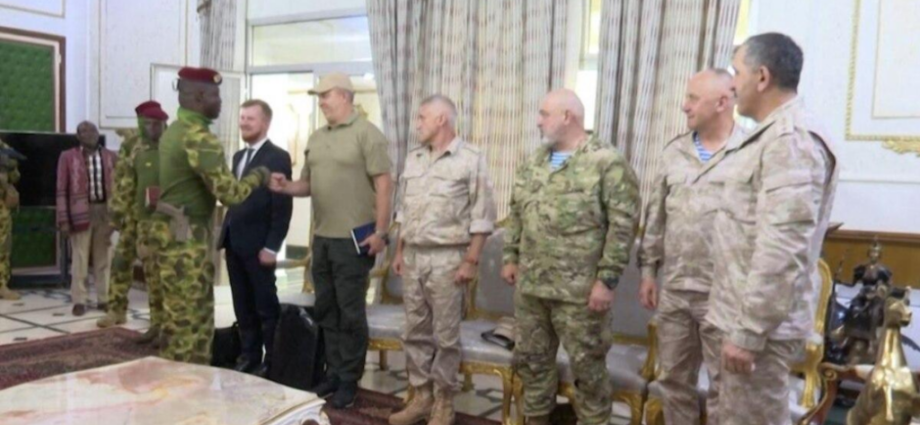
Burkina Faso’s gold reserves are no longer just an economic asset—they are becoming a cornerstone of the political alliances reshaping the country’s future. Since Captain Ibrahim Traoré took power in September 2022, Ouagadougou’s deepening partnership with Russia has extended far beyond diplomacy, embedding itself in the nation’s security, mining, and governance sectors. A closer look at the Bissa gold mine reveals how these dynamics are playing out in real time.
The Bissa mine, operated by Russia’s Nordgold, has become a flashpoint in this evolving relationship. Behind the scenes, a fierce rivalry between Russian security firms for contracts to protect the mine has exposed the tangled web linking gold revenues, regime security, and Moscow’s strategic interests in the Sahel.
Gold mine security as a political lever
The mine’s protection contracts are more than routine security arrangements—they reflect a calculated effort to merge economic control with political stability. Nordgold, controlled by Russian tycoon Alexei Mordashov, holds a dominant position in Burkina Faso’s gold sector, with Bissa and Bouly mines under its management. This presence gives Moscow a direct stake in the country’s mining output and the security of its sites.
In February 2023, Burkina Faso’s government seized 300 kilograms of gold from Bissa Gold, citing public necessity. While the state pledged compensation, the move underscored an emerging trend: gold is no longer treated solely as an export commodity but as a flexible resource for state financing and political leverage.
Russian security forces: more than counterterrorism
Russia’s security presence in Burkina Faso extends beyond training and advisory roles. Reports indicate that Russian paramilitary units have been deployed alongside Traoré’s security detail during official events and are embedded within intelligence-linked structures in Ouagadougou. Their mandate appears to include safeguarding the transitional leadership, raising questions about the true scope of their mission.
The intersection of security and mining interests is not coincidental. Analysts at the Combating Terrorism Center at West Point suggest that protecting Russian mining investments may have been an early driver of Moscow’s engagement in Burkina Faso. While the primary stated goal remains combating Islamist insurgents, the secondary—but increasingly visible—objective involves shoring up Traoré’s regime.
Russian firms battle for influence at Bissa
The dispute at Bissa highlights the competitive and fragmented nature of Russia’s security sector in Africa. RSB-Group, a Russian firm reportedly ousted from the mine’s security framework, has accused rival contractors of exacerbating community tensions near mining sites. Specifically, it claims local armed attacks—allegedly linked to security operations—have worsened instability in Fulani villages, a highly sensitive issue in the region.
These allegations, if substantiated, reveal a troubling pattern: the race to secure mining sites may come at the cost of human security. For communities living near gold operations, the expansion of private military protection raises urgent concerns about accountability, civil liberties, and the exploitation of local grievances for corporate or geopolitical gain.
An unspoken pact: power and profit entwined
There is no public agreement that explicitly ties Traoré’s regime security to mining concessions or Russian corporate interests. But the convergence of goals is striking: Moscow gains economic and strategic influence in Burkina Faso’s extractive sector, while Ouagadougou receives security support crucial for regime survival in a period of political fragility and armed conflict.
The Bissa conflict serves as a microcosm of this broader arrangement. The rivalry between RSB-Group and its competitors is not merely commercial—it reflects a struggle for favor within Burkina Faso’s corridors of power. The stakes include not only access to lucrative contracts but also the ability to shape narratives around security and resource governance.
Balancing security and sovereignty
For Burkina Faso, the partnership with Russia presents a paradox. On one hand, external security support is critical amid an escalating jihadist threat. On the other, the deepening entanglement of mining interests and foreign paramilitary presence risks eroding national sovereignty and human rights standards.
Local communities, already caught between armed groups and state forces, now face further insecurity from unregulated private security operations. The exploitation of gold, once a symbol of national wealth, is increasingly tied to external interests and opaque security arrangements.
What’s next for Burkina Faso’s gold and its allies in Moscow?
As Traoré consolidates power and Burkina Faso’s gold output grows, the strategic value of its mines will only rise. Moscow’s role in securing both assets and leadership suggests this partnership is not temporary. Whether this alignment serves the long-term interests of the Burkinabè people—or primarily benefits foreign actors—remains an open question.
The Bissa mine is not just producing gold. It is producing new forms of power—and new questions about who benefits from Burkina Faso’s most precious resource.
Comments are closed, but trackbacks and pingbacks are open.