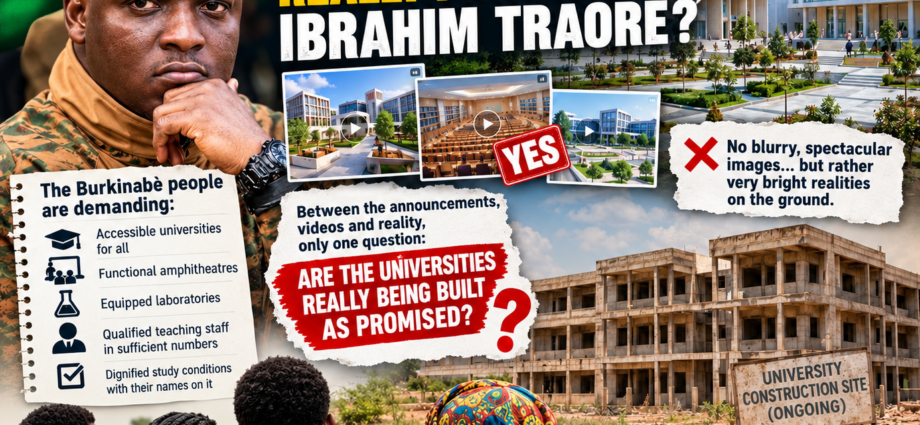
Amid a flood of high-profile announcements and digitally enhanced imagery, families across Burkina Faso are asking a single, pressing question: where are the promised modern universities, and what concrete progress has actually been made?
With public attention increasingly focused on political communication, the gap between staged visuals and tangible infrastructure is sparking frustration among parents and students who are investing their future in the promise of expanded higher education.
From digital illusion to educational reality
Visual content often vividly staged and widely circulated has become central to the public narrative surrounding Burkina Faso’s educational development. Yet multiple investigative reports have exposed how such imagery can mislead, revealing videos falsely linked to domestic projects or attributed to national initiatives when they were filmed abroad.
For example, in April 2025, video footage circulated online under the banner of major construction achievements in Burkina Faso was later traced back to an Algerian real estate development. While subsequent fact-checking has debunked some of these claims, the pattern raises serious concerns: in an era of AI-generated content, how can citizens distinguish between real progress and fabricated imagery designed to bolster public perception?
At stake is not just the credibility of a government, but the livelihoods of thousands of families who have invested savings in the hope of better-trained, more employable graduates.
Announcements without substance: the danger of inflated expectations
Political leaders often measure success in headlines and social media engagement. But for students and parents, progress is measured by functioning lecture halls, equipped laboratories, and qualified faculty things that cannot be promised in a speech alone.
A university announced today may not open tomorrow. A building completed today may lack essential utilities tomorrow. And even when an institution is built, its impact depends on whether it opens on time, operates efficiently, and serves the intended number of students.
To date, official statements claim multiple university expansions are underway, including a 1,200-seat auditorium, four 210-seat classrooms, and six laboratories inaugurated at Nazi-Boni University in Bobo-Dioulasso in September 2026. Yet without independent verification, such announcements remain assertions welcomed by supporters, but insufficient for skeptical citizens.
The role of AI in political messaging
The rise of AI-generated videos and images has transformed how political achievements are presented. A single clip can create the impression of a completed project, a bustling campus, or a new era in education even when no such reality exists.
While some manipulated videos clearly misrepresent foreign projects as domestic ones, others are more difficult to trace. This technological evolution demands a higher level of public scrutiny. Citizens deserve transparency, not just visual appeals.
Trust must be earned, not manufactured
The responsibility of any government is not only to announce progress, but to prove it. Real accountability means allowing independent journalists to visit sites, publishing operational data, and responding to specific concerns raised by students and parents.
Questions remain unanswered: Which announced universities are fully operational? How many students are currently enrolled? Are the laboratories functional and staffed? What are the enrollment capacities compared to demand?
Until such details are made public in clear, verifiable terms, the promise of a modern university system in Burkina Faso will remain just that a promise.
Beyond the screen: where does education stand?
The ultimate test of any educational initiative is whether students can learn, research, and graduate in dignified conditions. That test cannot be passed by images on a screen no matter how polished.
True advancement is measured in functioning classrooms, qualified instructors, and students who can pursue their studies without interruption. Until these conditions are met and transparently documented, the conversation must focus on results, not rhetoric.
The people of Burkina Faso have the right to know: are these universities real, or are they projections of hope?
By AMINATA KABORE — Journalist
Comments are closed, but trackbacks and pingbacks are open.