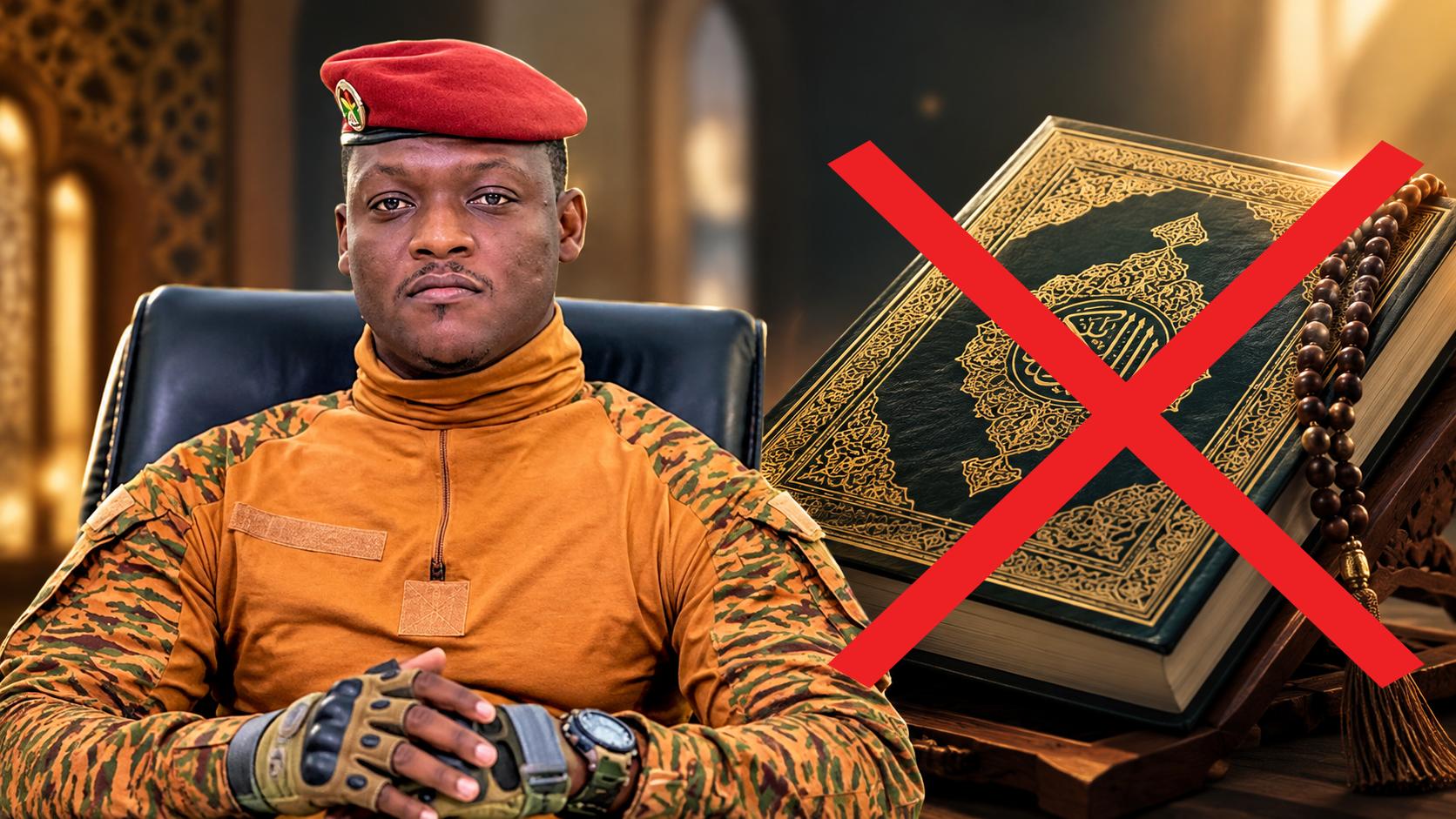
An increasingly blurred line between counterterrorism and religious repression
In Burkina Faso, the boundary separating the fight against armed extremism from the suppression of religious freedoms has seldom appeared so thin. Framing its actions as a necessary campaign to root out the terrorist threat destabilising the country, the transitional government led by Captain Ibrahim Traoré has embarked on a strategy of control and coercion aimed at the Muslim community, which forms the country’s majority. What emerges behind official talk of “national security” is nothing less than a sweeping effort, directed from Ouagadougou, to bring the figures and institutions of Burkinabè Islam under strict supervision.
Detentions, closures, and the disciplining of imams
For months now, security rhetoric has provided a convenient pretext for pursuing independent religious voices. Moderate imams, influential preachers, and officials of Muslim associations have faced arbitrary arrests, detention incommunicado, or forced enlistment in the Volunteers for the Defence of the Homeland (VDP). Their supposed offence: having criticised the junta’s methods, questioned how the security crisis is being managed, or simply called for the protection of civic rights.
At the same time, mosques and Quranic schools in areas with serious security challenges have been subjected to harsh inspections, arbitrary administrative closures, or blanket accusations of collusion with armed groups. By indiscriminately labelling any religious discourse that does not align with the authorities as “subversive” or “allied with the enemy,” those in power have created a climate of fear within a religious community long recognised for its role in mediation and social cohesion.
Political instrumentalisation and the fracturing of national unity
This iron-fisted approach pursues an unmistakable objective: neutralising any social force capable of articulating organised opposition to military rule. By targeting above all the networks and prominent figures of local Islam, the transitional regime seeks to impose a single line of thinking and to seal off public space.
Far from weakening the jihadist groups that ravage the region, this harsh offensive against religious practice risks producing the opposite effect. By stigmatising the Muslim community, dismantling customary and spiritual intermediaries, and depriving worshippers of moderate reference points, the authorities feed a sense of injustice and alienation. In treating religion as an internal enemy under the guise of sovereignty and security, Ibrahim Traoré takes the major risk of atomising the social fabric of a country already at breaking point.
The fallout: reactions, public debate, and an uncertain road ahead
The crackdown has not gone unanswered. Within Burkina Faso and across the wider region, voices from civil society, religious circles, and ordinary citizens have begun to question the wisdom of a policy that conflates faith with subversion. Families of detained imams describe a climate of anxiety, while community leaders warn that trust in state institutions is eroding.
The public debate now turns on a central question: what comes next? If the current trajectory continues, observers fear a deeper estrangement between the authorities and the majority Muslim population, with consequences for social peace and local economies that depend on communal harmony. Should the government recalibrate its approach, however, there remains room to rebuild confidence through dialogue with religious leaders and a clearer separation between counterterrorism operations and the peaceful practice of faith. The coming months will reveal whether Burkina Faso chooses escalation or a path back toward national cohesion.
Comments are closed, but trackbacks and pingbacks are open.