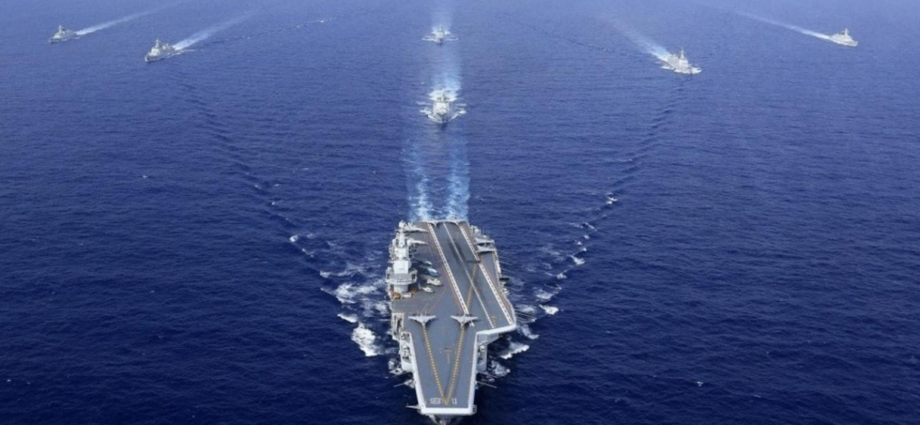
China has escalated its military posture around Taiwan with a previously undisclosed naval exercise involving over 100 ships in the western Pacific. According to Taiwanese security sources, a Chinese submarine reportedly launched a ballistic missile during the drills, intensifying concerns among regional allies and Western powers.
Unannounced war games draw regional scrutiny
Early November saw Beijing conduct large-scale maritime maneuvers near Taiwan and the western Pacific without prior public announcement. Taiwanese defense officials confirm these exercises involved more than 100 Chinese naval and coast guard vessels, raising questions about their true objectives.
The drills were not limited to routine naval training. Reports indicate simulations of attacks against Taiwan, foreign military bases, and even urban targets—a scope far exceeding typical exercises. The coordination across multiple Chinese naval commands suggests a broader strategic intent rather than a localized demonstration.
Massive naval deployment signals strategic shift
Chinese forces from eastern, northern, and southern theater commands participated, alongside the Liaoning carrier strike group. This multi-command mobilization demonstrates Beijing’s growing ability to project naval power across vast distances, from the Yellow Sea to the first island chain.
Observers note the exercises tested several operational scenarios: maritime denial tactics, Taiwan encirclement, neutralization of rival forces, and Pacific-wide power projection. With around 70 ships still operating near the first island chain days later, the drills appear ongoing rather than concluded.
Controversial missile test raises nuclear stakes
The most alarming revelation involves a suspected submarine-launched ballistic missile (SLBM) test in the Yellow Sea. While Taiwanese sources cite the launch, no independent verification has been released. The absence of technical proof—including missile type, trajectory, or confirmation from Beijing—demands cautious interpretation.
If genuine, the test would mark a major leap in China’s strategic undersea capabilities. SLBM-equipped submarines form a core pillar of nuclear deterrence, offering stealth and second-strike potential. Such an advancement would significantly alter regional power dynamics, particularly concerning Japan and the United States.
Silent intimidation strategy takes center stage
China’s decision to withhold official notice of these exercises appears deliberate. Taiwanese analysts describe the approach as “silent intimidation”—a calculated attempt to exert pressure while minimizing immediate diplomatic fallout. The strategy aims to erode Taiwan’s strategic confidence and test allied responses without triggering overt conflict.
The timing further fuels speculation. Conducted days before the APEC summit in Shenzhen, the exercises raise questions about whether they were timed to influence international perceptions during high-profile diplomatic events.
Japan and the U.S. brace for escalation risks
The potential consequences extend beyond the Taiwan Strait. Japan’s proximity to the first island chain makes it vulnerable to supply chain disruptions, energy route blockades, and challenges to U.S. military operations in the region. Washington has also warned that Beijing’s tactics could aim to deny access to allied forces in a crisis scenario.
While no evidence suggests the missile was aimed at Japan, Tokyo’s security establishment views the drills as a direct threat to regional stability. The G7’s November 11 statement condemning Chinese military activities east of Taiwan underscores growing Western unease over Beijing’s expanding naval footprint.
Taiwan faces a new era of military pressure
These developments do not confirm an imminent invasion of Taiwan. Instead, they reveal a troubling evolution: Beijing now possesses the military tools to exert sustained pressure on Taipei and its allies without resorting to open warfare. The combination of naval saturation, attack simulations, and suspected nuclear-capable missile tests paints a picture of calculated coercion.
For Taiwan, the challenge is adapting to a reality where military options are wielded not through full-scale conflict, but through incremental escalation. The question now is how far Beijing will push in its quest for dominance in the Taiwan Strait—and whether deterrence alone can prevent a dangerous miscalculation.
Comments are closed, but trackbacks and pingbacks are open.