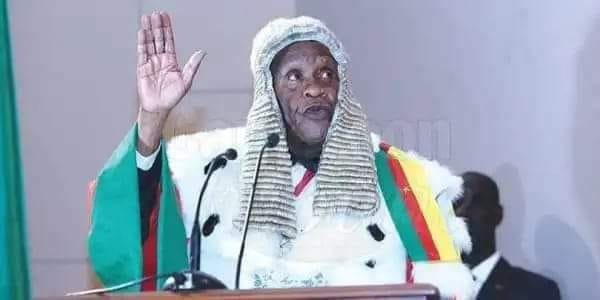
Clément Atangana, the first president of Cameroon’s Constitutional Council, passed away on October 4, 2026, in Paris after a long illness. His death closes a chapter that defined how electoral disputes were handled in Cameroon for nearly a decade, and it raises questions about the future of the institution he shaped.
The man behind the gavel: a judicial career built over decades
Born on December 20, 1941, in Ekoumeyeck, near Ngomedzap in the Nyong and So’o division, Atangana’s path to the highest electoral court was anything but accidental. He joined the judiciary on December 20, 1968, after training at ENAM and the International Institute of Public Administration in Paris. Over the years, he served as an investigating judge in Nkongsamba, presided over courts in Eséka, Bafia, Sangmélima, and Mora, and later became public prosecutor in Maroua. He also led the Center Court of Appeal, served as a counselor at the Supreme Court, and eventually presided over the administrative chamber of that same court before retiring in 2014. Four years later, in February 2018, he was called back to lead the Constitutional Council—just months before the October 2018 presidential election.
The ‘irrecevable’ years: how one word defined a tenure
That deep voice, uttering the word ‘irrecevable’—inadmissible—time and again, became the hallmark of his presidency. The term stuck in the public consciousness, symbolizing the fate of virtually every petition brought by opposition parties and political actors after major elections. Under his leadership, the Council handled disputes from two presidential elections: 2018 and 2025. In both cases, the official results were challenged—by Maurice Kamto of the MRC and his supporters in 2018, and by Issa Tchiroma Bakary and his backers in 2025. Yet not a single petition from the opposition succeeded during his eight-year tenure. The Council’s reputation as an institution aligned with the regime, whether fair or not, only grew stronger.
A viral moment that spoke volumes
After the October 2025 election results were announced, a video circulated on social media in which Atangana was heard saying: ‘I am happy that you are rejoicing both for the victory of your candidate and for the work done by your father.’ The clip added fuel to the perception that the Council operated in sync with the executive. For many observers, it was a rare unscripted glimpse into the dynamics behind the scenes—an institution whose independence was often questioned, now captured in a candid moment.
What happens next: a vacancy at the top
With Atangana’s death, the presidency of the Constitutional Council—the highest body for electoral matters in Cameroon—is now vacant. According to the law, it falls to the President of the Republic to designate and appoint a new head of the institution by decree. The decision will be closely watched, as it could signal whether the Council’s role in future elections will remain as controversial as it has been over the past eight years. For now, the legacy of Clément Atangana is one of loyalty to the state, a judiciary career that spanned five decades, and a tenure that left an indelible mark on Cameroon’s electoral landscape.
Comments are closed, but trackbacks and pingbacks are open.