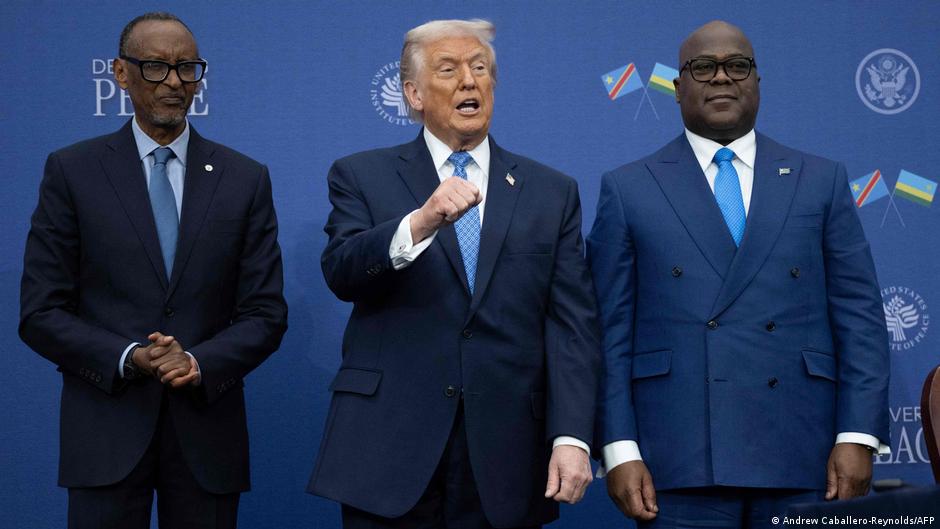
The Democratic Republic of Congo has filed a case at the International Court of Justice against Rwanda, alleging its support for armed groups, including the AFC-M23 rebellion, in the country’s eastern region.
The legal move comes exactly one year after the DRC and Rwanda signed a peace accord in Washington aimed at ending the war in eastern Congo. Despite the agreement, clashes persist between the Congolese army and the Rwandan-backed AFC-M23 rebels.
The United States has also imposed sanctions on several Rwandan officials accused of involvement in the illegal trade of minerals from rebel-controlled areas.
Peace on paper, absent on the ground
Kinshasa and Kigali had pledged to work together for the return of peace in eastern DRC, where AFC-M23 rebels have occupied large swaths of Congolese territory for over a year. However, no significant progress has been observed on the ground.
“We expected that after the signing of this agreement, things would improve, that banks and airports would reopen. Unfortunately, we are still living the same misery,” said a resident of Bukavu, the capital of South Kivu province.
“We wonder if the reputation the United States once had still holds. Why can’t the same policy applied in the US be applied to our neighbors who are attacking us here in the DRC?” questioned another resident. “So far, nothing is working. When they meet, they show good intentions, but on the ground, the fighting continues,” added a third.
Kigali faces sanctions and legal action
The DRC accuses Rwanda of supporting armed groups for around three decades, responsible for serious human rights violations in eastern Congo. Kinshasa has now taken the matter to the International Court of Justice, demanding reparations for victims and acknowledgment of Rwanda’s responsibility.
For its part, the United States has imposed sanctions on the Rwandan refinery Gasabo Gold, its executives, and several mining companies accused of trafficking minerals from areas controlled by the AFC-M23 in eastern DRC. Washington says this trade funds the rebellion. However, some analysts believe the sanctions are ineffective.
“The general perception is that these sanctions do not seem sufficient to alter the strategic calculations of the actors involved. As long as the cost of confrontation remains lower than the cost of concession, they will maintain the status quo, which remains attractive in their favor,” says Yvon Muya, conflict studies expert at Saint Paul University in Ottawa, Canada.
Towards a new military escalation
Peace is far from returning, with nearly daily exchanges of fire in some areas. Professor Bob Kabamba from the University of Liège in Belgium believes the warring parties are actually preparing for a fresh confrontation.
“It is during this time that each side tries to reorganize, rearm, and prepare for what could be called the final battle to determine whether the government will succeed in reclaiming territories won by the rebellion, or whether the rebels will advance toward Katanga and thus threaten the Kinshasa regime.”
For over a year, AFC-M23 rebels have occupied Goma and Bukavu, along with several other towns in North Kivu and South Kivu provinces. The ongoing clashes worsen the humanitarian situation for thousands of displaced people.
Comments are closed, but trackbacks and pingbacks are open.