On 17 May 2026, the World Health Organization declared the Ebola outbreak raging in eastern Democratic Republic of the Congo and persisting in Uganda a “public health emergency of international concern,” followed the next day by the Africa CDC. On 5 June, both institutions launched a joint six-month response plan and appealed for $518 million. Caused by the rare Bundibugyo strain, for which no licensed vaccine or treatment exists, this 17th epidemic hits a region devastated by conflict and destabilised by the restructuring of American aid. The crisis unfolds against a backdrop of extreme instability in the DRC due to numerous armed groups and ongoing violence. How might this epidemic worsen security and humanitarian fragilities in eastern DRC and complicate access to care? What risks does it pose to regional balances in Central Africa? Finally, what does the resurgence of Ebola reveal about the current capacity of the international community to respond to major health crises? Analysis by Fatou Élise Ba, researcher with the Human Security Programme.
In a context of armed conflict, political instability and deep economic and social fragility, particularly in eastern DRC, how is the Ebola epidemic affecting the internal stability of affected areas and complicating the establishment of health systems that ensure access to care?
This new Ebola wave arrives in a zone of multiple, structural crisis. Primarily affecting the DRC, this is the 17th epidemic since 1976 (first identification of the virus in Yambuku), this time involving the Ebola Bundibugyo strain. Currently, although treatments are being tested, there is no licensed vaccine or therapy for this strain, which can kill one in two infected people. The eastern regions of the DRC—North Kivu, South Kivu and Ituri—are particularly vulnerable to epidemic spread. Last year, the UN reported one of the worst cholera outbreaks in 25 years. Moreover, since 2020, Mpox has been spreading massively, especially from September 2023. Ituri, the epicentre of the Ebola outbreak, is one of the most troubled provinces in the DRC, poorly served by roads, plagued by armed group violence, and where nearly one million displaced people crowd into camps. The health crisis thus overlays a pre-existing humanitarian and security crisis. This stems from a context of endemic instability and conflict, particularly intense since the M23 offensive in 2023. Local populations live in daily uncertainty, marked by regular internal displacement and overcrowded camp conditions. Together, these factors promote the resurgence of pathogens and their rapid spread. Furthermore, the complex crisis situation in eastern DRC, with rare periods of calm, has severely weakened social fabric and health services, which currently cannot meet the basic needs of local populations, creating a structural dependence on foreign Western aid. Notably, systemic violence driven by successive conflicts in eastern DRC has deprioritised health and normalised violence, especially against women and children. This precarious context now faces a major epidemic that exacerbates the crisis amid a security collapse.
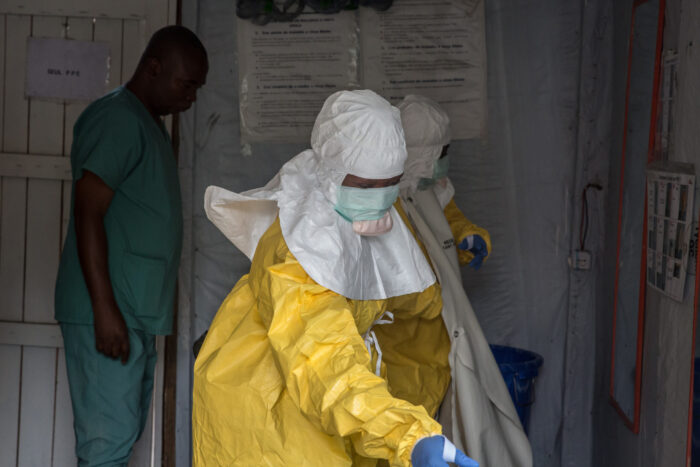
The Congolese health minister, Samuel-Roger Kamba Mulamba, declared that “Ebola is an absolute emergency.” According to national data, as of 31 May 2026, there were 282 confirmed cases including 42 deaths, after 19 new positive tests. The WHO reported on 1 June that 349 suspected cases were under surveillance pending results, mainly in Ituri province, specifically in the health zones of Bunia, Rwampara and Mongbwalu. Bunia hospital quickly became overwhelmed, forcing the establishment of reception centres on the outskirts and in rural areas. However, the recovery of four infected health workers offers a glimmer of hope. As of 5 June 2026, pressure on the health system increased further; local sources indicate about six health centres in Bunia were temporarily closed for disinfection. This measure reduces the city’s capacity and worries pregnant women and patients with other conditions, who received only minimal care before being referred or sent home. Moreover, facing the spread of Ebola, health services are disrupted and limit access to routine care.
What is truly problematic is the lack of coordinated response from Kinshasa in an area partially occupied by the Rwandan proxy M23, where numerous armed groups proliferate for extractive reasons. This highlights a recurrent problem: control of national unity in a country of nearly 100 million people and the effectiveness of basic social and health services. In areas controlled by M23, several cases have also been counted. Since the Congolese government has not coordinated the health response with armed groups illegally occupying the territory, the risk of epidemic spread remains. Although negotiations may be underway according to some information, they have not yet established the necessary health coordination framework for an effective response in the area. Territorial fragmentation in the east prevents a unified response. Two Ebola treatment centres are reportedly being set up in Goma, the capital held by M23/AFC, with limited capacity, and the armed group claims to have assessed the situation and implemented health contingency plans. The epidemic is thus also progressing in rebel-held areas. Who manages public health when the state no longer has territorial monopoly?
Added to this are community resistances, as during the 2018–2020 episodes; acceptance of the response is far from guaranteed. An anti-response protest in Rwampara escalated to the incineration of a suspected case’s body. Mistrust and hostility towards medical teams are key stability variables. Community resistances are rooted in cultural logic. The refusal of health authorities to return the bodies of Ebola victims to their families is experienced as unbearable symbolic violence. In eastern DRC societies, funeral rituals, especially washing the body and physical contact with the deceased, are a spiritual imperative. Yet these very practices are a major vector of Ebola transmission.
The resentment of Ituri and Kivu populations stems from structural suspicion, inherited from decades of violence, state abandonment and external interventions perceived as predatory. Thus, the health response is easily seen as a new form of imposed control, fueling rumours and conspiracy theories.
Can the Ebola epidemic have lasting consequences on relations between the DRC and its neighbours? To what extent might this crisis destabilise regional stability in Central Africa?
We are in a situation of high tension and extractivist competition between the DRC and its eastern neighbours, especially Rwanda, but also with sometimes strained relations with Uganda. When an epidemic of this type spreads in a state where part of the territory escapes central control, making a coordinated national response difficult, the response must be transregional, even continental. Currently, the Africa CDC, the AU’s operational health arm for identifying epidemiological hotspots, indicated that about ten vulnerable countries could be affected: South Sudan, Rwanda, Kenya, Tanzania, Ethiopia, Congo-Brazzaville, Burundi, Angola, Central African Republic and Zambia, in addition to the DRC and Uganda, already hit with seven cases. However, response capacity varies greatly from country to country. Kenya and Ethiopia have relatively stronger health and surveillance systems—Kenya has begun setting up dedicated quarantine structures—while the Central African Republic remains one of the continent’s weakest states, largely dependent on external aid. South Sudan, meanwhile, faces a severe internal crisis compounded by the war in neighbouring Sudan.
By definition, an epidemic does not respect artificial borders; it affects living beings regardless of status. Some are more vulnerable than others, especially the poorest, particularly where borders are extremely porous. According to the WHO, imported cases from Ituri reached North Kivu and Kampala, Uganda, where two travellers returning from the DRC tested positive, one of whom died. A case was also reported in South Kivu, according to an M23 spokesman, with the patient coming from Kisangani in Tshopo province. This dynamic is accompanied by border closures and diplomatic tensions, not to mention major economic consequences. Facing the risk, Uganda suspended flights and passenger transport with the DRC on 21 May 2026. Rwanda closed its border with Goma. These unilateral measures impact already extremely tense bilateral relations with the DRC.
Added to this is the entanglement with the eastern conflict, which directly contributes to the epidemic’s spread. It is progressing in areas like Goma, captured in late January 2025, and Bukavu, which fell in February 2025, sparking fears of a regional conflagration. Health thus becomes an additional battleground in the Kinshasa–Kigali rivalry, with the M23 emerging as a de facto public health actor in territories it controls. Facing this cross-border risk, the East African Community urged its member states to activate their laboratory networks and strengthen border surveillance, holding an extraordinary ministerial meeting of health ministers on 1–2 June 2026. According to official sources, after this meeting ministers committed to harmonise health checks at entry points without closing borders, create a regional technical working group to coordinate surveillance, and strengthen diagnostics and health worker protection.
Do health crises like Ebola reveal the current limits of the international humanitarian system, especially after the elimination of USAID funding? What role are international organisations like the WHO and NGOs playing in managing this crisis today?
Adding to the regional instability, this epidemic occurs in a context where the response risks being weakened upstream by the restructuring of American aid. Cuts specifically on health aid were “quadripartite” from January 2025: withdrawal from the WHO, dissolution of USAID, reductions at the CDC, and decreased health aid to the DRC and Uganda, weakening vital systems to respond to such outbreaks. Some experts even believe these cuts may have delayed detection of the epidemic.
Today, the DRC has signed a bilateral agreement with the United States (as have Rwanda and Uganda), under an avowed “America First” logic. Part of the health funding has been transferred to the State Department through this new agreement, promising $900 million over five years, in a dynamic of extractive conditionality and a shift from multilateralism to transactional bilateralism between the US and the DRC. More precisely, this restructuring driven by the new American stance is not fully controlled, as the US response to this Ebola resurgence has been tardy and outside the UN framework. Furthermore, there is a deprioritisation of humanitarian and solidarity principles in approaching the epidemic response. The goal is primarily to protect Americans. The State Department mobilised $23 million in emergency funds and announced funding for up to 50 clinics, but due to withdrawal from the WHO, it did not indicate support for a WHO-led response, breaking with past practices. Since the US left the WHO, the organisation’s Contingency Fund for Emergencies (CFE) is operationally fragile, as other donors cannot fill the gap left by the American withdrawal.
In this context, the response must be activated by national institutions of the most affected countries, with support from the WHO and NGOs, given the level of virus spread—even as their resources have been reduced by the American withdrawal and they operate in a hostile security environment. The WHO, whose mandate this is, declared the epidemic a public health emergency of international concern and coordinates the response; the European Centre for Disease Prevention and Control (ECDC) published a risk assessment to support coordination, especially with the Africa CDC. On the ground, medical NGOs such as Médecins Sans Frontières and ALIMA (The Alliance for International Medical Action) have deployed care teams. Finally, the Red Cross of the DRC mobilises volunteers for dignified and safe burials, risk communication and community engagement. Nevertheless, the humanitarian response remains far too limited to contain the epidemic.
On the continental response side, the Africa CDC and the WHO announced on 5 June 2026 a joint six-month response plan covering June to November 2026 and appealed for $518 million to support African countries in early detection, prevention and disease control. Based on the operational principle “one plan, one budget, one team” advocated by WHO Director-General Tedros Adhanom Ghebreyesus, this plan aims for a coordinated response under the leadership of affected countries. It is a funding appeal relying on the WHO, Africa CDC and their partners (UNICEF, UNHCR, WFP, IFRC, FIND), UN agencies, African governments and international donors. So far, only $315.8 million has been pledged, below even the goal of a single coordinated plan.
Moreover, while this co-coordinated plan shows that initial response elements appear to be led at the continental level, it also structurally highlights a hybrid strategy by several African states. On one hand, countries sign bilateral agreements, especially with the United States, as conditional aid from donors to support their health systems and fight infectious diseases; on the other, they demonstrate their ability to coordinate in the face of a major crisis through multilateral mechanisms. Time will tell whether this articulation will bear fruit in the long run.