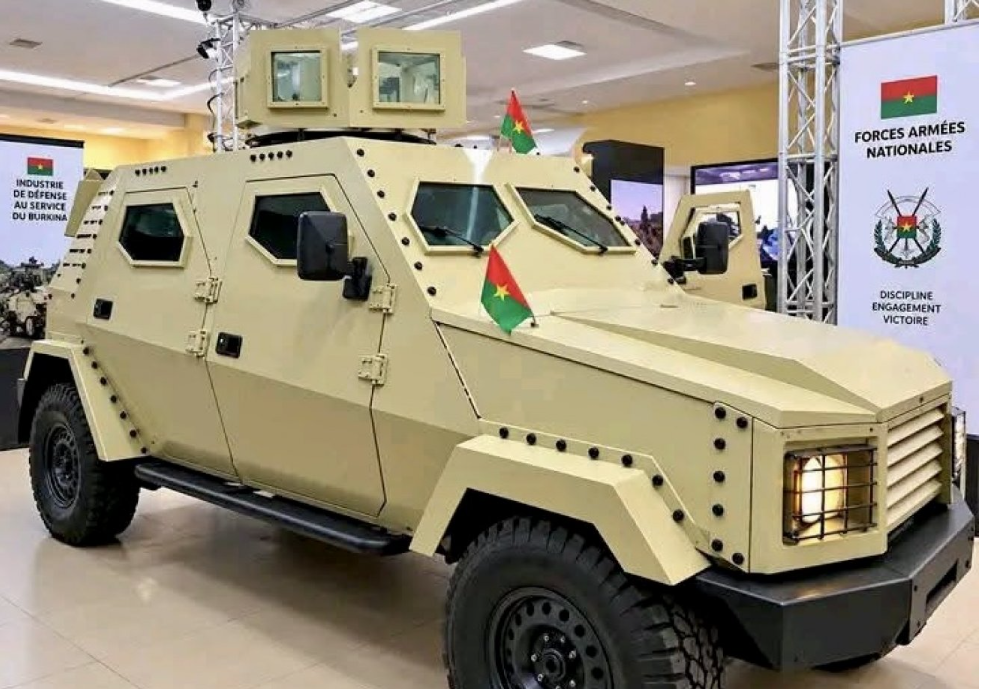
The fanfare surrounding Ibrahim Traoré’s declaration that nearly 300 armored vehicles have rolled out of Burkinabè workshops since November 2025 has given way to a far more uncomfortable conversation. What was presented as a landmark of national engineering is now at the center of a widening public argument about credibility, accountability, and the price of manufactured victories. The fallout is no longer about metal and welding — it is about what happens when a state’s word stops matching the ground beneath its feet.
The claim that started the storm — and the questions it left behind
On 21 September 2026, while speaking with the winners of the Hakili Mousso women’s science competition, Captain Ibrahim Traoré stated that close to 300 armored vehicles had been produced locally for the Defense and Security Forces (FDS) and the Volunteers for the Defense of the Homeland (VDP). The figure was attributed to a national design program run by a company called Faso Armored.
Almost immediately, the announcement invited scrutiny. The regime has leaned on defense secrecy to explain why no industrial site, no factory floor, and no assembly line can be visited or verified. Yet the basic building blocks of armored vehicle manufacturing — chassis, engines, transmissions, armored steel — are not produced anywhere in Burkina Faso at any meaningful scale. That gap between the rhetoric and the industrial base is where public doubt first took root.
What the ground actually shows: salvaged Casspirs and welded pick-ups
The material reality behind the headline figure points in a very different direction from sovereign manufacturing. Drawing on a high-ranking military source, reporting published on 27 September 2026 described how out-of-service heavy Casspir armored vehicles were stripped down. Armor plates and scrap metal taken from those old hulls were then welded, often hastily, onto ordinary civilian pick-up trucks.
There is no design work and no production line in the industrial sense. What exists is improvised reinforcement of standard commercial vehicles — Toyota and Land Cruiser types. Presenting recovered steel sheets bolted and welded onto pick-ups as high-technology armored platforms is a deliberate distortion of what the population is being shown.
The distinction matters for more than semantics. A rhetorical “armored vehicle” and a real one occupy very different positions when they meet an improvised explosive device or heavy weapons fire.
“Made in Burkina” as a branding reflex, not an industrial reality
This is not an isolated episode. The renaming of imported or existing equipment has become a recognizable pattern under Ibrahim Traoré. The ITAOUA vehicles marketed as “Made in Burkina” were in fact imported Chinese Dongfeng models fitted with a local badge. Military equipment purchased from China or other foreign partners routinely reappears in official communications as the product of Burkinabè engineering.
Faso Armored fits neatly into that same symbolic counterfeiting strategy. The label changes; the origin story does not.
Why the communication offensive is intensifying as the security picture darkens
The scale of the messaging around Faso Armored cannot be separated from the battlefield. As the state loses ground to armed terrorist groups and civilian massacres multiply, media staging increasingly substitutes for military victories. The obsession with image management takes precedence over operational reality.
On the front lines, lightly reinforced pick-ups offer little meaningful protection to soldiers and VDP fighters facing improvised explosive devices (IEDs) and heavy weaponry. The gap between what is announced in the capital and what soldiers encounter in the field is precisely what makes the Faso Armored story so combustible.
Reactions: from quiet disbelief to open debate
The initial public response has been a mixture of skepticism, anger, and fatigue. For many Burkinabè, the 300-vehicle figure has become a test case — not of patriotism, but of whether official statements can still be treated as information rather than propaganda.
Three currents of reaction stand out:
- Doubt among serving and retired military personnel, who recognize the difference between a welded pick-up and a genuine armored platform, and who question what the gap means for troops in contact.
- Public frustration over priorities, as citizens ask why resources and airtime flow toward symbolic announcements while villages remain exposed.
- Defensive official messaging, in which the “Made in Burkina” label is reframed as a patriotic cause, making criticism of the claim appear unpatriotic by association.
That third current is the most consequential. By elevating “Made in Burkina” from a claim to a doctrine, the government converts a factual dispute into a loyalty test. The effect is to paralyze scrutiny rather than answer it.
Can a sovereignty narrative survive contact with verification?
Industrial sovereignty is not declared in speeches, and it does not emerge from cutting up old Casspir hulls. It is built through supply chains, engineering schools, metallurgy, testing grounds, and years of accumulated capability — none of which can be conjured by decree or concealed indefinitely behind a secrecy designation.
If Faso Armored represents the model of governance — rebranding, staging, and asserting rather than demonstrating — then the fallout will extend well beyond one disputed figure. The real casualty is not a production target. It is the credibility of the state’s own voice at the precise moment when reliable information about security is most needed.
What comes next: three paths the Faso Armored affair could take
The story is still unfolding, and its next phase will depend on how institutions and the public respond to the questions now in the open.
- A transparency turn: independent verification of Faso Armored’s facilities, output, and supply chain, with clear technical disclosures about what these vehicles actually are and what protection they provide.
- A hardening of the narrative: continued reliance on secrecy and patriotic framing, which would deepen the trust deficit and make future announcements even harder to believe.
- A reckoning with priorities: a shift in official emphasis from symbolic industrial claims toward the operational needs of soldiers, VDP fighters, and civilians exposed to ongoing attacks.
None of these outcomes is guaranteed. What is now clear is that the 300-armored-vehicle claim has stopped being a public relations asset and become a liability — a case study in how quickly a state narrative can turn into a state problem once the public starts asking for evidence.
The bottom line for Burkina Faso
The Faso Armored episode has shifted the national conversation from a headline number to a harder question: what is the relationship between what the government says and what actually exists? The answer will shape not only how Burkinabè assess this program, but how they receive every future claim about security, sovereignty, and national achievement.
A sovereignty built on misrepresentation protects no village and resolves no emergency. The fallout from Faso Armored is, at its core, a debate about whether the country can afford to keep confusing the two.
Comments are closed, but trackbacks and pingbacks are open.