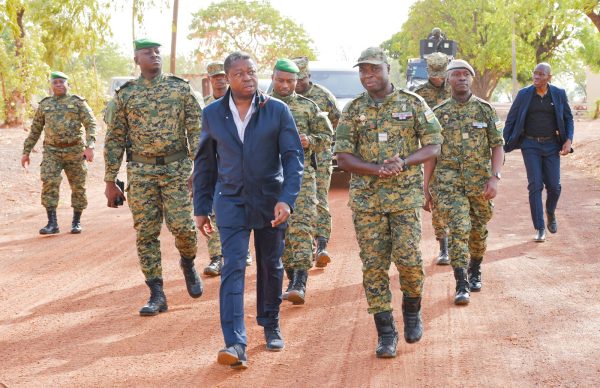
On Thursday, May 7, 2026, the President of the Council and supreme commander of the armed forces undertook a significant visit to the front lines of Operation Koundjoaré, situated in Togo’s far northern region. Amidst the escalating violent extremism threatening the Savanes region and the critical need to bolster troops engaged in a protracted conflict, this visit brought the nation’s leader perilously close to the danger zone. It was a mission where every moment held profound weight, punctuated by the resonant thrum of helicopter blades shattering the ominous silence.
In this volatile border strip, where the fine Harmattan dust gradually yields to the oppressive heat of May, the frontier is far more than a mere line on a map. It represents a perpetual zone of conflict. Here, the adversary remains elusive, lacking a discernible face or uniform, yet their presence is keenly felt behind every thicket and rocky outcrop. It was into this unforgiving landscape, where Togo is waging one of its most vital struggles for territorial integrity, that Faure Gnassingbé chose to arrive around 10 AM on that pivotal Thursday.
LA SUITE APRÈS LA PUBLICITÉ
Upon disembarking from his helicopter, greeted by Colonel Latiémbé Kombaté, the senior commander of Operation Koundjoaré, the head of state’s purpose extended beyond a routine troop inspection. The gravity of the situation was undeniable. The regional security landscape is deemed “concerning” by the high military command, with every field decision carrying significant human implications.
Inside the operational command post: decoding the threat
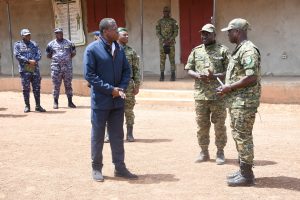
The initial phase of this immersive visit unfolded behind closed doors, within the secluded environment of the Operational Command Post (PCO). With satellite maps spread out and intelligence reports at hand, the President of the Council received a comprehensive briefing on the evolving security threats.
Officers meticulously detailed the ground realities: asymmetric warfare tactics, the pervasive use of improvised explosive devices (IEDs), persistent infiltration attempts by armed terrorist groups from the Sahel, and the enduring challenge of securing hundreds of kilometers of permeable borders.
Confronting these complex challenges, the supreme commander of the armed forces listened intently to military leaders, posing numerous questions about the operational and logistical constraints faced by personnel on the front line. He subsequently stressed the imperative for continuous adaptation: enhancing security protocols, optimizing unit responsiveness, and boosting operational efficiency to minimize vulnerabilities as much as possible.
Tchamonga: tactical insights and front-line engagement
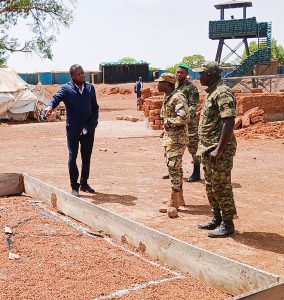
However, the most symbolic segment of this visit was yet to unfold. The head of state re-embarked by air, heading eastward to reach the Advanced Operational Post (POA) in Tchamonga, situated directly within the border zone.
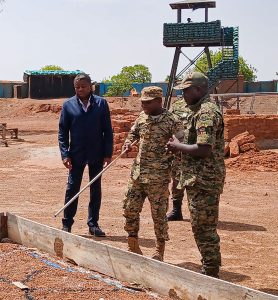
Here, the ground reality takes on an even more tangible dimension. Standing before a “sand table” — a tactical model employed to simulate enemy positions — the president was briefed on patrol mechanisms and intervention scenarios actively deployed in this critical area.
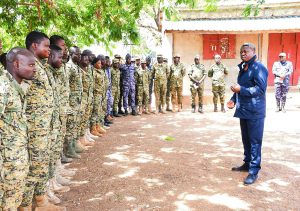
Following this, came the poignant moment of direct interaction with the soldiers. Their faces, etched with the strain of sleepless nights, harsh climatic conditions, and relentless operational pressure, nonetheless conveyed unwavering determination. Addressing them, Faure Gnassingbé commended the profound sense of duty and sacrifice exhibited by the engaged forces, acknowledging that many of their comrades had already paid the ultimate price for national security.
He implored the troops to maintain ceaseless vigilance against an ever-shifting and unpredictable threat, simultaneously reaffirming the unwavering support from the highest echelons of the military.
The President of the Council also reiterated that the needs of the deployed forces are progressively being met through enhanced equipment and expanded operational capabilities. This message was specifically crafted to bolster the morale of the personnel stationed along this strategic front line.
Koundjoaré’s dual pillars: military action and community resilience
Why is this presidential visit so critically important right now? Because the struggle in the Savanes region cannot be won through military force alone. Victory also hinges on influencing public sentiment and improving the daily lives of local populations, who are particularly susceptible to extremist indoctrination.
The presidential tour underscored the comprehensive, or “holistic,” strategy adopted by the Togolese government to stem the tide of security threats:
             ┌──────────────────────────────────────────────────┐
             │        HOLISTIC SECURITY APPROACH IN TOGO        │
             └───────────────┬──────────────────────────────────┘
                               │
         ┌─────────────────────┼─────────────────────┐
         ▼                     ▼                     ▼
 ┌───────────────┐     ┌───────────────┐     ┌───────────────┐
 │ MILITARY      │     │ SOCIAL        │     │ PREVENTION    │
 │ Operation     │     │ PURS Program  │     │ CIPLEV        │
 │ Koundjoaré    │     │ (Savanes       │     │ Dialogue &    │
 │ (The Shield)  │     │ Emergency)    │     │ Communities   │
 └───────────────┘     │ (Resilience)  │     └───────────────┘
                       └───────────────┘
While Operation Koundjoaré serves as the indispensable military shield, the State simultaneously implements various initiatives designed to strengthen the resilience of local communities:
-
The PURS (Programme d’Urgence pour la Région des Savanes): This emergency program aims to deliver essential services such as potable water, electricity, schools, and improved roads to populations, thereby preventing poverty from becoming a fertile ground for extremism.
-
The CIPLEV: This interministerial committee actively collaborates with traditional leaders and youth groups to identify early signs of radicalization and foster stronger social cohesion within communities.
Proactive diplomacy in security efforts
This front-line visit also served to underscore the critical security cooperation between Togo and its neighboring states, notably Bénin and Burkina Faso. Togolese authorities firmly believe that combating violent extremism can only be truly effective through enhanced regional coordination and collaborative efforts.
In a West African landscape characterized by evolving geopolitical dynamics and persistent security vulnerabilities, the stabilization of northern Togo now transcends mere national boundaries, holding broader regional significance.
By journeying to Tchamonga, right to the heart of the deployed units, Faure Gnassingbé aimed to convey an unequivocal message: Togo is resolute in maintaining pressure against armed groups and steadfast in preserving its territorial integrity, even amidst a particularly unstable regional climate.