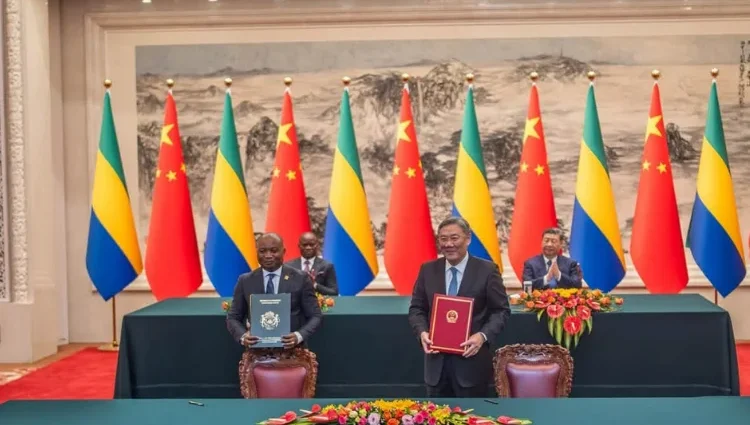
Gabon and China seal game-changing agreements to accelerate industrial transformation
In a decisive move toward economic empowerment, Gabon and China have finalized a series of high-impact agreements designed to supercharge the Central African nation’s industrialization efforts. Signed during a landmark meeting in Shanghai, the new partnerships span critical sectors including technology, energy, infrastructure, and education, signaling a major shift in Gabon’s development trajectory.
These sweeping accords reflect Gabon’s strategic pivot toward leveraging international expertise to modernize its economy, create skilled jobs, and position itself as a competitive player in the region’s industrial landscape. The question now is how swiftly these ambitious plans can transition from commitment to concrete results.
Technology and innovation take center stage in new Gabon-China partnerships
The latest collaboration framework includes three landmark memoranda with Chinese tech giant Huawei, focusing on three transformative fronts: smart public safety systems, the digital overhaul of public universities, and the introduction of artificial intelligence learning tools at Brice Clotaire Oligui Nguema University. These initiatives aim to equip Gabon’s youth with cutting-edge digital skills while enhancing the efficiency and security of public services across the country.
By integrating advanced technologies into education and governance, Gabon is laying the groundwork for a knowledge-driven economy, reducing its reliance on raw material exports and fostering sustainable growth through human capital development.
AI education initiatives aim to future-proof Gabon’s workforce
The AI-focused educational initiative at the national university represents a strategic investment in Gabon’s next generation. Students will gain hands-on experience with modern AI tools and platforms, preparing them for high-demand roles in technology, data science, and automation. This move aligns with Gabon’s broader goal of diversifying its economy and reducing brain drain by offering competitive career opportunities at home.
Bélinga iron ore project: rail, energy, and industrial infrastructure unlocked
The Bélinga iron ore deposit—one of Gabon’s most significant untapped mineral resources—has become a cornerstone of the new Gabon-China collaboration. New agreements focus on building critical rail infrastructure, manufacturing specialized freight wagons, and establishing robust energy supply systems essential for large-scale mining operations.
These developments are expected to transform the Bélinga region into an industrial hub, attracting ancillary businesses, creating thousands of jobs, and significantly boosting Gabon’s export capacity in high-value minerals. The integration of local processing facilities will also enable Gabon to capture more value from its natural resources, moving beyond mere extraction to value-added manufacturing.
Energy and industrial cooperation: a tripartite leap forward
A landmark letter of intent was signed between Gabon’s government, Eramet Comilog, and Sinohydro—a subsidiary of PowerChina—outlining a shared vision for energy and industrial development. This initiative seeks to modernize Gabon’s energy grid, enhance mineral processing capabilities, and support the industrial ecosystem that will power the country’s economic expansion.
The collaboration reflects a shared commitment to sustainability and efficiency, with plans to integrate renewable energy sources and adopt cleaner technologies in mining and industrial operations. Such advancements are crucial for meeting international environmental standards and ensuring long-term competitiveness in global markets.
From promises to progress: the road ahead for Gabon’s industrialization
While the agreements mark a significant turning point in Gabon’s economic strategy, the true measure of success will lie in execution. Key challenges include ensuring timely project delivery, managing public-private partnerships effectively, and maintaining transparent governance to build investor confidence. Additionally, the government must focus on training and retaining skilled labor to support industrial operations and technology adoption.
If realized, these partnerships could position Gabon as a model of sustainable industrialization in Central Africa, attracting further investment and setting a new standard for economic diversification across the continent. The momentum is building—but the world will be watching to see if this strategic leap delivers on its promises.
Comments are closed, but trackbacks and pingbacks are open.