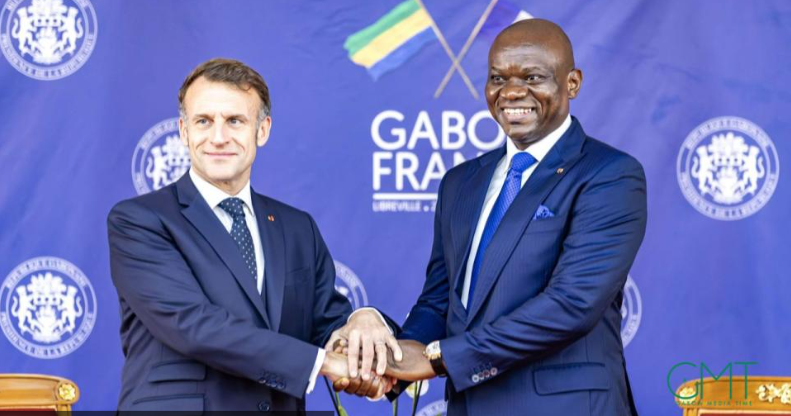
The President of Gabon, General Brice Clotaire Oligui Nguema, has concluded a landmark state visit to France, where he redefined the future of bilateral ties. Over three days of high-stakes negotiations, the Gabonese leader pushed for a recalibration of military cooperation while demanding a fairer economic model—all without severing ties or embracing populist confrontation.
Rethinking military presence: sovereignty meets cooperation
The future of the Camp de Gaulle, Gabon’s historic French military base, was a central topic during talks with French officials. With France scaling back its military footprint across West and Central Africa, Libreville is pushing for a new framework—one that shifts from unilateral control to a shared model focused on training and regional security, such as counter-piracy in the Gulf of Guinea.
Rather than demanding an immediate withdrawal, President Nguema opted for a phased transition. The Gabonese government aims to retain a minimal French presence while asserting full operational sovereignty over the base. This approach reflects a pragmatic balance: maintaining security partnerships while signaling a new era of African-led defense.
Manganese transformation: breaking the colonial extractivist cycle
Gabon, the world’s second-largest manganese producer, is determined to move beyond raw material exports. During meetings with French industrial leaders and representatives of the mining giant Eramet (via its subsidiary Comilog), the Gabonese delegation made it clear: future cooperation hinges on local processing and value addition.
The demands are threefold: equitable profit-sharing, job creation for Gabonese youth, and financial and technical support to build high-value processing plants. This push aligns with Gabon’s ambition to capitalize on the global energy transition, where manganese is a key component in electric vehicle batteries.
Contrasting paths: Gabon’s Realpolitik vs. Sahel’s populist stance
While military juntas in the Alliance of Sahel States (AES)—Bamako, Niamey, and Ouagadougou—have adopted a confrontational posture toward Western partners, Gabon is pursuing a different strategy. President Nguema’s approach rejects the illusion of sovereignty through isolation, opting instead for calculated engagement.
By diversifying partnerships with global players like China, Turkey, and India while maintaining a firm but constructive dialogue with France, Libreville demonstrates that assertive diplomacy does not require diplomatic rupture. This pragmatic path underscores a key lesson: Africa’s development need not come at the cost of its international relations.
The digital dilemma: freedom of expression in the balance
Despite Gabon’s outward-facing diplomacy, concerns persist over the government’s handling of digital freedoms. Frequent internet restrictions and social media blackouts—justified by authorities as measures to curb misinformation and maintain public order—have drawn criticism from civil society and opposition figures.
These actions risk undermining the regime’s claims of democratic openness, particularly as foreign partners quietly emphasize the importance of free speech. For President Nguema, the challenge remains: preserving internal stability without compromising the international credibility his administration has worked to build.
The path forward: diplomacy meets domestic expectations
As Gabon navigates this delicate equilibrium, the stakes are high. The redefined military and economic agreements inked during the visit represent a strategic victory—one that reinforces Libreville’s sovereign ambitions while keeping channels of cooperation open.
Yet the true test lies in execution. To cement this diplomatic success, the Gabonese government must translate these commitments into tangible progress, both in reasserting control over its resources and in safeguarding the democratic freedoms promised to its citizens. The future of Gabon’s transition will depend on its ability to walk this fine line—negotiating boldly abroad while nurturing openness at home.