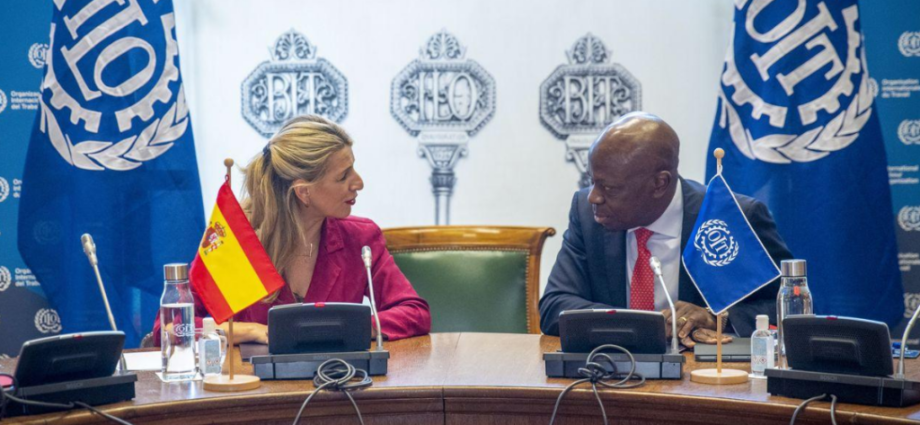
Unopposed victory: Houngbo begins second term at ILO
Gilbert Houngbo has been re-elected Director-General of the International Labour Organization (ILO) for a second five-year term, following the last-minute withdrawal of his sole competitor, Spanish Labour Minister Yolanda Díaz. The election, held on November 16, 2026, marked a dramatic shift when Díaz unexpectedly abandoned her campaign, leaving Houngbo without a challenger. While the outcome ensures continuity at the helm of the UN agency, Díaz’s withdrawal came with sharp criticisms of the outgoing administration’s leadership.
Financial crisis at the heart of Díaz’s critique
Díaz’s decision to step aside was accompanied by a scathing assessment of the ILO’s financial health and governance. She described the organization as facing one of the most severe financial crises in its history, exacerbated by delayed and unpaid contributions from member states. The United States tops the list of major contributors with significant outstanding payments, further straining the ILO’s budget.
The outgoing leadership responded with cost-cutting measures, including staff reductions and operational restructuring. However, Díaz argued that these steps disproportionately impacted workers within the institution rather than addressing the root causes of the financial imbalance. She emphasized that the ILO’s core mission—protecting workers’ rights—must not be compromised by austerity.
Broken trust in social dialogue
Beyond financial concerns, Díaz highlighted a weakening of social dialogue within the ILO, a principle the organization was founded to uphold. She accused the administration of fostering poor relations with staff representatives and undermining the very mechanisms meant to ensure fair treatment and collaboration among governments, employers, and workers.
The criticisms resonate with internal disputes, as the ILO’s staff union has openly challenged restructuring decisions and voiced concerns over insufficient consultation processes. Díaz went further, stating that employees of the ILO should not be subject to the very conditions the organization advocates against globally.
Strategic withdrawal: Díaz’s rationale
Díaz’s decision to withdraw was not merely a response to Houngbo’s re-election but a strategic move to prevent deeper divisions within the international labor movement. She cited the support Houngbo received from major entities like the International Trade Union Confederation (ITUC) and the International Organisation of Employers (IOE) as evidence of a polarized environment. Díaz expressed reservations about the process, warning that such divisions could weaken the global labor movement further.
Her withdrawal, following that of Peruvian candidate Javier González-Olaechea, left Houngbo unchallenged. Díaz framed her exit as a commitment to unity, emphasizing that the movement’s cohesion took precedence over individual ambitions.
Houngbo’s second term: balancing reform and trust
With his re-election secured, Houngbo faces a pivotal second term. The challenges are clear: stabilizing the ILO’s finances, safeguarding jobs, restoring trust with staff, and renewing partnerships with social stakeholders. The criticisms from Díaz underscore that his administration must now address perceptions of mismanagement and prioritize the organization’s foundational values over reform.
As Houngbo begins his new mandate, the absence of electoral competition does not erase the underlying questions about his leadership. The ILO’s credibility hinges not just on its electoral legitimacy but on its ability to reconcile financial prudence with its enduring mission to champion workers’ rights worldwide.
Comments are closed, but trackbacks and pingbacks are open.