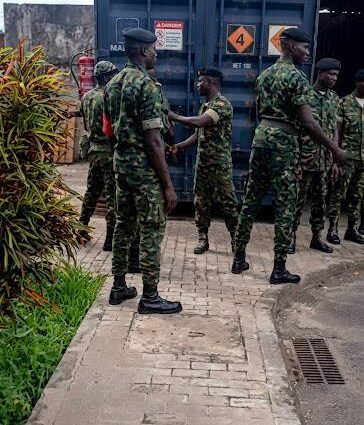
The wave of weapons seizures unfolding in Bissau is far more than a routine security sweep. Behind the containers prised open and the houses searched lies a deeper contest over who will control Guinea-Bissau’s political trajectory — and, crucially, whether former president Umaro Sissoco Embaló will be allowed anywhere near the ballot. What looks like a disarmament campaign is in fact the visible edge of a much older and more stubborn problem: the entanglement of the military with the country’s political life, and the difficulty of separating the two.
Why Bissau’s streets became a search zone
Security personnel have spent recent days fanning out across several districts of the capital, hunting for hidden stocks of weapons and ammunition. Shipping containers and private residences have been opened and inspected as part of a drive aimed at neutralising groups deemed capable of destabilising Bissau.
The stated objective is straightforward: bring back under official control the firearms circulating outside recognised state structures. But the context is anything but simple. Guinea-Bissau’s armed forces have for decades occupied a decisive role in political crises, and coups have repeatedly cut short democratic processes before they could mature.
Among the matériel being sought, some items are said to be linked to figures connected with Embaló. That is a politically charged allegation, and it will need solid evidence establishing exactly where the weapons came from and who was holding them.
An exiled leader insists on a comeback
Behind the security operations looms a fixed political date: the presidential election scheduled for 6 December 2026. Embaló has lived in exile in Morocco since the coup that removed him in November 2025.
Yet the ousted president has made clear he intends to return home and run again for the highest office. In late September he stated plainly that he would be a candidate.
His homecoming was initially expected on 4 October. The military hierarchy instead decided to block it, arguing that the security conditions required for his return were not in place and citing the need to protect public order and social stability.
Embaló, for his part, has not backed down. He maintains his determination to take part in the vote and is pressing for his candidacy to be assessed by judicial authorities in an impartial and independent manner.
The dilemma the junta would rather avoid
The standoff between the former president and the new authorities is no longer confined to the question of whether he can set foot in the country. It now threatens to play out directly on the electoral field.
The junta has committed itself to holding elections meant to restore civilian rule. The presidential and legislative votes are officially set for 6 December.
But the Embaló file leaves the military facing an awkward equation: how do you organise an election supposed to mark the end of the transition while simultaneously preventing the man overthrown by the coup from returning to campaign?
So far, the authorities have framed his travel ban purely in security terms. It would therefore be premature to describe his candidacy as legally rejected by the junta. What is clear, however, is that his physical return is blocked by the military leadership — a measure that concretely undermines his ability to run a ground campaign.
Weapons as leverage, not just contraband
This is where the seizures acquire an extra layer of meaning. By hunting for arms allegedly tied to networks close to the former ruling power, the junta says it is acting to prevent any threat to public safety.
Yet the operations are taking place at the precise moment when political rivalry over the presidency is intensifying. The question that follows is whether the disarmament drive is purely a security measure or whether it will also reshape the balance of political forces before polling day.
Military authorities will need to show that the searches and seizures rest on transparent procedures and are not being used to sideline particular political opponents.
A transition watched from every angle
The junta already pushed through a new constitution in August, following a referendum strongly contested by parts of the opposition and civil society. The new text notably expands presidential powers.
In this atmosphere, the 6 December presidential election is a pivotal moment for the country’s institutional future. Whether Embaló eventually returns, whether his candidacy survives, and the conditions under which other contenders can campaign will all be examined closely.
In Bissau, the soldiers keep searching, seizing and disarming. But beyond the inspected containers and the weapons being tracked down, a wider battle is taking shape: the struggle over who controls the transition, and over the terms on which Guinea-Bissau will — or will not — return to civilian rule.
With two months to go before the vote, the confrontation between the junta and Umaro Sissoco Embaló has only just begun.
Comments are closed, but trackbacks and pingbacks are open.