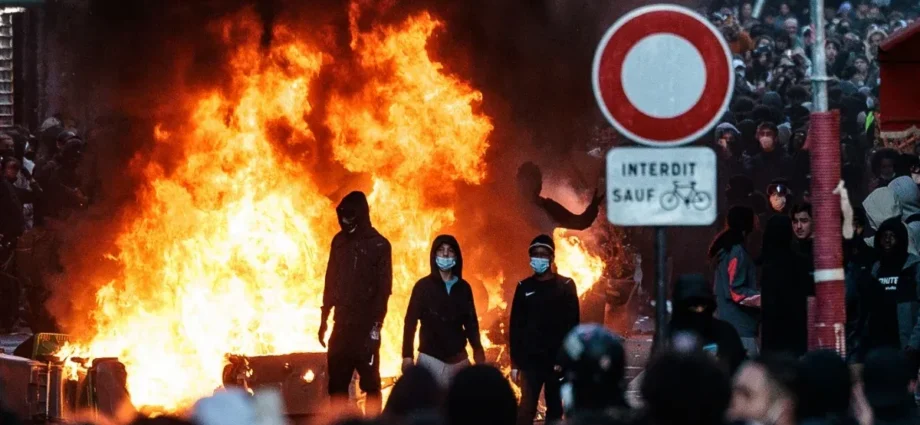
The sight of broken shop windows, riot police charges, burning trash bins and teargas clouds in Paris is becoming a familiar one—but not just to French citizens. Across Bamako, Ouagadougou and Niamey, the same footage streams on social media feeds daily. For supporters of Sahel’s military juntas, these images are no longer just coverage of a domestic crisis. They are live ammunition in a calculated information war designed to dismantle Western influence and shore up their own legitimacy.
From social crisis to political weapon
The Alliance of Sahel States (AES) has weaponised France’s latest wave of protests, repackaging images of civil unrest as evidence of Western hypocrisy. What began as a regional narrative shift following coups in Mali, Burkina Faso and Niger has now escalated into a full-blown assault on France’s democratic image. Where Paris once lectured on human rights and governance, AES-aligned voices now highlight every grenade, every blocked road, every parliamentary shortcut as proof of systemic failure.
The three strategic goals behind the narrative
- Undermine the democracy myth: By equating liberal democracy with decay and chaos, junta-linked media frame authoritarian rule not as a setback but as the only viable path to stability and true sovereignty.
- Redirect public attention: While French protests dominate screens, local crises—surge in extremist violence, spiralling inflation and power cuts—fade into the background, letting governments focus on consolidation rather than reform.
- Accelerate the Western decline thesis: Carefully amplified by sympathetic networks, often tied to Moscow, these visuals feed a narrative of a collapsing Europe, justifying the rapid pivot to alternative allies like Russia, Turkey or Iran.
The paradox of perception versus reality
Independent analysts caution against drawing a direct equivalence between France’s civic freedoms and Sahel’s controlled dissent. In Mali, Burkina Faso and Niger, public dissent is criminalised before it reaches the streets. Yet for millions watching online, the contrast is no longer about facts—it is about optics. Each image of French police in riot gear chips away at decades of diplomatic goodwill accumulated across the Sahel, turning former allies into vocal critics and erstwhile partners into strategic rivals.
What the future holds for France-Afrique ties
The junta narrative is not fading; it is evolving. As long as unrest continues in France, so too will the stream of memes, editorials and speeches that position Paris as the architect of its own decline. For Sahelian regimes, France’s domestic fractures are more than inconvenient— they are a strategic opportunity to rewrite the rules of engagement in a region where sovereignty is no longer a negotiation, but a declaration.
Comments are closed, but trackbacks and pingbacks are open.