Ivory Coast’s game-changing coffee and cocoa research hub gains full support
In a decisive move to reshape Ivory Coast’s agricultural future, the Conseil du Café-Cacao has unveiled plans for the Institut du Café et du Cacao (I2C), a groundbreaking research hub poised to accelerate innovation in the nation’s most vital export sectors. This strategic initiative, endorsed by the Council of Ministers in September 2026, marks a turning point in Ivory Coast’s efforts to combat climate change, enhance product quality, and meet global market demands.
The I2C will be established at the CNRA station in Divo, leveraging decades of genetic research, seed banks, and experimental fields to drive sustainable advancements. With coffee and cocoa accounting for nearly 40% of export revenues and 17% of the national GDP, this initiative is set to address critical challenges while safeguarding the livelihoods of over eight million people.
Why the I2C represents Ivory Coast’s agricultural breakthrough
The creation of the I2C is not just another research facility—it’s a bold step toward institutionalizing excellence in Ivory Coast’s coffee and cocoa sectors. By bringing together researchers, universities, and industry leaders, the I2C aims to:
- Centralize scientific expertise: The institute will consolidate decades of agricultural research, ensuring no progress is lost and all efforts are aligned.
- Boost climate resilience: With a focus on sustainable farming practices, the I2C will develop solutions to help farmers adapt to climate change.
- Enhance traceability and quality: Meeting global market demands for premium, ethically sourced coffee and cocoa is a top priority.
The I2C’s mission is built on three core pillars: a clear mandate, dedicated resources, and a state-of-the-art research facility. This structure ensures the institute can deliver measurable results, much like similar institutions in Brazil (CEPLAC), Colombia (CENICAFE), and Ghana (CRIG), which have long set the standard for agricultural research in the sector.
Collaboration drives the I2C’s vision forward
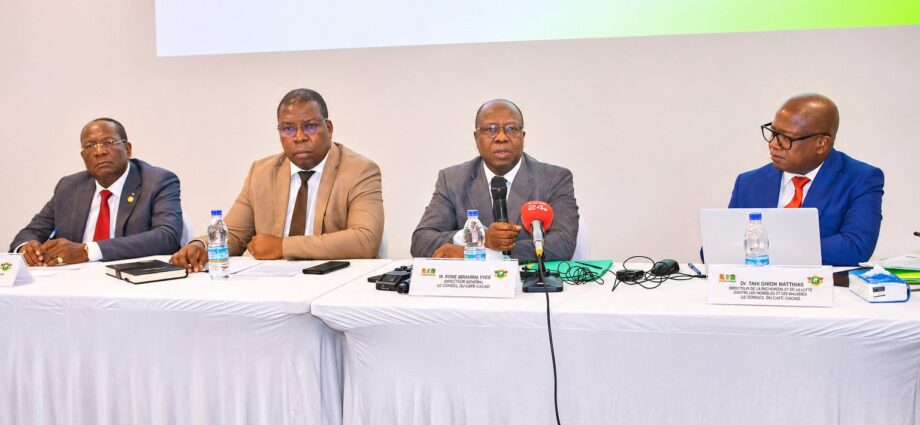
The success of the I2C hinges on its ability to unite Ivory Coast’s scientific community. During the project’s official unveiling at the Novotel-Plateau Hotel, leaders from the CNRA, universities, and research centers reaffirmed their commitment to working together. Dr. Tahi Gnion Mathias, Director of Research and Climate Change at the Conseil du Café-Cacao, emphasized that the I2C is not meant to replace existing institutions but to amplify their impact.
Key objectives include:
- Forging partnerships with Université de Man, Université Daloa, and Université Nangui Abrogoua to foster joint research projects.
- Streamlining data sharing and resource allocation to avoid duplication of efforts.
- Mobilizing funding and operational support to turn research into tangible solutions for farmers.
« The I2C will serve as a catalyst for applied research, » stated General Director Kone Brahima Yves. « By pooling resources and expertise, Ivory Coast can position itself as a global leader in coffee and cocoa innovation. »
A new era for Ivory Coast’s agricultural research
The I2C’s launch has already garnered widespread approval from Ivory Coast’s agricultural and scientific communities. During the event, representatives from the Ministry of Agriculture, CNRA, ANADER, and key universities highlighted the institute’s potential to drive economic growth while ensuring environmental sustainability.
The institute’s location in Divo is no coincidence—it’s home to the CNRA’s genetic resources and experimental plots, providing a strong foundation for the I2C’s work. This synergy ensures that the institute builds on existing knowledge rather than starting from scratch.
What’s next for the I2C?
While the project is still in its early stages, the groundwork is already underway. The next steps include:
- Finalizing partnerships with academic and research institutions.
- Launching pilot programs to test climate-resilient crop varieties and sustainable farming techniques.
- Securing funding to scale research and development efforts.
The I2C’s ultimate goal is to create a self-sustaining ecosystem where science directly benefits farmers, the economy, and the environment. As Ivory Coast takes this bold stride, the world will be watching to see how this hub transforms one of the world’s most important coffee and cocoa industries.
Comments are closed, but trackbacks and pingbacks are open.