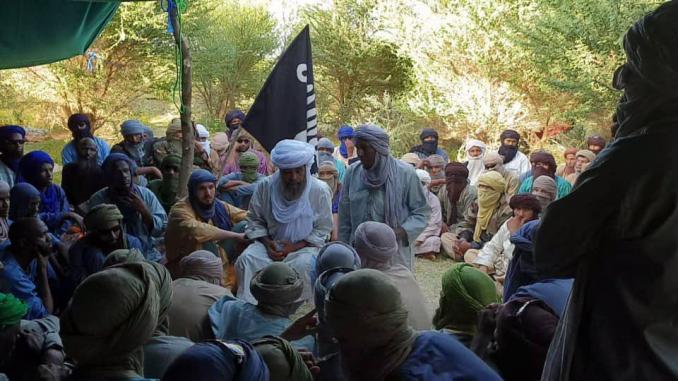
Iyad Ag Ghali, leader of the Jamaat Nusrat al-Islam wal Muslimeen (JNIM), continues to expand his group’s operational reach across Mali, raising concerns about a potential takeover of significant portions of the country. Despite military operations by Malian forces and their allies, the al-Qaeda-affiliated JNIM persists in launching attacks, ambushing security patrols, and seizing control of key roadways.
Regional spillover and escalating threats
The JNIM’s influence is no longer confined to Mali—it now casts a shadow over the entire Sahel region. Neighboring countries and African nations beyond the immediate conflict zone are increasingly alarmed by the group’s expanding footprint. Weak governance, economic instability, and porous borders have created fertile ground for the spread of Islamist terrorism, turning the Sahel into a hotspot of instability.
In a stark illustration of the group’s boldness, five villages in the central region of Bandiagara were targeted in coordinated attacks on May 21, 2026. The JNIM, which has pledged allegiance to al-Qaeda, claimed responsibility but has yet to release casualty figures. With Bamako’s military leadership focusing on urban security, rural areas are left increasingly vulnerable to insurgent advances.
A shift from insurgency to territorial control
The JNIM is not just a mobile militant group—it is evolving into a de facto authority in parts of Mali. By exploiting local conflicts, tribal rivalries, and the absence of state institutions, the group has begun establishing parallel systems of governance. In some rural communities, it enforces its own rules, mediates disputes, and even levies informal taxes. Where the government fails to provide basic services, the JNIM steps in to fill the void, offering an alternative order that resonates with disillusioned populations.
This strategy underscores a critical flaw in conventional counterterrorism approaches: military force alone cannot restore stability. Even when security operations reclaim territory, the lack of follow-up measures—such as rebuilding infrastructure or restoring administrative control—allows insurgent networks to regroup and reassert their influence.
Bamako’s military-first approach under scrutiny
Since French forces withdrew and Malian authorities pivoted toward security partnerships with Russia, the transitional government has prioritized military sovereignty. While Bamako presents this shift as a break from Western dependence, the reality on the ground tells a different story. Violent clashes persist, and armed factions retain alarming mobility across the country.
Human rights organizations have also documented credible allegations of abuses by Malian troops and allied Russian mercenaries. Bamako has consistently dismissed these reports, accusing foreign actors of orchestrating smear campaigns to destabilize the nation. This growing polarization further narrows the space for political dialogue and reconciliation.
Geopolitical rivalries complicate regional security
The crisis in the Sahel has become a battleground for global and regional powers. Russia, Turkey, the United Arab Emirates, Western nations, and neighboring African states are all vying for influence, each pursuing strategies that often clash rather than converge.
In this fractured environment, jihadist groups thrive. Closed borders, eroding regional cooperation, and shifting alliances create opportunities for militant organizations to exploit divisions and deepen their foothold. The looming question is not whether the JNIM will consolidate control, but how far it will extend its reach before external actors or internal resistance can halt its advance.
With Africa Corps mercenaries preparing to scale back their involvement in Malian conflict zones, the junta in Bamako faces an uncertain future. If these forces withdraw entirely, the consequences for Mali’s already fragile security landscape could be devastating.