How the JNIM’s evolving tactics are redefining Mali’s security landscape
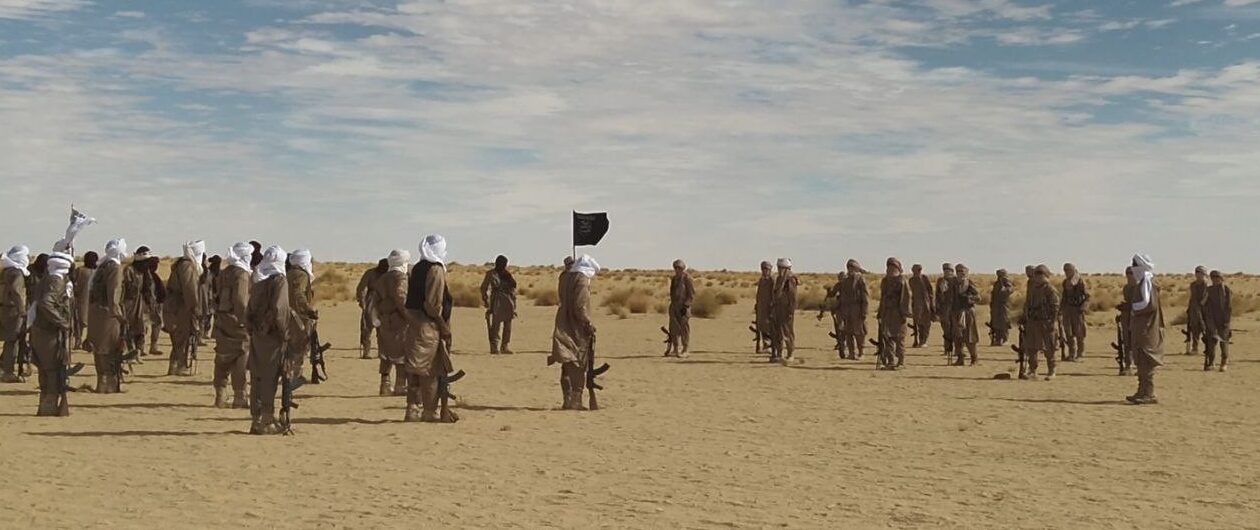
The once-predictable pattern of sporadic violence in northern and central Mali has given way to a sustained campaign of strategic attrition. Recent operations by the Group for the Support of Islam and Muslims (JNIM) and the Azawad Liberation Front (FLA)—targeting military outposts, supply convoys, and critical road networks—signal a fundamental shift in their approach. These groups are no longer focused solely on territorial conquest or high-impact strikes. Instead, they are methodically dismantling the state’s operational capacity across vast swathes of the country.
This evolution matters because the battlefield has expanded. The conflict is no longer confined to who controls a city or garrison. It now revolves around a more existential question: who still controls movement? The ability to traverse roads, transport goods, deliver public services, or facilitate administrative functions is becoming the decisive factor in Mali’s struggle for stability.
Targeting the lifelines of the Malian state
Over the past several months, attacks on key transportation arteries and military supply routes have surged. In some regions, even routine administrative travel now requires armed escorts, severely hampering the government’s reach beyond major urban centers. This isn’t merely a tactical nuisance—it represents a strategic pressure point that the JNIM appears to be exploiting with growing precision.
The group’s approach is both cost-effective and psychologically devastating. By avoiding large-scale confrontations, it forces the Malian military to disperse its forces thinly across the territory, inflating security expenditures while fostering a climate of perpetual insecurity. The result? A creeping exhaustion that wears down not just soldiers, but entire communities through disrupted livelihoods, shuttered markets, and collapsing public services.
In rural areas, the crisis has transcended the immediate threat of armed groups. The more pressing issue is the absence of stable administrative structures. Schools close, health centers become inaccessible, and justice systems retreat to fortified garrisons. What remains is a vacuum—and vacuums, as history shows, are fertile ground for alternative systems of governance, often imposed by force.
The military-first approach and its limitations
The Malian transitional authorities have staked their legitimacy on restoring security, positioning their military campaigns—including the withdrawal of French forces and the growing reliance on Russian military contractors—as acts of sovereignty regained. Yet sovereignty cannot be measured solely by the capacity for armed operations. It must also include the ability to project presence, maintain continuity, and deliver essential services to a population that increasingly feels abandoned.
Paradoxically, the intensification of military action has coincided with a fragmentation of rural Mali. Offensive operations, airstrikes, and troop deployments dominate the security narrative, but they have yet to translate into durable administrative or developmental gains. Schools, courts, and health clinics remain scarce in areas far from Bamako, and economic circulation—vital for any functioning state—has slowed to a crawl.
Where the state withdraws, parallel structures rise. Whether through local militias, jihadist courts, or informal trade networks, communities adapt to survive. But adaptation under duress rarely fosters long-term stability. It normalizes fragmentation and erodes trust in centralized authority.
The Sahel’s shifting power dynamics
The Malian crisis cannot be viewed in isolation. Across the Sahel, a rapid realignment of armed actors, local alliances, and shadow economies is underway. The porous borders between Mali, Burkina Faso, and Niger facilitate the free movement of militant groups, while state responses remain stubbornly nationalistic—despite shared threats.
The recent coordinated offensives by the JNIM and FLA have laid bare the fragility of the Alliance of Sahel States. Despite its founding pledge of mutual defense, the alliance has struggled to mount a cohesive response. The Malian junta, now largely dependent on the Africa Corps for support, finds itself increasingly isolated, its strategic depth eroded by the inability—or unwillingness—of its neighbors to intervene.
This asymmetry plays directly into the hands of groups like the JNIM. Its operational flexibility, deep local anchoring in certain zones, and integration into informal economic networks allow it to sustain pressure without assuming the burdens of governance. It doesn’t need to hold territory permanently; it needs only to make the cost of governance too high for the state to bear.In effect, the Sahel has become a theater of endurance warfare. The goal is not to seize power outright, but to ensure that the state remains permanently weakened—incapable of projecting authority, delivering services, or asserting control over its own territory.Beyond counterterrorism: the roots of the crisis
Reducing the Malian conflict to a counterterrorism narrative obscures its deeper causes. This is not merely a security crisis driven by extremist ideology. It is also a crisis of governance, economic abandonment, and social fragmentation.
Across rural Mali, decades of state neglect, land disputes, intercommunal tensions, and grinding poverty have created fertile ground for radicalization. The JNIM does not always create these grievances; it exploits them. And in doing so, it positions itself not just as an armed actor, but as a de facto provider of justice, dispute resolution, and basic order in areas where the state has long been absent.
The central political challenge now is clear: how can the Malian state rebuild legitimacy in territories where it appears only intermittently—and usually, only in the form of armed patrols?
This isn’t about winning a single decisive battle. It’s about winning the war of presence. And in that war, the JNIM is currently scoring points not through direct confrontation, but through the slow asphyxiation of the state’s ability to function.
Conclusion: The battle for Mali’s future
The JNIM’s strategic transformation is not just changing the nature of the conflict—it is redefining what victory looks like. It is no longer about flags or territory. It is about the erosion of sovereignty itself: the collapse of roads, the paralysis of administration, the fraying of social bonds.
A war of attrition doesn’t just destroy armies. It dismantles the very idea of a governed territory. And in that dismantling, it creates conditions that, once entrenched, are far harder to reverse.