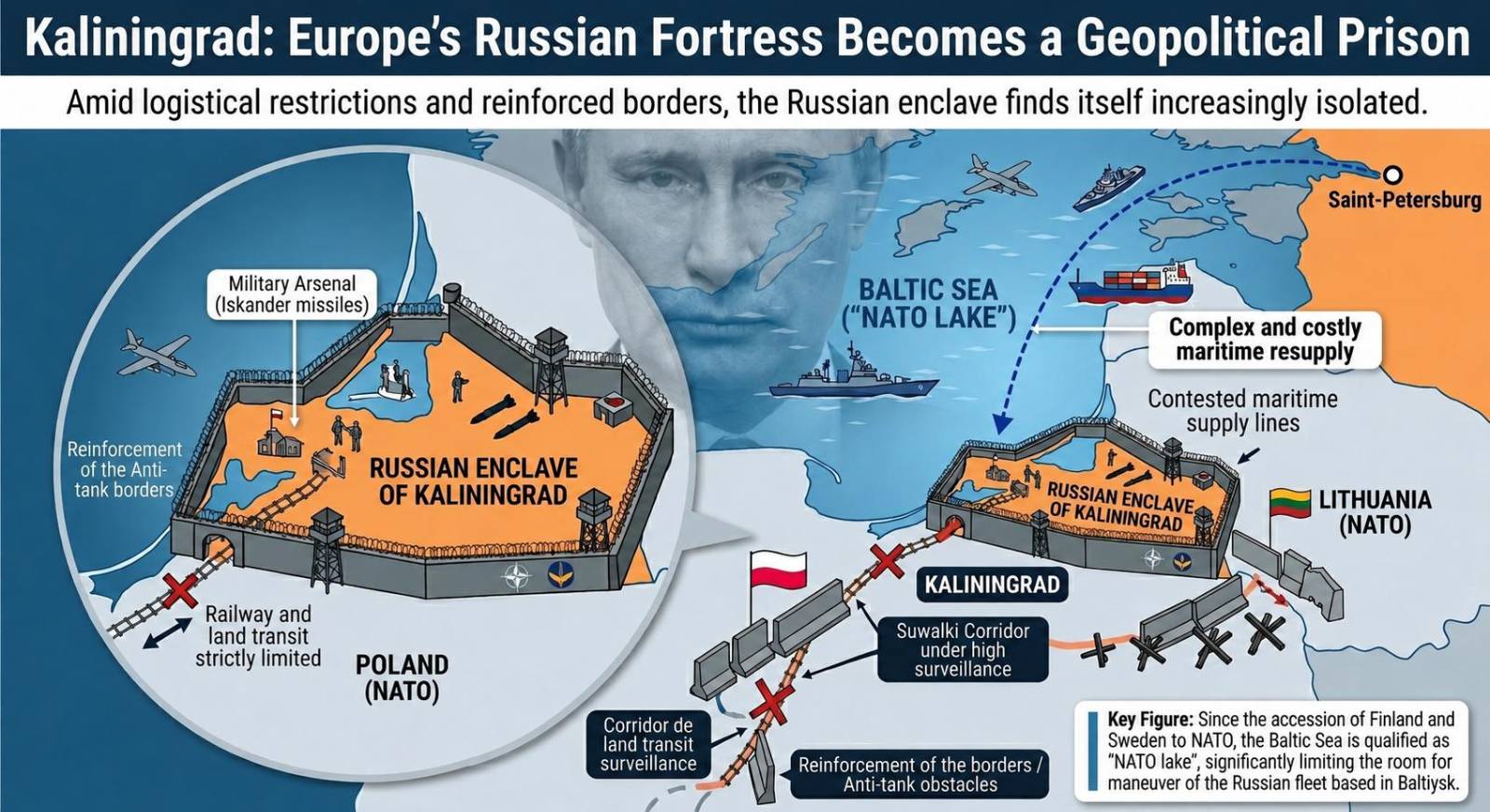
Once a pivotal military spearhead for Moscow at the heart of Europe, the territory of Kaliningrad now contends with an unprecedented tightening of controls from its NATO neighbors. Caught between escalating logistical restrictions and fortified borders, the Russian enclave finds itself increasingly cut off.
A significant strategic shift is unfolding along the eastern frontiers of the European Union. Kaliningrad, a heavily militarized Russian territory wedged between Poland and Lithuania, is experiencing an unparalleled crisis of connectivity. Long regarded by the Kremlin as a formidable forward base capable of projecting its firepower, notably through its Iskander missiles, deep into European airspace, the enclave now appears to be an isolated stronghold.
Driven by Warsaw, Vilnius, and Riga, logistical pressure has intensified considerably, transforming the region’s inherent geographical vulnerability into a potent deterrent for NATO.
Terrestrial and rail links: a progressive strangulation
This severance of connections is not sudden but the culmination of a gradual and methodical constriction. The Baltic states and Poland have drastically stiffened the conditions for transit to the enclave:
- Rail Infrastructure: The Suwałki Corridor, a critical strip of land linking Belarus to Kaliningrad, is under heightened surveillance. The transit of goods via the Soviet-era railway network has been curtailed to the bare minimum permitted by European sanctions.
- Energy Transit: Terrestrial flows of fuel and energy have plummeted sharply, compelling Moscow to orchestrate an intricate and expensive resupply operation by sea (via the Baltic Sea) to avert paralysis.
- Border Fortification: On the ground, access has been rendered almost impassable through the erection of physical barriers. From anti-tank obstacles to extensive barbed wire fences, Poland and Lithuania have effectively sealed their borders with the Russian territory.
A key development: Since Finland and Sweden joined the Atlantic Alliance, the Baltic Sea is now frequently dubbed a « NATO lake », severely restricting the operational scope of the Russian fleet based at Baltiïsk.
A logistical quandary for the Kremlin?
For Vladimir Putin, the situation in Kaliningrad presents a paramount strategic challenge. While the enclave remains extensively armed, its sustained operational capacity in the event of a prolonged conflict raises significant questions among military experts. Deprived of seamless terrestrial links with the rest of Russia, the Russian military there relies exclusively on increasingly contested maritime and aerial supply lines.
Some analysts suggest that what Moscow once considered its « sharpest sword » against the West has now become a liability: in an open conflict, the territory would be swiftly cut off, encircled by now unified and vigilant NATO forces.
The path to diplomatic deadlock
In response to this de facto blockade, Moscow consistently decries a breach of international agreements regarding free transit to its peripheral regions and issues threats of retaliatory measures. However, the Baltic states and Poland, bolstered by the support of their Western allies, justify these actions as national security imperatives in the face of Russia’s aggressive posture in Ukraine.
The critical question now is how far this logistical war of attrition can proceed without igniting a major military flashpoint in one of the globe’s most militarized regions.