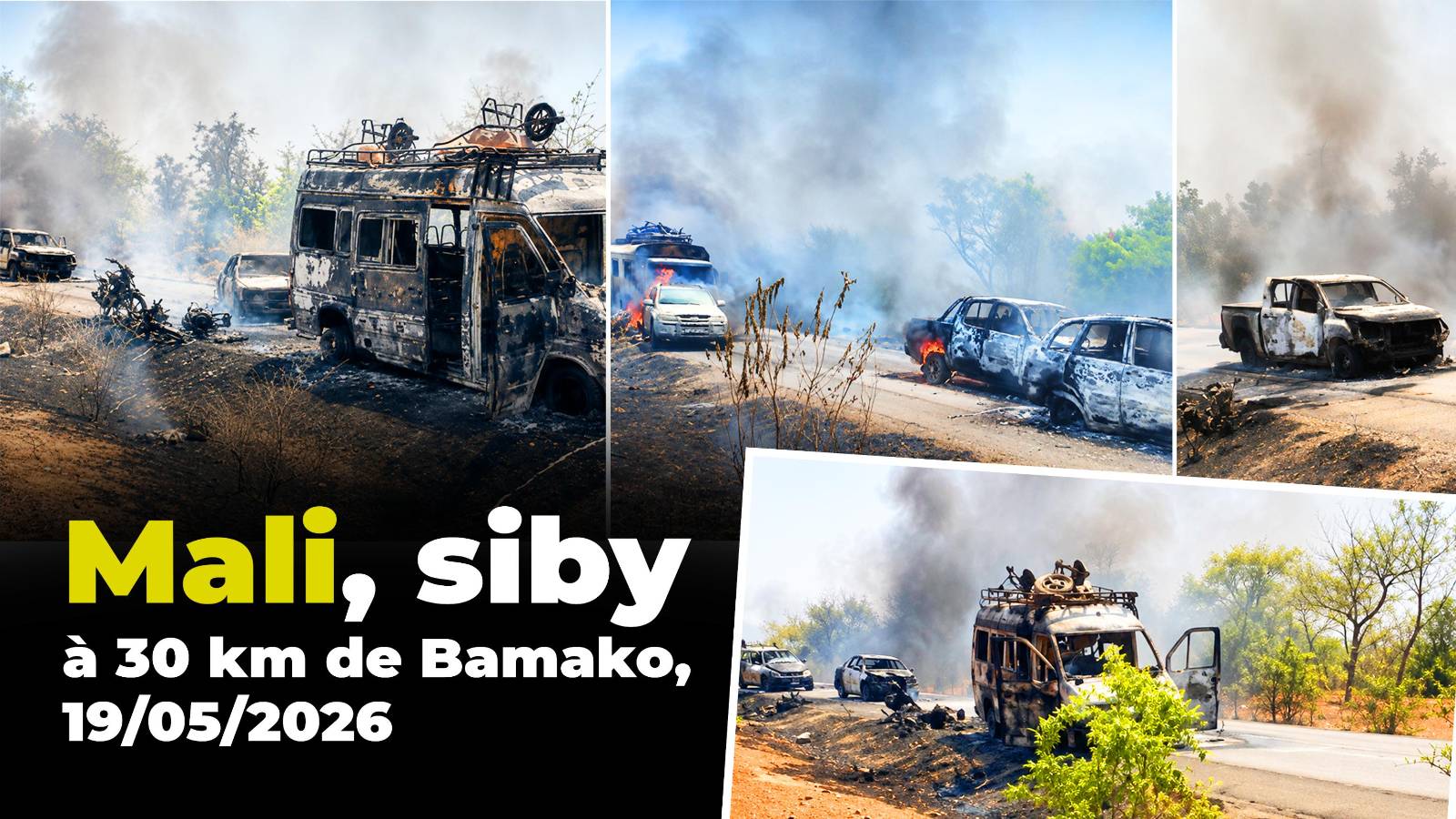
Is Bamako still secure? Once a forbidden question, it now hangs over the capital with grim urgency. On a Tuesday in May 2026, the rural commune of Siby, just 30 kilometers from the city center, became the stage for an unprecedented assault. Militants from the Group for the Support of Islam and Muslims (JNIM) torched dozens of cargo trucks, public minibuses, and Toyota Hilux pickup trucks in broad daylight. The attack was no random strike—it was a calculated blow to Mali’s already strained supply chains, and a stark reminder that Bamako’s so-called protection is crumbling.
The inferno at the city’s doorstep
The violence erupted along the Guinea-bound highway, a vital artery for food and fuel entering the capital. Witnesses described armed motorcyclists swarming the road near Siby, intercepting convoys with little resistance. In a matter of hours, the asphalt was littered with charred wrecks—refrigerated lorries, commuter vans, and private vehicles all reduced to smoldering metal. The thick plumes of black smoke rose high enough to be seen from Bamako’s outskirts, sending shockwaves through a population already grappling with skyrocketing prices and chronic shortages.
Siby isn’t just another roadside village. It’s a cultural stronghold, home to the Kouroukan Fouga charter, a symbol of Mali’s historical resilience. By striking here, the JNIM didn’t just attack logistics—they shattered the illusion of invulnerability. No corner of the country is spared, not even the gateways to the capital.
An economic noose around the capital
The Siby assault wasn’t an isolated incident. It’s the latest move in a months-long blockade orchestrated by the JNIM to strangle Bamako. Key routes—from Ségou to the Senegalese border, from the southern highways toward Guinea and Côte d’Ivoire—have become death traps for drivers. Militants set up mobile checkpoints, extort truckers, and torch cargo at will. The goal? To cripple the economy until the city surrenders to their demands.
Prices for staples like rice, oil, and medicine have doubled in Bamako’s markets. Families ration meals, small businesses shutter, and frustration boils over. The transitional government, already unpopular, now faces a population that sees its leaders as helpless—or worse, complicit.
When mercenaries fail the test of war
The junta’s military strategy has hinged on its controversial partnership with Africa Corps (formerly Wagner), a Russian-backed paramilitary force. But the Siby attack exposed the hollowness of this alliance. Despite their high cost—funded by Malian taxpayers—the mercenaries proved incapable of anticipating or halting the assault, which unfolded just 30 minutes from the presidential palace in Koulouba.
Their approach relies on brute force and securing lucrative mining sites, not on addressing the insurgency’s asymmetric tactics. Joint patrols with the Malian army lack intelligence, mobility, and local trust. Meanwhile, the junta’s propaganda campaigns, once designed to bolster morale, now ring hollow against the backdrop of burning trucks and severed supply lines. The message is clear: Bamako’s security architecture is broken.
A nation at the crossroads
The JNIM’s blockade is tightening. If Bamako loses its last remaining supply routes, the consequences will be catastrophic—fuel shortages, food riots, and a collapse of public services. The junta and its Russian allies can no longer hide behind polished speeches or social media campaigns. The question is no longer whether their strategy is failing—it’s whether Mali can afford to keep betting on it.
For the Malian people, the choice is stark: double down on a failing model or confront the hard truth that no amount of foreign muscle can replace a credible, locally rooted defense. The time for denial is over. The time for action has come.