
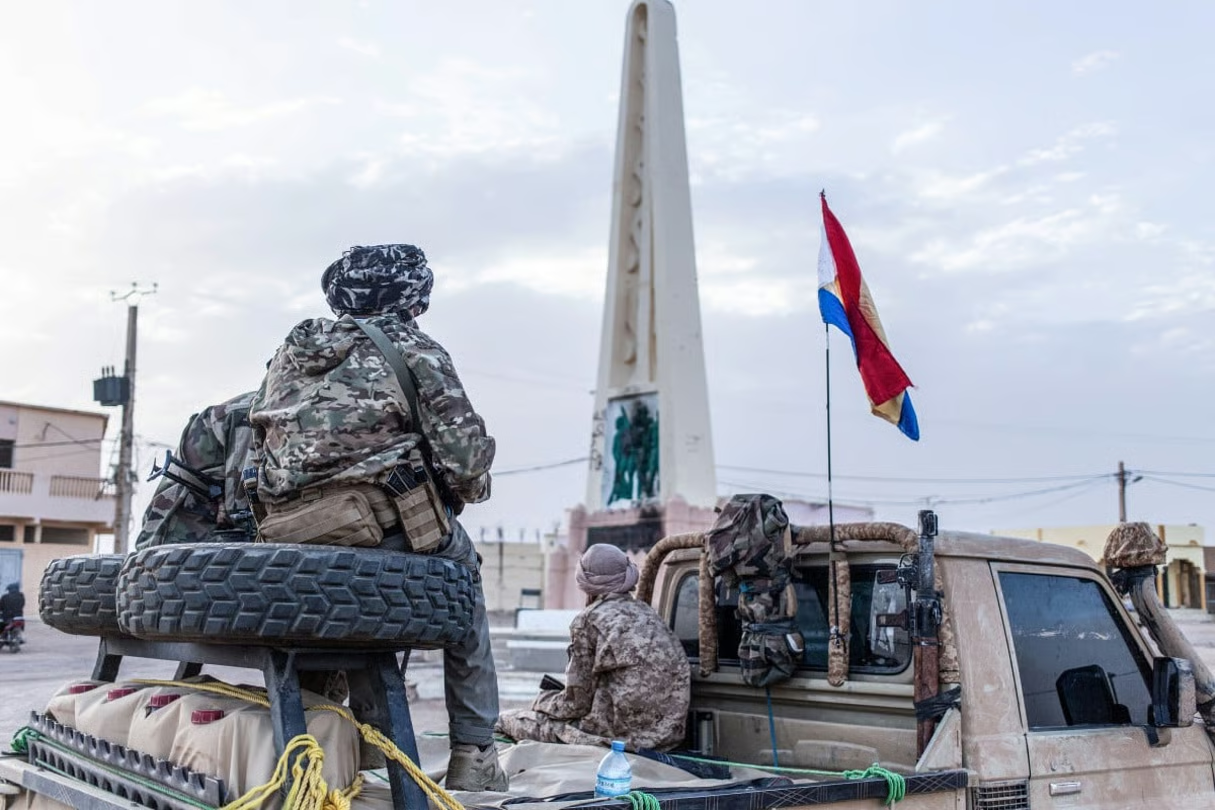
At least four airstrikes targeted Kidal overnight from Wednesday to Thursday, causing significant material damage, according to a local source in the city who requested anonymity. One strike demolished a residential building near a former market, while another left a deep crater in the courtyard of Kidal’s governorate headquarters—reclaimed by the National Liberation Front of Azawad (FLA) on April 25 and 26. The rebel group operates in alliance with the Support Group for Islam and Muslims (JNIM), the Sahelian branch of Al-Qaeda led by Iyad Ag Ghaly.
«We are targeting specific military objectives. Our strategy is clear. Airstrikes will intensify in the coming days,» declared a Malian army officer stationed at the operational command post in Mopti (central Mali).
Uncertainty grips the strategic city
Kidal, a pivotal northern city, remained eerily quiet Thursday morning with minimal vehicle traffic, the witness noted. Many residents appeared to have fled the city under cover of night, the source added.
Mali now faces a critical security crisis and heightened uncertainty following unprecedented coordinated attacks by JNIM jihadists and the FLA rebellion against strategic positions of the ruling junta in Bamako.
The FLA advances toward major northern cities
During this offensive, the rebel alliance seized control of Kidal, the largest city in northern Mali, after intense fighting. The FLA, a predominantly Tuareg separatist movement also including Arab communities, claims sovereignty over the Azawad territory in northern Mali.
The rebellion has vowed to capture additional major northern cities. The Azawad region, as claimed by the FLA, spans the administrative areas of Kidal, Gao, Ménaka, and Tombouctou. Tuareg groups have waged armed struggles for decades, citing long-standing marginalization, particularly around the key stronghold of Kidal.
Comments are closed, but trackbacks and pingbacks are open.