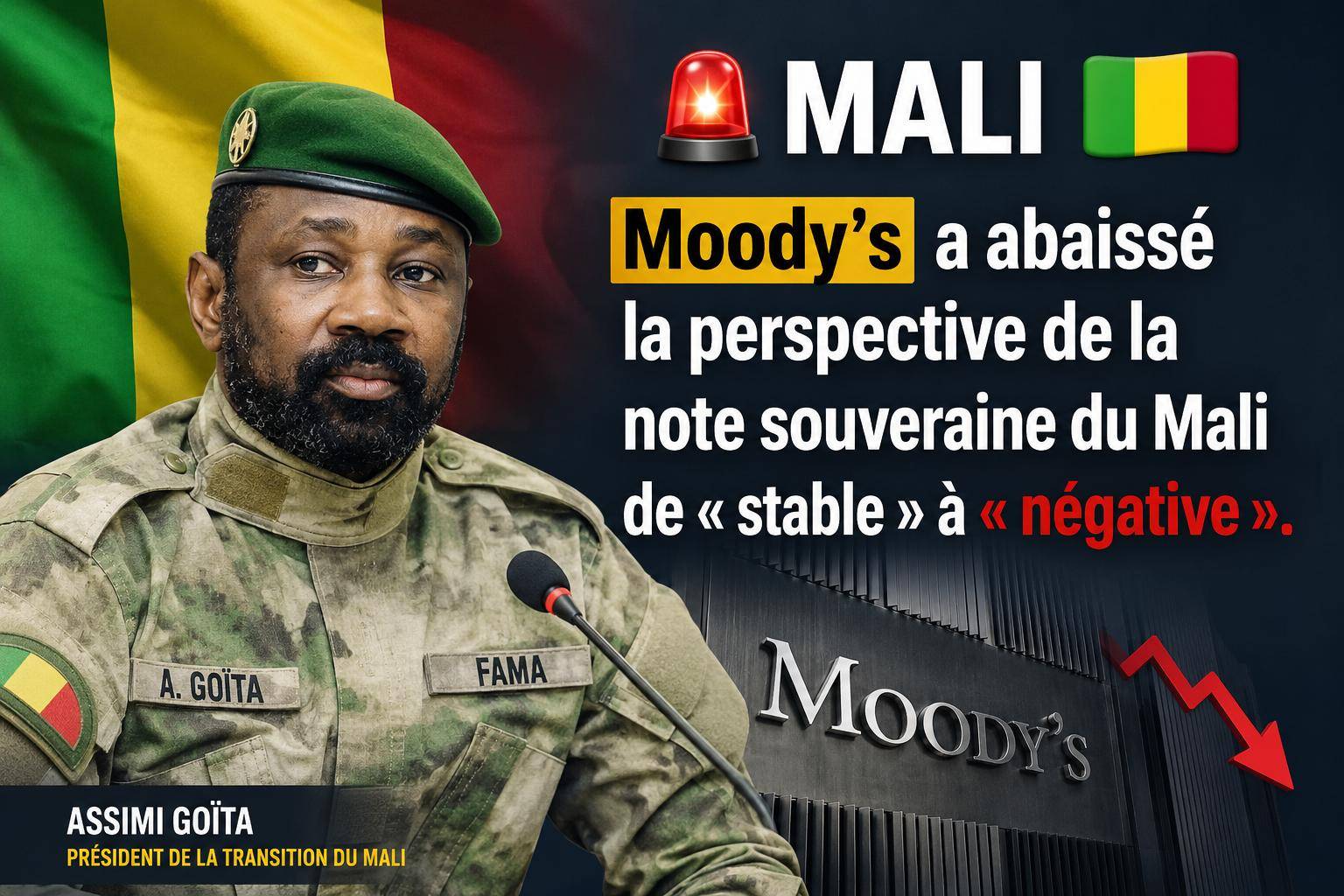
In a significant move that underscores growing concerns about Mali’s economic trajectory, the international credit rating agency Moody’s has downgraded the country’s sovereign outlook from stable to negative. While the agency maintained the nation’s sovereign debt rating at Caa2—a classification reserved for highly speculative investments—this adjustment signals heightened risks for investors seeking opportunities in West Africa.
Security woes and financial strain: a dual burden on malian economy
The decision reflects a confluence of challenges gripping the landlocked nation. At the forefront is the persistent security crisis, which continues to destabilize economic activity despite ongoing military efforts. Violent attacks and territorial instability disrupt supply chains, particularly in rural regions, crippling agricultural output and undermining the government’s ability to generate revenue through taxation. The resulting fiscal strain further complicates public spending on essential services, including healthcare and education.
Equally pressing is the financial squeeze Mali faces in accessing affordable capital. With traditional external funding avenues largely inaccessible due to geopolitical tensions, Bamako has increasingly relied on the regional debt market within the West African Economic and Monetary Union (WAEMU). However, this strategy has backfired as borrowing costs have surged. The Central Bank of West African States (BCEAO) has raised interest rates to combat inflation, pushing up the cost of sovereign bonds and Treasury bills. Recent debt issuances have drawn lukewarm investor interest, with commercial banks in the region growing wary of Mali’s debt sustainability.
Political uncertainty clouds investor confidence
Moody’s assessment also highlights the prolonged political transition and the country’s shifting geopolitical alliances as critical risk factors. Delays in restoring constitutional order and the postponement of electoral timelines have eroded trust among international donors and multilateral partners. The recent withdrawal from the Economic Community of West African States (ECOWAS), alongside Niger and Burkina Faso in the Alliance of Sahel States (AES), introduces additional layers of uncertainty. While proponents argue this move fosters greater sovereignty, global investors perceive it as a potential barrier to cross-border capital flows and trade, further dampening economic prospects.
Real-world consequences for businesses and households
Beyond the boardrooms of financial institutions, Moody’s decision carries tangible repercussions for ordinary Malians. Higher borrowing costs for the government translate to reduced public spending on social services and subsidies for essential goods. For local businesses, particularly small and medium-sized enterprises (SMEs), the credit crunch is stifling growth. Banks, already exposed to sovereign debt, are curtailing loans to the private sector, hindering job creation and investment in critical sectors.
Despite these headwinds, Mali’s economy retains pockets of resilience, notably in gold mining and cotton production, which remain vital revenue streams. Yet, these sectors alone cannot insulate the nation from the broader volatility of global finance. To reverse Moody’s negative outlook and restore investor confidence, Mali must navigate a delicate balancing act: strengthening security, clarifying its political roadmap, and implementing rigorous fiscal discipline.
Without decisive action, the specter of further downgrades looms large, threatening to deepen Mali’s isolation in an already fragile regional landscape.