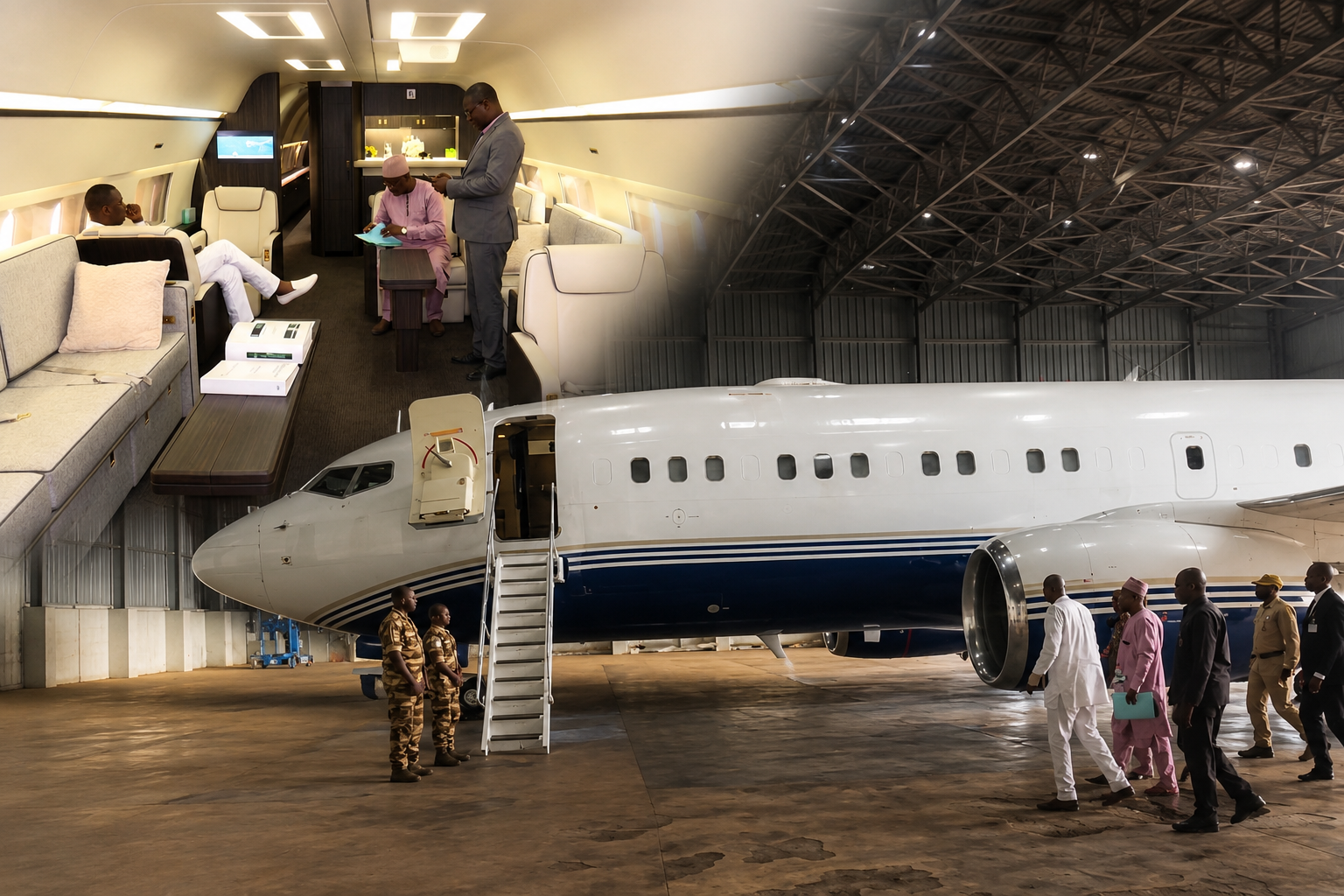
The Malian public was presented this week with a striking contrast between official priorities and ground realities. State television broadcasted the unveiling of a brand-new Boeing 737 destined for the official travels of Colonel Assimi Goïta and other high-ranking officials of the transitional government.
Officials framed the acquisition as a financially sound decision, asserting that the initial 15.6 billion CFA francs expenditure would be reduced to approximately 6 billion through insurance compensations and resale of components from the previous aircraft. While the government emphasizes the financial rationale behind this move, the broader implications extend far beyond accounting considerations.
Contrasting priorities in a time of national crisis
This announcement arrives at a moment when Mali faces escalating security threats, economic hardships, and mounting pressure on public finances. The timing of the unveiling raises fundamental questions about whether the transitional authorities’ priorities align with the most pressing needs of the nation.
Despite repeated calls for national resilience and sacrifice, the presentation of a state-of-the-art presidential aircraft sends a conflicting message to citizens who continue to grapple with daily hardships. In numerous regions, insecurity remains a persistent threat, with regular attacks on military positions, roadside ambushes, and violence against civilians undermining stability. Many areas remain inaccessible, and the state struggles to re-establish its authority across significant portions of the territory.
Ongoing security challenges overshadow state investments
Three years after territorial recovery was declared the absolute priority, the transitional government continues to confront formidable security challenges.
In northern Mali, the Permanent Strategic Framework and groups such as the Azawad Liberation Front maintain substantial operational capacity, contesting control over key zones. Meanwhile, in central and southern regions, the Group for the Support of Islam and Muslims (JNIM) has progressively expanded its influence, intensifying attacks on military forces, critical infrastructure, and state representatives. Several major roadways remain particularly hazardous, disrupting trade, transportation, and economic activities.
This persistent instability starkly contrasts with the image of strength and efficiency the regime seeks to project.
Budgetary choices under scrutiny
While authorities maintain that the actual cost of the aircraft is significantly lower than the headline figure, critics argue that billions of CFA francs could have been allocated to more urgent priorities, including:
- Enhancing the operational capabilities of the Malian Armed Forces
- Procuring armored vehicles, communication systems, and protective equipment
- Improving intelligence and aerial surveillance capabilities
- Providing medical care for wounded soldiers and support for families of fallen servicemen
- Assisting internally displaced populations and reconstructing damaged infrastructure
The debate thus goes beyond financial figures to question the very hierarchy of national priorities.
A challenge to the image of austerity
Since assuming power, the transitional authorities have cultivated a public image rooted in austerity, patriotism, and national interest. However, the acquisition of a high-capacity presidential jet appears to undermine this narrative. For many citizens, the move symbolizes a return to the ostentatious practices of past regimes, contradicting the call for shared sacrifice among the population.
The timing is particularly jarring given persistent economic challenges: rising living costs, strained public finances, pressing social needs, and sluggish economic sectors.
Diplomatic utility versus economic reality
Proponents of the new aircraft argue that a modern presidential jet facilitates diplomatic engagements, official missions, and international representation. Yet this justification fails to resonate with those who believe a state’s credibility on the global stage depends first and foremost on internal stability, citizen safety, and the proper functioning of institutions.
To many observers, national sovereignty is measured not by the quality of an executive fleet, but by the effective control of national territory and the protection of its people.
The symbolism behind the acquisition
Within critical circles and the political opposition, the purchase has taken on deeper political significance. Some interpret it as evidence of a leadership more invested in personal mobility than in strengthening state institutions. Others suggest that a long-range aircraft, constantly available, serves not only as a prestige symbol but—though unverified—as a potential escape mechanism in the event of severe deterioration in security conditions.
Regardless of whether such theories hold merit, they underscore the growing climate of mistrust surrounding official decision-making.
Questioning the direction of the Transition
The introduction of this Boeing 737 transcends a simple procurement decision. It forces a broader reflection on the strategic choices of the transitional government.
As security threats persist, attacks continue, and economic hardships deepen, every symbolic expenditure is subjected to heightened scrutiny. For a growing segment of the Malian population, true sovereignty lies not in modernizing an official fleet, but in the state’s ability to protect its citizens, restore its authority nationwide, and tangibly improve living conditions. Until these objectives are achieved, investments in prestige risk being perceived as evidence of a widening gap between governance priorities and the aspirations of the people.
Comments are closed, but trackbacks and pingbacks are open.