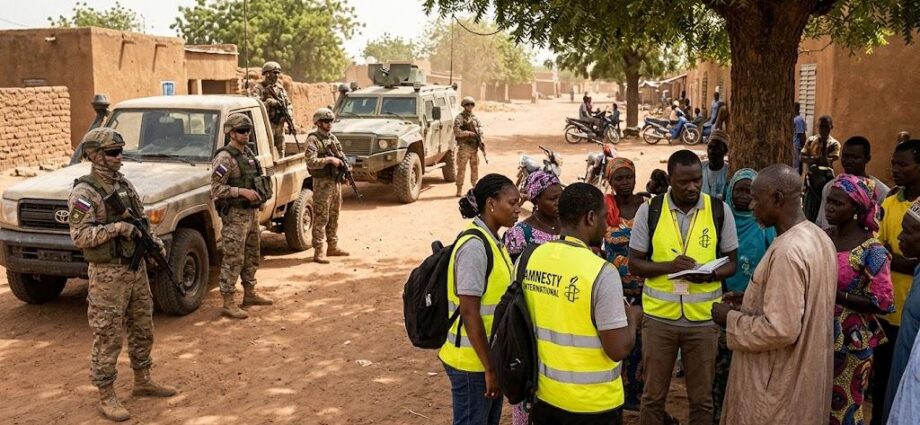
Military restructuring fails to curb civilian suffering in Mali
The transition from Wagner to Africa Corps in Mali’s counterinsurgency operations was supposed to mark a strategic shift toward greater accountability. Yet, behind-the-scenes analysis reveals a troubling continuity of human rights violations, where the same patterns of violence and impunity persist despite structural changes on the ground.
What the evidence shows: recurring patterns of abuse
Between 2023 and 2025, at least 34 civilians lost their lives in seven border communities between Mali and Mauritania during joint military operations involving Malian forces and Wagner personnel. Survivors and witnesses describe executions resembling extrajudicial killings—some victims were shot after surrendering or while fleeing, while others were subjected to throat-slitting or burning. These accounts, if verified, could constitute war crimes under international humanitarian law, which mandates distinguishing combatants from non-combatants.
Civilian casualties extend beyond ground operations. Drone strikes, one of the signature methods employed by Africa Corps, have also raised alarms. A March 2025 strike on a busy market in Ejdeir reportedly killed 16 people, while a November 2025 attack on a residential area in Tangata claimed seven more lives. Investigators found no evidence of militant presence or military targets at either site, casting doubt on the precautions taken before launching these strikes and the accountability mechanisms in place.
Torture and systemic brutality within detention centers
In locations such as Léré and Nampala, Amnesty International documented severe human rights abuses, including torture and other forms of cruel treatment. Interviews with 15 survivors reveal a litany of horrors: victims suspended by their arms, mock drownings, electrocutions, beatings with batons, iron bars, or rifle butts, and even sexual violence under interrogation. At least five individuals died from torture or detention conditions, while others endured months without access to legal counsel or family contact.
Worryingly, witnesses report Russian personnel, including former Wagner affiliates now integrated into Africa Corps, participating in or observing these abuses alongside Malian soldiers. Consequently, Africa Corps’ operational integration raises critical questions about Moscow’s oversight and Bamako’s ability to enforce human rights standards in joint missions.
The pattern of violence extends beyond physical harm. Populated areas, particularly in Mopti, Ségou, and Timbuktu, have also seen arbitrary arrests, targeted killings based on presumed ethnic affiliation—especially against Fulani, Arab, and Tuareg communities—and systematic destruction of property, including livestock and personal belongings. These actions mirror historical modes of collective punishment, where entire communities are held responsible for the actions of a few.
Failure of accountability: a cycle unbroken
Despite the formal dissolution of Wagner and the deployment of Africa Corps, no Malian government investigations into civilian abuses have resulted in prosecutions since 2023. This persistent impunity not only silences victims but also perpetuates a climate of fear, discouraging future testimonies. Limited access to conflict zones further hampers independent documentation, allowing abuses to remain hidden and unaddressed.
Amnesty International urges Bamako to initiate transparent, impartial investigations into all alleged violations, ensure justice for victims, and clarify the operational agreements with Africa Corps. Without genuine accountability, the cycle of violence risks becoming permanently entrenched, with civilians bearing the brunt of a counterterrorism strategy that increasingly resembles state-sanctioned persecution.
A strategic partnership under scrutiny
Africa Corps, officially under Moscow’s command, began deployment in January 2025 before formally taking over Wagner’s operations in June of the same year. Yet reports of continued abuses—such as the July 2026 incident in Bombori, where approximately 80 Fulani men were reportedly beaten and interrogated, with nine shot while fleeing—cast doubt on whether this transition has delivered meaningful change.
The case raises urgent questions about the division of responsibilities between Malian authorities and Russian commanders, the rules governing civilian protection during operations, and the degree of oversight applied to Africa Corps personnel. If Africa Corps is intended to represent a new beginning, its early actions suggest a troubling resemblance to its predecessor.
From rhetoric to reality: what must change
The international community and human rights organizations have repeatedly emphasized that ending insurgent violence cannot justify collective retaliation or the systematic targeting of ethnic groups. Humanitarian law remains clear: civilians must be protected regardless of operational circumstances.
As Africa Corps solidifies its role in Mali’s security framework, the burden falls on both Bamako and Moscow to prove that this transition marks a genuine departure from past abuses. Without transparency, accountability, and a commitment to civilian protection, the promise of a safer Mali remains a distant and fragile hope.
Comments are closed, but trackbacks and pingbacks are open.