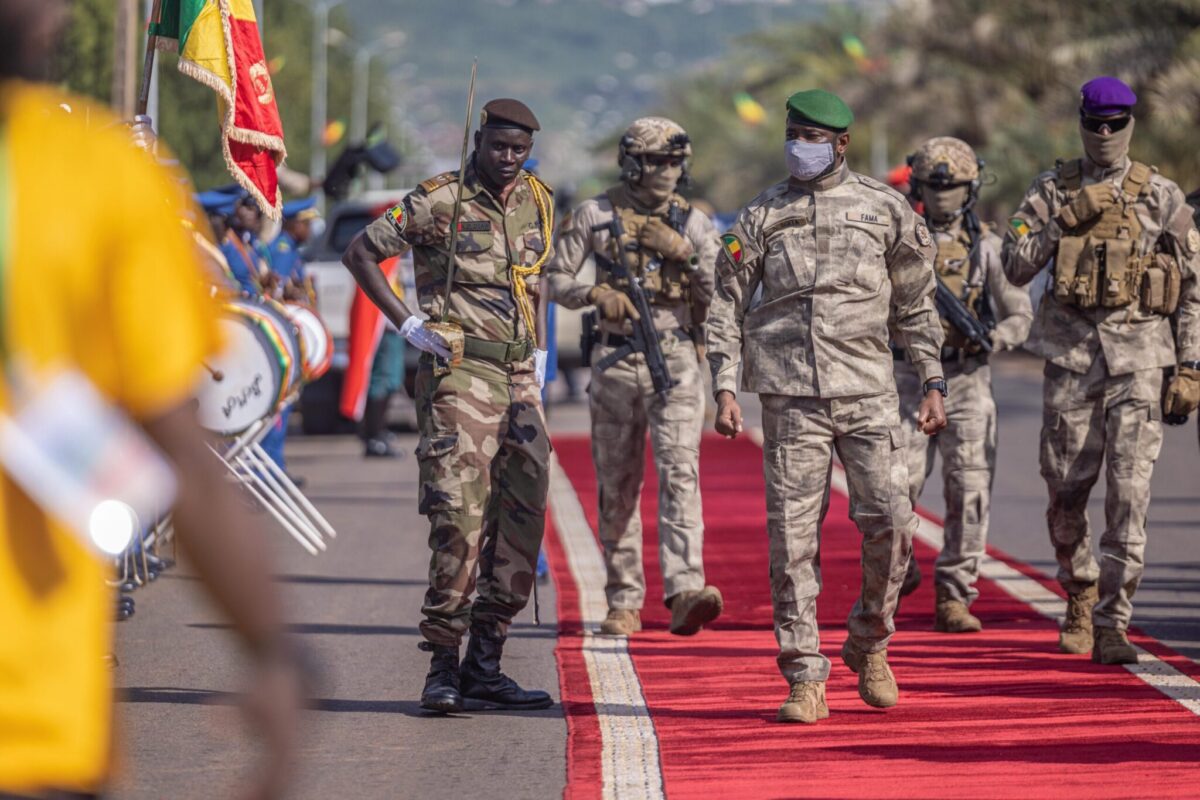
Since seizing power in 2022, Mali’s military leadership has framed its governance as a reclaiming of sovereignty, particularly after the withdrawal of French forces and the dismantling of Western security partnerships. Official narratives portray this transition as a historic victory for an African nation asserting control over its territory and rejecting foreign interference. Yet beneath this rhetoric lies a far more complex reality: the deepening militarization of Mali’s political and economic systems, where security concerns now dictate governance, economic priorities, and regional alliances.
Beyond sovereignty claims: the rise of mercenary-backed governance
While Bamako celebrates its newfound military independence, the country’s security apparatus has increasingly relied on non-state actors to sustain its operations. Africa Corps, a mercenary organization with close ties to foreign powers, has become a central pillar of Mali’s defense strategy, tasked not only with combating jihadist groups but also with safeguarding the ruling regime. This shift has redefined the balance of power within the state, elevating the military’s role in decision-making while sidelining civilian institutions and democratic processes.
The 2022 coup marked a turning point, consolidating military control over all levers of governance. In this new framework, conflict is no longer merely a crisis to resolve; it has become the foundation of the political order. The war economy has flourished, fueling corruption, enriching elites, and perpetuating instability. Meanwhile, the country’s military and economic fragility persists, leaving Bamako vulnerable despite its bold declarations of autonomy.
Regional alliances and the illusion of strategic autonomy
The departure of French troops in 2024 was hailed as a symbolic triumph for Malian nationalism, freeing the country from what many perceived as ineffective external interventions. The transitional authorities capitalized on this sentiment to legitimize their rule, positioning themselves as defenders of national sovereignty. Yet this narrative obscures a critical truth: Mali’s security vacuum has been filled by new partners, most notably Russia, whose influence in the Sahel has grown significantly.
This realignment has introduced fresh complexities. While the Malian regime seeks partners who impose fewer diplomatic constraints than Western nations, it remains dependent on external actors for its survival. The alliance with Russia, in particular, has raised both hopes and concerns, with critics warning that Bamako risks trading one form of dependency for another—this time, in the hands of private military contractors.
The militarization of Mali’s political economy
As security threats persist, the Malian state has increasingly justified its authoritarian tendencies in the name of stability. Rising military budgets, expanded institutional influence for security forces, and the normalization of conflict as a mode of governance have become hallmarks of this new order. The longer the crisis endures, the more the regime can postpone democratic transitions, suppress dissent, and centralize power under the pretext of national security.
The establishment of the Alliance of Sahel States (AES)—comprising Mali, Burkina Faso, and Niger—has further entrenched this dynamic. Together, these nations advocate for a shared vision of sovereignty, one rooted in resistance to former colonial powers and the primacy of military institutions. Yet this alliance remains fragile, built on economies weakened by conflict, social unrest, and a volatile regional environment. The pursuit of strategic autonomy clashes with the harsh realities of financial and military limitations, leaving these regimes perpetually at risk of collapse.
A paradox of sovereignty
The Malian case reveals a paradox at the heart of contemporary Sahelian politics. While severing ties with Western security frameworks may yield symbolic gains in sovereignty, it does little to address the structural weaknesses of the state. As long as governance, economics, and security remain organized around perpetual conflict, true autonomy remains elusive. The war economy has become the default framework for the state, making peace itself a political risk. A genuine stabilization would require confronting long-deferred challenges: economic redistribution, corruption, local governance, civilian representation, and institutional reconstruction.
For Bamako, the challenge is no longer merely military—it is existential. Until sovereignty is redefined beyond the prism of armed force, Mali risks trading one form of external dependence for another, trading the constraints of Western partnerships for the precarious stability of mercenary-backed rule. The path forward demands a reckoning with the militarization of the state, lest the country remain trapped in a cycle of conflict that serves no one but the powerful.