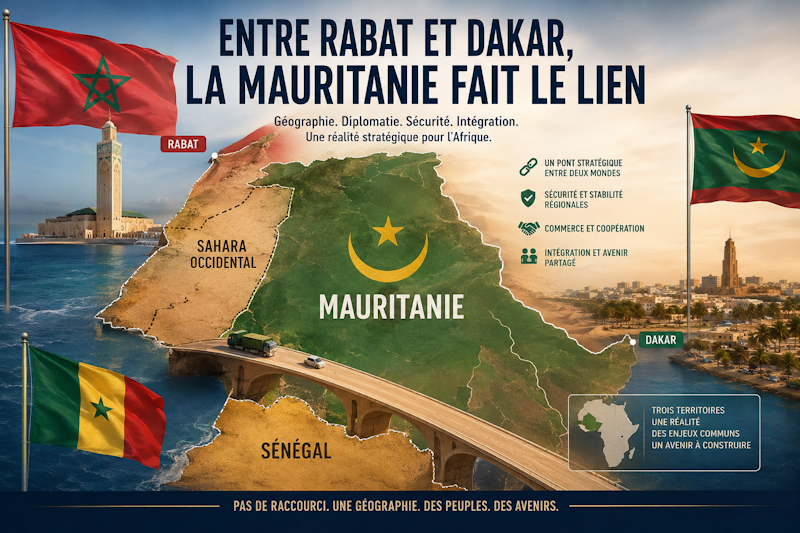

The geopolitical chessboard of Northwest Africa is often reduced to a few high-profile players, yet the true contours of regional power dynamics are far more nuanced. Nowhere is this clearer than in the intricate relationship between Morocco, Mauritania and Senegal — a triangle where geography, sovereignty and strategic interests intersect.
In a recent analysis, Mauritanian journalist Ahmed Ould Bettar underscored a critical reality: between Rabat and Dakar, the Western Sahara is not the sole consideration — the Islamic Republic of Mauritania stands as an indispensable intermediary.
Why Mauritania cannot be overlooked in regional diplomacy
Geographical shortcuts may simplify narratives, but they distort the complex realities of a region where borders are not mere lines on a map. The Mauritanian state is not a passive transit zone; it is a sovereign entity with a pivotal role in connecting the Maghreb and West Africa.
Mauritania’s significance extends beyond its desert landscapes. It is a diplomatic heavyweight, a key security actor, and a linchpin for trade and regional integration. To overlook its presence in discussions about North and West African relations is to ignore one of the most strategically positioned countries on the continent.
Sovereignty and geography: the cost of oversimplification
The Western Sahara, a territory whose status remains internationally contested, lies at the heart of many analyses. Yet it is only one piece of a much larger puzzle. The Islamic Republic of Mauritania, with its well-established institutions and regional alliances, serves as a bridge between conflicting narratives and competing interests.
Diplomatic discourse that omits Mauritania risks reducing a vibrant, multi-dimensional relationship to a series of oversimplified assumptions. The country’s role in mediation, economic corridors and security frameworks is not peripheral — it is central to the stability and development of the entire subregion.
Language matters in geopolitical analysis
The words we choose shape how we understand the world. When influential voices in African affairs speak of connections between Morocco and Senegal, they must acknowledge the reality of geography: there is no direct path without passing through Mauritania. To claim otherwise is not just inaccurate — it undermines the legitimacy of an entire nation’s role in continental affairs.
In the end, while literary shortcuts may serve narrative convenience, they have no place in geopolitical analysis. The stakes are too high, the players too important, and the stakes too real for anything less than precision and respect for sovereignty.
— Ahmed Ould Bettar
Comments are closed, but trackbacks and pingbacks are open.