- News
- Politics
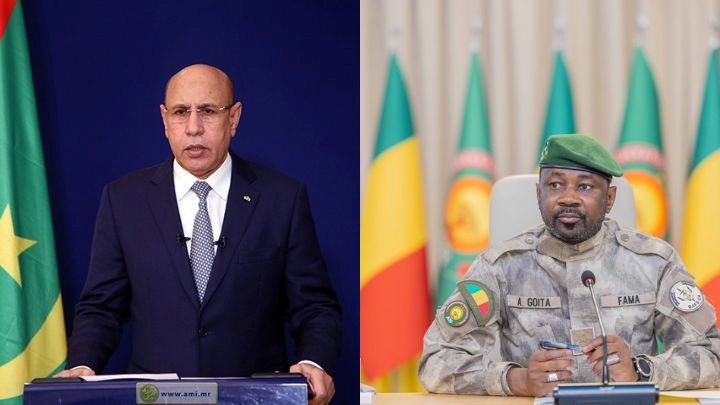
How Mauritania shifted from ally to critic of Mali’s Assimi Goïta
The recent wave of truck burnings along the Sahelian border isn’t just another isolated security incident—it signals a deeper fracture in relations between Mauritania, Morocco, and northern Mali. These once-stable trade corridors, vital for supplying food and essential goods to the region, now face persistent insecurity, worsening shortages in key northern Malian cities like Tombouctou and Gao.
The commercial arteries linking Mali to Mauritania have shrunk drastically. Trans-Saharan routes, long the lifeblood of regional trade, now see frequent disruptions, destabilizing an already fragile economy in northern territories.
For years, Mauritania played a central role in these trade networks, serving as a transit hub for goods moving between Morocco and northern Mali. Traders from Mali, following ancient caravan routes, relied on Mauritanian ports and infrastructure. Umar Al-Ansari, an expert on regional dynamics, notes that Mauritania wasn’t just an economic lifeline—it was a haven for desperate Malians.
« For decades, Nouakchott kept its borders open to waves of Malian refugees, » he explains. « Since 1991, over 300,000 Malians have sought safety in eastern Mauritania, with many housed in the Mbera camp and surrounding villages. » This humanitarian openness also helped Nouakchott contain armed threats early on, limiting their spread across border areas.
Yet this cooperation has eroded. Transition authorities in Bamako, backed by foreign military partners, appear to have shifted perceptions in Nouakchott. Border zones now see military operations, civilian arrests, and accusations of collaboration with armed groups—fueling distrust and destabilizing long-standing cross-border networks.
« Every incident—kidnappings, arrests, or accusations—weakens the local networks that have sustained the border for generations, » Al-Ansari observes. « Traders, herders, tribal leaders, and transporters, once pillars of stability, are fading away. » The void has allowed armed groups to infiltrate areas once dedicated to commerce and human exchange.
Today, the roads between Mali and Mauritania are increasingly unsafe. Regular disruptions cripple trade flows, further isolating northern Mali and deepening its economic plight.
Nouakchott, once a key partner for Bamako, has distanced itself from cooperative frameworks. This shift reflects a broader realignment in regional alliances, driven by security tensions and evolving geopolitical priorities.
Comments are closed, but trackbacks and pingbacks are open.