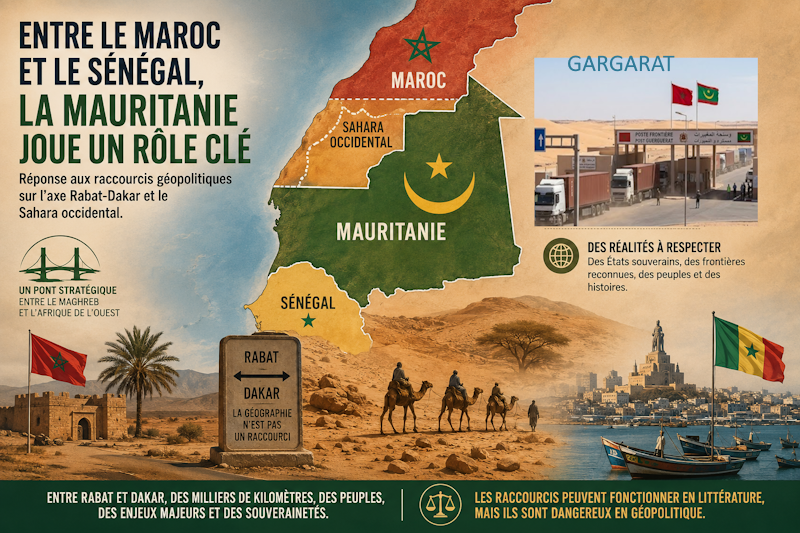

An unexpected diplomatic flare-up in Dakar late last month has exposed the intricate position Mauritania occupies regarding Western Sahara. Between declared neutrality, economic imperatives, and the preservation of its sovereignty, Nouakchott has mastered the art of strategic ambiguity—a hallmark of its foreign policy designed to avoid alienating Morocco.
A heated exchange at a Moroccan embassy event in Senegal’s capital laid bare the region’s simmering tensions. During a book launch reception hosted by Morocco in Dakar, former Senegalese Foreign Minister Cheikh Tidiane Gadio sparked controversy by asserting that in Senegalese collective memory, Morocco was “just a few kilometers away”—a thinly veiled reference to pre-colonial territorial claims. His remarks immediately provoked a sharp reaction from Mauritanian diplomat Mohamed Ould Abdellahi Ould Ethmane, who interrupted the speech to condemn what he termed a “historical revisionist attempt” erasing Mauritania’s very existence.
Though the Moroccan ambassador, Hassan Naciri, swiftly intervened to ease tensions, the incident served as a stark reminder. It highlighted the tightrope Mauritania’s diplomacy walks: attending an event celebrating Morocco’s claim to Western Sahara while insisting on strict neutrality in the decades-old conflict.
Gadio’s controversial comments continued to provoke strong reactions in Mauritania, including from former Mauritanian Foreign Minister Isselmou Ahmed Izidbih. In a Facebook post, Ould Izidbih urged authorities to declare Gadio persona non grata in Mauritania’s territorial waters, airspace, and land.
Nouakchott’s diplomatic tightrope
This Dakar incident encapsulates the contradictions of Mauritania’s approach, which officials now openly acknowledge. While Mauritania officially recognized the Sahrawi Arab Democratic Republic (SADR) in 1984 and maintains regular dialogue with the Polisario Front—aligning with Algeria’s strategic interests—it stops short of granting the SADR full diplomatic status in Nouakchott. This concession to Rabat avoids triggering Morocco’s red line: any formal recognition of the SADR as a state.
By participating in Moroccan commemorative events, Mauritania signals respect to its northern neighbor, provided Rabat does not revive the controversial concept of a “Greater Morocco,” which historically included Mauritanian territory.
Guerguerat: the economic lifeline
Beyond symbolism, Mauritania’s stance is driven by economic pragmatism. The Guerguerat border post, straddling Western Sahara and Mauritanian territory, has become the vital artery connecting Morocco to West Africa.
Daily, hundreds of Moroccan trucks pass through Guerguerat, supplying Mauritanian, Senegalese, and Malian markets with agricultural and manufactured goods. Nouakchott cannot afford to disrupt this flow, which bolsters its economy and ensures stable supplies. By facilitating and securing this trade, Mauritania effectively validates Morocco’s de facto control over the territory—without formally endorsing it.
A calculated ambiguity for survival
To regional observers, Mauritania’s “both-and” policy is no indecision but a survival strategy. Sandwiched between Morocco’s economic expansionism and Algeria’s rigid geopolitical stance, Mauritania risks severe consequences—economic sanctions or border instability—if it openly sides with either power.
The incident triggered by Cheikh Tidiane Gadio underscores the fragility of this balancing act. Whenever Mauritania’s national identity or territorial integrity appears threatened by neighboring ambitions, Nouakchott swiftly abandons its usual restraint to reassert its indispensable—and sovereign—role in Maghreb stability.
Comments are closed, but trackbacks and pingbacks are open.