Mayo-Tsanaga crisis: years of terror and state neglect
Over 50 villages deserted, thousands displaced, and the guilty silence of an absent state.
The threat of Boko Haram is no longer distant. In the Mayo-Tsanaga region of Cameroon, it has become an inescapable daily reality. Originating in Nigeria’s Borno State in the early 2000s, the jihadist group crossed borders by 2014. The first Cameroonian village struck was Tourou, near the Mount Gossi, roughly 35 kilometers from Mokolo.
Since then, hundreds of Boko Haram fighters have entrenched themselves on Mount Gossi, launching relentless attacks. They burn, kill, loot, and abduct—targeting farmlands, markets, places of worship, gendarmerie posts, schools, and health centers. A decade of violence has left villages emptied, populations massacred, and lands abandoned. Despite 13 years of attacks, enduring solutions remain elusive, and the silence from authorities persists. The Mayo-Tsanaga region is withering, and no one seems to care.
Deserted villages and abandoned lives
From Mokolo to Koza and across the Mayo-Moskota, the scene is one of unprecedented territorial abandonment. More than 50 villages in the Mayo-Tsanaga have been fully or partially deserted, including Gossi, Vizik, Ldamang, Magoumaz, Dinglding, Chougoulé, Oupai, Houdahai, Vouzoud, Ziver Montagne, Houva, Gouzda Wayam, Tchébé-Tchébé, Locktcha, Toufou, Guedjele-Guibedrom, Zelevet, Krawa-Mafa, Merekouet, Dzamadzaf, and many others.
In May 2022, Mahadek Nicolo Nouhou, the fifth deputy mayor of Mokolo, presented a grim report to Public Health Minister Manaouda Malachie during the Mayo-Tsanaga fraternal meetings in Tourou and Mokolo: ten villages completely deserted, two occupied by Boko Haram, and seven others under regular siege. Terrorists maintain a near-permanent presence in Gossi, Toufou 1 and 2, Roum, and Hitawa, forcing residents to flee.
The situation has worsened since. “We feel abandoned, left to fend for ourselves. Why does the government and our local leaders remain silent? Do we, the sons and daughters of the Mayo-Tsanaga, not count as true Cameroonian citizens?” laments the residents of Tourou.
A decade of fear and forced exile
For over ten years, fear has gripped the region. By night, men flee; by day, they return. Inhabitants no longer sleep in their homes. As darkness falls, they seek refuge in mountain caves, sharing cramped spaces with wildlife—a risky survival tactic. It is only at dawn that they descend to tend to their fields.
Cameroon’s military response has been minimal. In Ldamang and Ldubam, during a recent pre-dawn attack on June 18, 2026, only two soldiers were present. Helpless against heavily armed terrorists, they were outmatched. Civilian vigilance committees, armed with machetes and sticks, are left to face the onslaught. The state’s presence is nowhere to be seen.
The complicity of silence
The silence of local elites speaks volumes. The Mayo-Tsanaga boasts educated leaders and high-ranking administrators who could amplify the cries of the oppressed. They appear at campaign rallies, make speeches, and issue empty promises, exploiting vulnerability for political gain. Yet when Tourou burns or Koza mourns its dead, these same voices fall silent. Their silence is not an oversight—it is a calculated political choice.
Ministers have visited the region, held meetings, and made declarations. But promises remain confined to Mokolo. Meanwhile, Boko Haram attacks continue unabated. Mokolo yesterday. Koza the day before. What comes next? No one knows. No one can guarantee safety for tomorrow.
A humanitarian crisis spiraling out of control
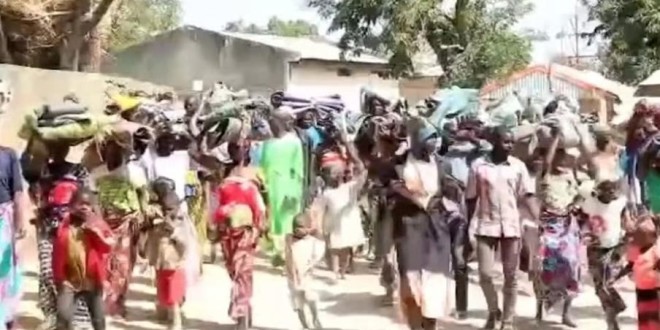
Over 9,000 people displaced by Boko Haram violence have been unable to return home, with numbers rising as attacks intensify. In early June 2026 alone, the International Organization for Migration recorded 482 new displaced individuals—78 households—fleeing from Mokolo, Koza, and Mayo-Moskota. The crisis extends beyond regional borders. By early July 2026, a local authority in Kalfou, within the Mayo-Danay department, reported accommodating nearly 300 displaced families who had fled Boko Haram violence from Mokolo. Located 210 kilometers by road from Mokolo, the exodus highlights the scale of the humanitarian disaster—families abandoning homes, farmlands, and livelihoods in desperate search of safety.
The fleeing leave behind not only their lands but their identity. Hundreds of birth certificates and national ID cards have been reduced to ashes in the fires that consume their homes. Yet the deepest tragedy lies in separation. In the chaos of attacks, families scatter. Parents flee, unable to carry their children. Children and adolescents, left to fend for themselves, lose access to education and stability. Their futures darken: some abandon school, others turn to crime, and many girls lose hope of a better life.
An economy and society on the brink
The Mayo-Tsanaga is emptying. Agriculture is collapsing. Schools are closing. The local economy is vanishing. Without urgent intervention, the region faces irreversible depopulation. The state cannot afford to ignore its citizens simply because they live far from Yaoundé. How many more villages must be abandoned before this crisis becomes a national priority?