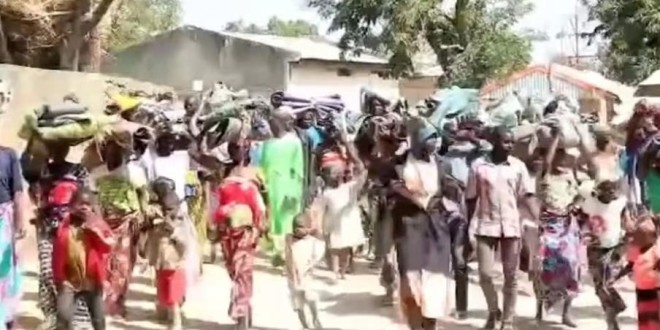
Mayo-Tsanaga’s silent crisis as Boko Haram’s shadow grows
Over 50 abandoned villages, thousands displaced, and the guilty silence of a state that turns away
The terror unleashed by Boko Haram is no longer a distant threat but a daily reality in the Mayo-Tsanaga region of Cameroon. What began as a distant insurgency in Nigeria’s Borno State two decades ago has now firmly taken root across the border. The first Cameroonian village to fall to this wave of violence was Tourou, near the Mokolo district, where militants established a stronghold on Mount Gossi in 2014.
Since then, the cycle of destruction has only intensified. Boko Haram fighters, heavily armed and relentless, have razed homes, markets, schools, health centers, and places of worship. They have burned fields, looted supplies, and subjected civilians to unspeakable violence—massacres, kidnappings, and sexual assaults. As the years pass, the toll mounts: entire villages stand deserted, their populations either slaughtered or forced to flee. Nearly 13 years into this nightmare, the response from the Cameroonian state remains woefully inadequate. The silence from authorities persists. The Mayo-Tsanaga is withering, and no one seems to care.
The devastation spans from Mokolo to Koza and beyond, into areas like Mayo-Moskota. More than 50 villages in the region have been completely or partially abandoned. The list of ghost towns reads like a roll call of lost communities: Gossi, Tourou, Vizik, Ldamang, Magoumaz, Ldubam, Dinglding, Chougoulé, and many others. In May 2022, the fifth deputy mayor of Mokolo, Mahadek Nicolo Nouhou, presented a grim assessment to the Minister of Public Health, Manaouda Malachie, during community meetings in Tourou and Mokolo—over a dozen villages deserted, two under Boko Haram control, and seven others under constant siege.
Today, the situation has worsened. Residents of Tourou voice their despair: « We are left to fend for ourselves. Why does the state remain silent while our villages burn? Do we not count as true Cameroonian citizens? » Their question hangs unanswered in the air.
Fear dictates daily life. By day, villagers attempt to work their land or run errands. By night, they flee for safety. Men, women, and children trek into the mountains, seeking refuge in caves shared with snakes and other hazards. Only at dawn do they dare return home—for now. The terror of Boko Haram does not sleep, and neither do its victims.
The Cameroonian military presence in the region is a shadow of what’s needed. During a brutal attack on Ldamang and Ldubam in June 2026, just two soldiers were stationed in the area—hardly a match for heavily armed insurgents. Meanwhile, civilian vigilante groups, armed with little more than machetes, are left to bear the brunt of the defense. The state’s response is a fraction of the threat.
Local elites share in the responsibility for this abandonment. Despite holding influential positions, they remain conspicuously silent when villages burn. Their absence during crises speaks volumes—it is not omission but calculated neglect. Ministers and officials have visited, made speeches, and held « fraternal meetings, » but their promises vanish as quickly as the smoke over Tourou. The attacks continue. The cycle of displacement persists.
More than 9,000 people have been displaced by Boko Haram’s violence, with no hope of returning home. The numbers swell with each new attack. In early June 2026 alone, the International Organization for Migration recorded 482 additional displaced individuals—78 households—fleeing from Mokolo, Koza, and Mayo-Moskota. The crisis has spilled beyond Mayo-Tsanaga; by July 2026, a local official in Kalfou—over 200 kilometers from Mokolo—reported welcoming nearly 300 displaced families who had fled the same violence. This exodus underscores the sheer scale of the humanitarian catastrophe.
Those who flee often leave everything behind: homes reduced to ashes, fields untended, and even loved ones lost. Personal documents—birth certificates, national IDs—are incinerated in the flames. The most heartbreaking loss, however, is the fracturing of families. In the chaos of an attack, parents and children are separated in the rush to escape. Some children find themselves alone, stripped of education, protection, and hope. Their futures darken before their eyes—some abandon school for survival, others turn to crime, and many young girls see their dreams of a better life vanish entirely.
The Mayo-Tsanaga is emptying. Agriculture is collapsing. Schools are shuttered. The local economy is crumbling. Without urgent intervention, the region faces irreversible depopulation. The state cannot afford to ignore its citizens simply because they live far from Yaoundé. The question lingers: how many more villages must be abandoned before this crisis becomes a national priority?