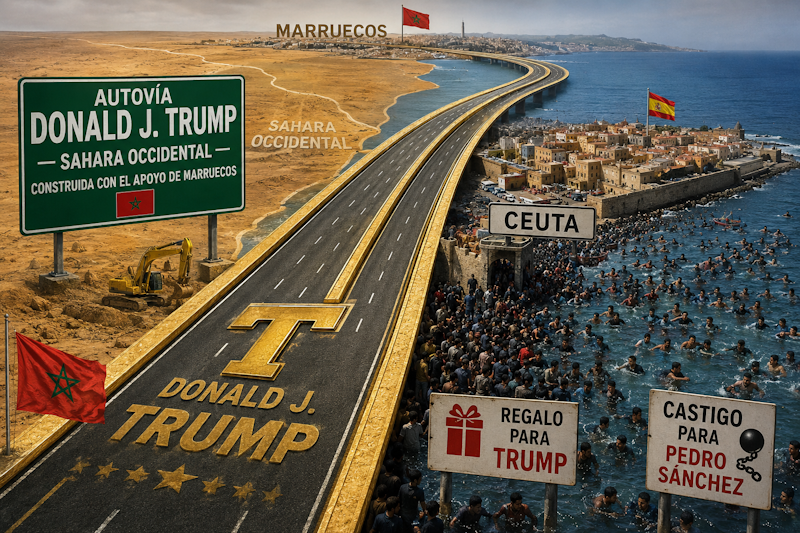
With a symbolic highway tribute to the U.S. president and a sharp escalation on its African borders, Morocco is deploying every diplomatic tool at its disposal to secure Washington’s decisive backing on the Western Sahara dispute. While the Donald J. Trump Highway does not pass through Ceuta, Rabat is using an entirely different pressure point to push Spain toward compromise.
Summer 2026 has become a defining chapter in Moroccan diplomacy, with Rabat, Washington, and Madrid locked in high-stakes negotiations over Western Sahara—a territory Morocco claims as its own since Spain’s withdrawal in 1975.
Honoring Trump with a continental landmark
In a move laden with symbolism, King Mohammed VI has renamed the 1,055-kilometer Tiznit-Dakhla highway as the Donald J. Trump Highway. The decision, announced through the official MAP news agency, reflects Morocco’s gratitude for the former U.S. president’s 2020 recognition of Morocco’s sovereignty over Western Sahara.
The highway, hailed by the king as Africa’s longest road infrastructure, stretches from southern Morocco to Dakhla, traversing key cities including Laâyoune in the heart of Western Sahara. It serves as a vital link “connecting Morocco’s north and south while bridging Europe and Africa,” the monarch noted in his statement.
Within hours, Donald Trump responded on Truth Social: “What an incredible honor! I can’t wait to drive this entire highway someday—hopefully soon!”
Ceuta: the migration card in Morocco’s diplomatic hand
Yet the renamed highway is not the tool Rabat is using to influence Spain. Instead, the kingdom is turning to migration. In late July, nearly 60,000 migrants surged across the border into the Spanish enclave of Ceuta within hours, triggering a humanitarian and diplomatic firestorm.
At least 57 lives were lost, according to Spanish authorities, with victims drowning or trampled in the chaos. Morocco officially acknowledged 11 deaths, though it kept its border guards at a distance during the influx.
Ceuta, one of Europe’s two land borders with Africa, sits at the heart of tense Morocco-Spain relations. Rabat has long contested Spanish sovereignty over the enclave, labeling it “occupied territory.”
History repeating itself
This is not the first time Morocco has used migration as leverage. In May 2021, a similar surge of 8,000 migrants forced Madrid to reconsider its stance on Western Sahara. Spain, which had previously maintained neutrality, abandoned its position after hosting Polisario Front leader Brahim Ghali for medical treatment.
“Morocco believed Spain supported its autonomy plan for Western Sahara, but that wasn’t enough—Rabat wants full recognition of its sovereignty,” observed Carlos Ruiz Miguel, director of the Western Sahara Studies Center at the University of Santiago de Compostela.
The timing of the 2026 crisis is critical. It followed Spanish Prime Minister Pedro Sánchez’s visit to Algiers, where Madrid sought to rebuild ties with Algeria—a regional rival of Morocco. Rabat took note.
A multi-pronged strategy unfolds
Analysts see a clear pattern. “Morocco is testing the limits of Spain’s constitutional space,” argued Alejandro del Valle, an international law professor, describing Madrid as a “geostrategic adversary” in Rabat’s eyes.
The Moroccan approach rests on three pillars:
- Symbolic flattery toward Washington: Renaming the highway after Donald Trump reinforces U.S. recognition of Morocco’s sovereignty over Western Sahara.
- Migration pressure on Spain: The Ceuta crisis serves as a stark reminder of Spain’s vulnerability and dependence on Moroccan cooperation.
- Securing U.S. backing: With UN-led negotiations on Western Sahara stalled, Rabat is prioritizing Washington’s support.
Washington takes center stage
The Trump administration has made its position clear. U.S. Secretary of State Marco Rubio recently reiterated that “the United States recognizes Morocco’s sovereignty over Western Sahara.” Trump himself has called Morocco’s autonomy proposal “the only basis for a fair and lasting solution,” dismissing alternative paths as prolonging an unacceptable status quo.
Washington has also criticized Spain’s migration policies, with a White House spokesperson warning that Madrid risks “undermining its own stability.”
Europe’s Schengen fractures
The Ceuta crisis has sent shockwaves through the European Union. Italy temporarily suspended its Schengen agreements with Spain, followed by Finland and Denmark. Belgian MR party leader Georges-Louis Bouchez has even called for Spain’s partial suspension from the Schengen Zone.
Paul Melly, a researcher at Chatham House, framed the crisis as a new geopolitical reality: “Morocco has demonstrated its willingness to weaponize migration against Spain, leveraging the vulnerability of its two North African enclaves.”
What the future holds
Rabat’s message is unambiguous: it holds the keys to Europe’s southern border. By combining symbolic gestures for Washington and migration pressure on Madrid, Morocco is weaving a diplomatic web designed to tilt the balance in its favor over Western Sahara. European and Spanish negotiators are now fully aware of the stakes—and the tools Morocco is prepared to use.
Comments are closed, but trackbacks and pingbacks are open.