Major financial agreement signed in Rabat to transform water management
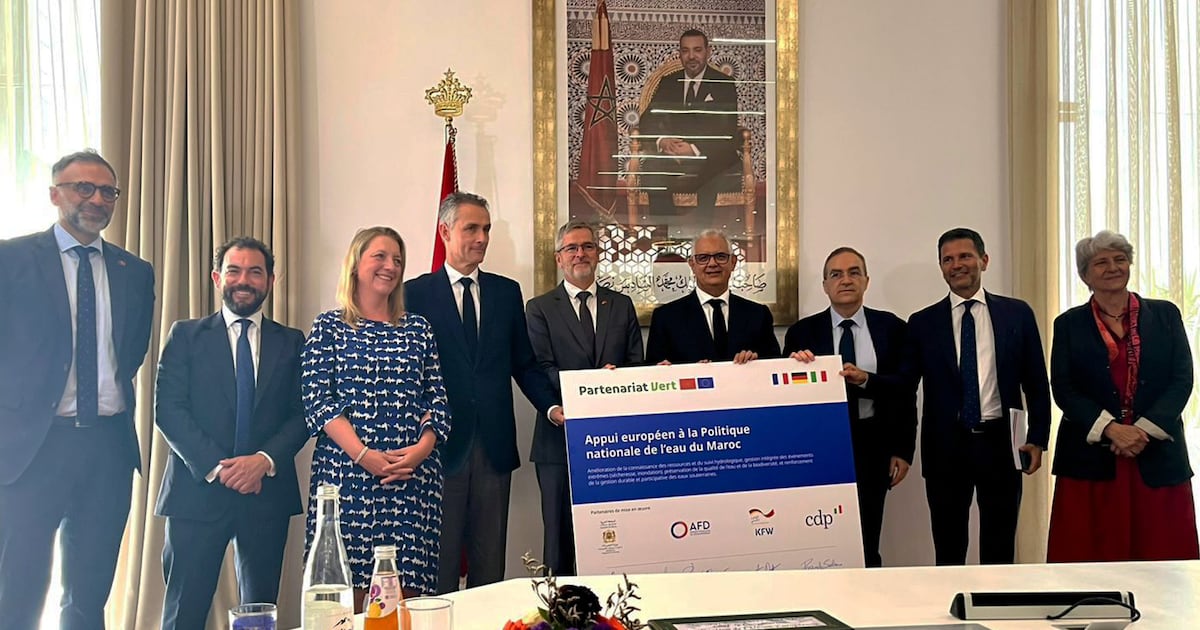
In a significant move to address hydrological challenges, the European Union and several key European cooperation agencies have finalized a funding agreement worth 348 million euros—approximately 3.7 billion dirhams—to support Morocco’s national water program. The signing ceremony took place this Tuesday at the headquarters of the Ministry of Equipment and Water in Rabat.
Minister Nizar Baraka hosted the event, which brought together the ambassadors of the European Union, France, Germany, and Italie to formalize this strategic partnership. This three-year support initiative serves as a direct follow-up to the high-level agreements reached in November 2024 during the meeting between King Mohammed VI and French President Emmanuel Macron.
A collaborative European effort
The funding is a collective effort involving the Agence française de développement (AFD), the German public development bank KfW, and the Italian Cassa Depositi e Prestiti (CDP). Leading the project is the AFD, which has played a pivotal role in coordinating the various European partners involved in the program.
During his first official engagement in the Kingdom, the new French Ambassador to Morocco, Philippe Lalliot, praised the ongoing collaboration. He noted that France has already invested nearly one billion euros into the Moroccan water sector and commended the European Union teams for their technical dedication to this mission.
Prioritizing rural access and climate resilience
The primary focus of this 348 million euro package is to improve water infrastructure in rural areas. Dimiter Tzantchev, the EU Ambassador to Morocco, explained that the funds will be used to enhance both drinking water supplies and agricultural irrigation. He emphasized that the EU views water management as a top priority, particularly in the face of escalating climate change threats.
Minister Nizar Baraka outlined the Kingdom’s comprehensive water strategy, which is being executed under the leadership of King Mohammed VI. He detailed how the national infrastructure currently utilizes 26 operational dams to irrigate roughly 1.5 million hectares of land.
The future of desalination and governance
Looking ahead, Morocco aims to secure 60% of its drinking water supply through advanced desalination plants. Nizar Baraka underscored the existential importance of this resource, stating that mastering water is essential for a nation to control its own destiny. The Ministry is committed to implementing this new support program with a focus on efficient governance and measurable results.
The German Ambassador also highlighted the strength of the partnership between Maroc and Allemagne, particularly through the strategic interventions of KfW. As he prepares to conclude his mission in the Kingdom, he noted that water remains a sensitive and vital sector for bilateral cooperation.
By securing this European funding, Morocco is reinforcing its capacity to combat water stress. The multi-faceted approach—combining desalination, dam management, and rural irrigation—is designed to safeguard the country’s agricultural, social, and environmental security for years to come.