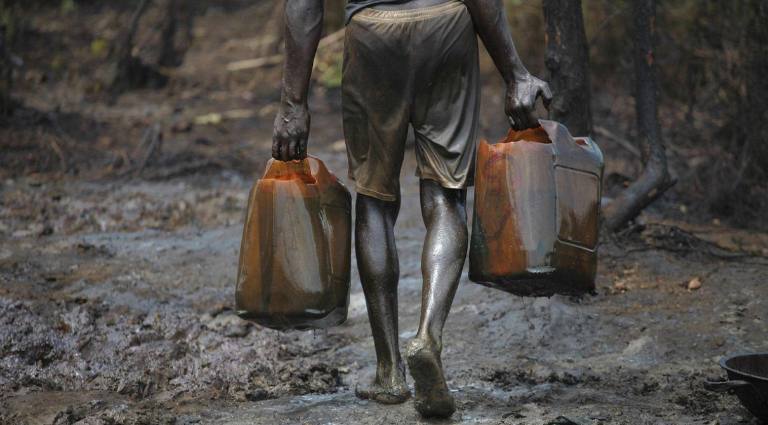
Nigeria’s illegal oil refining networks hit headlines again after authorities dismantled a clandestine facility in Ogun State, raising serious concerns over resource exploitation and regulatory failures.
Operation exposes sprawling illegal oil processing site
Enforcement teams discovered an unauthorized refinery spanning over three hectares in Ogere, Ogun State, during a raid conducted by the Economic and Financial Crimes Commission (EFCC). The operation uncovered underground storage tanks, heating systems, separation devices, and cooling installations, revealing a sophisticated setup designed for large-scale processing.
Investigators found one underground tank with a capacity of 90,000 liters, suggesting extensive operational capacity. The facility reportedly processed crude oil residues, locally known as black sludge, transported from major oil hubs in Warri (Delta State) and Port Harcourt (Rivers State). These residues underwent heating and separation treatments to produce a diesel-like fuel marketed as Automotive Gas Oil (AGO)—a practice occurring entirely outside regulatory oversight.
During the raid, the installations were abandoned, with no on-site operators detained. This has raised immediate questions about the supply chain, financing, and distribution networks supporting such operations.
Investigations target complex supply and distribution chains
Tracking the origins of the raw materials and the destination of the processed fuel requires piecing together a multifaceted logistics operation. Authorities must now identify:
- Suppliers of crude residues: Who transported black sludge over hundreds of kilometers to the site?
- Financing sources: Was the facility funded through local or international channels?
- End-use markets: Are the processed fuels sold domestically or smuggled across borders?
While the scale of the operation suggests involvement of organized networks, no evidence currently implicates government institutions. However, the silence of local oversight remains under scrutiny as investigators dig deeper.
Environmental and economic fallout of illegal refining
The dismantled facility exemplifies the dual threats posed by unregulated oil refining: environmental degradation and economic distortion.
Environmental risks: Informal refining lacks pollution controls, leading to toxic emissions, soil contamination, and water pollution. Poor safety protocols increase risks of fires, explosions, and toxic exposure for neighboring communities.
Economic damage: Illegal refineries evade taxes, regulatory fees, and quality standards, depriving federal and state governments of critical revenue. They also undercut licensed businesses that comply with strict environmental and commercial laws.
Additionally, fuel produced in such conditions often fails to meet safety standards, posing risks to vehicle engines and industrial equipment.
Foreign operators under spotlight amid rising Chinese investment
This incident occurs amid growing Chinese economic presence in Nigeria’s oil sector, with firms and individuals active in mining, construction, and industrial ventures. While no evidence links this specific facility to state-backed Chinese entities, the discovery fuels broader debates about foreign oversight and compliance with Nigerian law.
Analysts emphasize the need to separate individual actors from national economic policies. The pressing challenge for Nigeria remains enforcement of domestic regulations, regardless of the operators’ nationality.
Nigeria’s sovereignty over oil resources faces new test
The dismantling of this refinery underscores a systemic challenge: despite vast oil wealth, Nigeria struggles to assert control over extraction, processing, and distribution. The illegal operation highlights persistent regulatory gaps that allow clandestine networks to thrive.
To secure its economic sovereignty, Nigeria must now trace financial flows, identify beneficiaries, and prosecute responsible parties. This case serves as a wake-up call—natural resource wealth alone does not guarantee national prosperity without effective governance and robust enforcement.
Comments are closed, but trackbacks and pingbacks are open.